
Where Efficiency Becomes Exposure
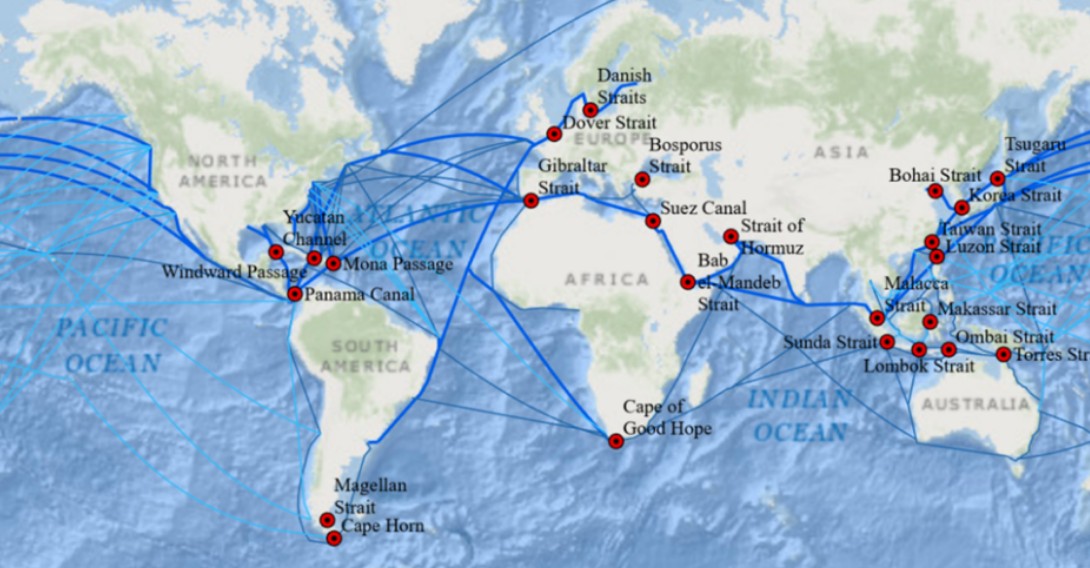
Global trade relies on a small set of maritime chokepoints—geographic bottlenecks through which much of the world’s energy, food, and goods must pass. When these routes function, they enable speed and efficiency across the global economy. When they are disrupted, the effects do not stay local; instead, they ripple through supply chains and energy markets. The same design that makes maritime trade efficient also concentrates risk, turning chokepoints into systemic vulnerabilities.
Recent events near the Strait of Hormuz illustrate a system limit. Geography determines whether adaptation is even possible. As examined in From Canals to Arctic Fronts: Advancing Marine Transportation System Resilience Through Network Science Modeling of Chokepoints, this chokepoint serves as a single point of failure, with no maritime alternative route available. When disruption occurs here, the system cannot adjust, and flow is directly constrained.
This case highlights a structural reality of the global maritime transportation system: not all chokepoints behave the same way. Some allow disruption to be absorbed through rerouting, while others concentrate risk through dependence. Distinguishing between these conditions is essential to managing risk.
Disruptions in Real Time
Maritime disruptions are often treated as isolated incidents, masking their system-wide effects. Operators continuously adjust voyage plans to real-world constraints, balancing time, cost, and risk.
When a major route is disrupted, shippers face a choice: wait and absorb delay, or reroute and incur additional distance and costs. On canal-dependent routes like the Panama and Suez Canals, this typically means shifting to longer cape routes. Cargo still arrives—but voyages take longer and cost more.
The system keeps moving, but under increasing strain. And these adjustments propagate outward: traffic shifts, secondary routes absorb additional load, and delays compound. What begins as a localized disruption becomes a system-wide rebalancing that affects global supply chains.
Maritime resilience, in practice, is the system’s ability to preserve flow even as performance degrades. It is lost when the system can no longer adapt.
Resilience Has Limits
Recent disruptions reinforce this pattern. Panama Canal drought restrictions pushed vessels onto longer routes, while instability in the Red Sea redirected traffic around the Cape of Good Hope. In each case, trade continued, but at increased distance, time, and cost.
A central finding of From Canals to Arctic Fronts is that the maritime network absorbs disruption by trading efficiency for continuity. That tradeoff is measurable and consistent across scenarios, but it is not free.
As voyages lengthen, costs rise, and demand on the global shipping fleet increases. The same vessels must travel farther to reach the same ports, placing sustained pressure on shipping capacity. Most importantly, this type of adaptation only functions where alternative routes exist.
Where Adaptation Ends
The Strait of Hormuz represents a structurally limited chokepoint in the maritime network. It is a single point of failure with no secondary route. In this case, alternatives move beyond the maritime transport system to pipelines, transshipment, or alternative sourcing.
This does not reflect a failure of efficiency, but a condition of system dependence.
For homeland security planners, this distinction is critical. Some chokepoints can be worked around; others cannot. This difference, which is a characteristic of the system’s structure, determines whether disruption can be managed or must be absorbed, often with immediate operational and economic consequences.
Seeing Risk Clearly
Maritime risk is often framed in terms of volume and cost—how much cargo moves, where, and at what price. Equally important is how those flows are connected: the routes they follow, the chokepoints they depend on, and the viability of alternatives when disruption occurs.
Viewed as a network, clear patterns emerge. Some disruptions stretch the system through reconfiguration, while others expose it by constraining trade movement and capacity.
Without a consistent way to identify these patterns, it becomes difficult to compare risks, anticipate cascading effects, or prioritize where action will have the greatest impact.
From Insight to Action
Better visibility supports better decisions. By tracking how routes change, where system pressure shifts, and where alternatives exist, planners can distinguish between disruptions the system can absorb and those it cannot.
This is the practical contribution of From Canals to Arctic Fronts: moving from observation to comparison, by providing a framework for identifying where resilience can be improved and where exposure must be managed.
For decision-makers and operators, the implications are clear. Investments that expand routing flexibility reduce systemic risk—but typically at a cost. Where flexibility does not exist, contingency planning, capacity management, and intermodal alternatives become essential.
Resilience is not only about maintaining trade flows. It is about understanding the cost of keeping trade corridors open—and recognizing when those costs become unmanageable.
The Hidden Cost of Efficiency
The maritime system will continue to face disruption; this is not new. What is changing is the recognition that efficiency and resilience are not the same. The design choices that enable global trade to operate with speed and cost-effectiveness also concentrate risk within a limited number of critical pathways.
Recent events illustrate this clearly. Disruptions at the Panama Canal and in the Red Sea demonstrate the system’s ability to adapt; vessels have rerouted, extending voyage distances and absorbing cost to preserve flow. By contrast, the Strait of Hormuz shows what happens when the system cannot adapt.
These cases reveal a fundamental structural reality of the marine transportation system: some disruptions strain the network through reconfiguration, while others push it beyond its capacity at sea. For homeland security planners, that distinction is critical as it defines where disruption can be managed, and where it must be anticipated and mitigated. The strength of the maritime trade system lies in its ability to adjust—and its vulnerability lies where that ability ends, particularly when those flows are critical to trade, energy, or national security.
Reference
1 Adapted from International Monetary Fund, “Chokepoints,” PortWatch database, accessed September 14, 2025, https://portwatch.imf.org/datasets/fa9a5800b0ee4855af8b2944ab1e07af/about; and P. Benden, “Global Shipping Lanes (2012),” ArcGIS REST Services Directory dataset, accessed September 14, 2025, https://services6.arcgis.com/22wyIskRdsHsTOJF/arcgis/rest/services/World_Shipping_Lanes/FeatureServer. Most maps in this thesis were created by this author in ArcGIS Pro using cited datasets.