
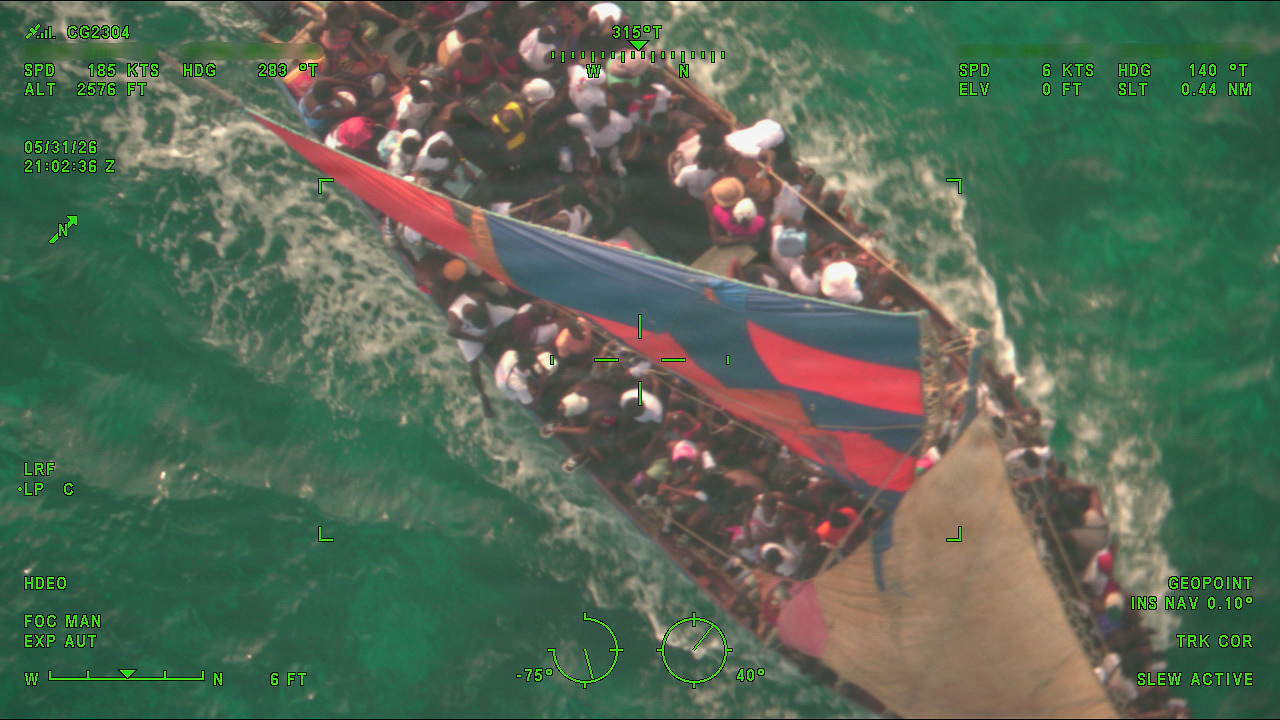
Are we witnessing a revival of the mass migration by sea crises of past decades? On June 5th, the U.S. Coast Guard announced the interdiction of a foundering boat carrying 240 Haitians near the Turks and Caicos and emphasized that such journeys “are extremely hazardous, frequently involving severely overcrowded and unseaworthy vessels that are often taking on water and lack basic life-saving equipment.” On March 25th, Alejandra Legarda reported in AL DÍA that “[i]n the waters of the Florida Straits, a scene … appears to be repeating itself with renewed urgency: fragile vessels, desperate journeys, and a steady flow of Cuban migrants”.
In 1992, President George H.W. Bush initiated the U.S.’s policy of interdicting migrant-carrying vessels on the high seas and repatriating migrants without first having to undertake potentially years-long adjudications of meritless asylum and withholding of removal claims. Since 2004, the USCG-led “Operation Vigilant Sentry” has sought to “protect the safety of life at sea while preventing unlawful maritime entry”.
The Trump administration should not only continue the interdiction policy, but also expand it to encompass vessels interdicted in U.S. territorial waters (generally within 12 miles of the coast). As the Eleventh Circuit concluded in 1982 in Haitian Refugee Center v. Smith, “[i]t is highly likely that [the former Immigration and Naturalization Service’s] inaction provided the greatest inducement to the ultimate swollen tide of incoming, undocumented Haitians.” The court explained that “[A] large percentage of the aliens bought passage … from promoters … whose best sales pitch was the large number of the prospect’s countrymen who … had reached Florida and were residing there undisturbed. Protestations by INS … could hardly be expected to prevail … [when] Haitians who reached southern Florida were living, working and earning” here.
In 1981, President Reagan issued a proclamation stating that “the continuing illegal migration by sea of large numbers of undocumented aliens” was “severely strain[ing] the law enforcement resources of [INS] and … threaten[ing] the welfare and safety of communities”. Reagan, relying on his statutory power to “suspend the entry of all aliens or any class of aliens” when “find[ing] that the[ir] entry … into the [U.S.] would be detrimental to the interests of the [U.S.]”, suspended “[t]he entry of undocumented aliens from the high seas”, to be “prevented by the interdiction of … vessels carrying such aliens.” An accompanying Executive Order charged the USCG with carrying out interdiction efforts (“only outside [our] territorial waters”) and “return[ing] the vessel[s] and [their] passengers to the country from which [they] came”. The EO clarified that “no person who is a refugee will be returned without his consent.”
As the Supreme Court has described, over the following decade, the USCG interdicted about 25,000 Haitians. Those identified as economic migrants were repatriated, while those making a “credible” showing of refugee status were brought to the U.S. to file asylum applications. Then, in 1991, Haitian President Jean Bertrand Aristide was deposed. Over the next half year the USCG interdicted over 34,000 Haitians, sending them to our naval base at Guantanamo Bay, Cuba.
In 1992, the Navy determined that the base could not safely accommodate additional migrants. President Bush was faced with a dilemma. As the Supreme Court put it in its 1993 decision in Sale v. Haitian Centers Council, Bush “had to choose between allowing Haitians into the [U.S.] for the screening process or repatriating them without … any opportunity to establish their qualifications as refugees.”
Bush’s advisers believed that “the first choice … would have defeated the original purpose of … controlling illegal immigration”, “impeded diplomatic efforts to restore democratic government in Haiti” and “posed a life-threatening danger to thousands of persons embarking on long voyages in dangerous craft.” He agreed and issued an EO superseding Reagan’s, clarifying that the Attorney General “in his unreviewable discretion, may decide that a person who is a refugee will not be returned without his consent” and that the EO should not “be construed to require any procedures to determine whether a person is a refugee”.
Litigation of course ensued. Litigants sought a temporary restraining order, contending that the EO violated the INA’s “withholding of removal” provision requiring that the Attorney General “not deport or return any alien [with certain exceptions] to a country if … determin[ing their] life or freedom would be threatened in such country on account of” a more likely than not risk of persecution. The case reached the Supreme Court, which in an 8-1 decision in Sale rejected these claims and affirmed the government’s ability to repatriate aliens interdicted on the high seas without screening for withholding, ruling that the withholding mandate does not “appl[y] to action taken by the [USCG] on the high seas.” The Court also noted that “the President [has] ample power to establish a naval blockade that would simply deny illegal Haitian migrants the ability to disembark on our shores.”
As the Court observed, “President Clinton decided not to modify” Bush’s policy. A former State Department official told me that he asked a Clinton administration official why they kept the policy in place despite the Clinton campaign’s attacks against Bush’s “inhumane” policy. The official responded that “Yes, we have the same policy, but we feel bad about it[!]”
The Court reasoned that the withholding obligation only applies within the U.S. It relied on “the presumption that [statutes] do not ordinarily apply outside our borders”, finding not “a scintilla of evidence” in the legislative history that Congress “intended … extraterritorial application”, and concluding “[i]t would have been extraordinary for Congress to make such an important change in the law without any mention of that possible effect.”
The Court stated that “[t]he reference to the Attorney General in the [withholding statute] … suggests that it applies only to [his] normal responsibilities under the INA[, t]he most relevant … being] deportation and exclusion hearings in which requests for asylum or for withholding … are ordinarily advanced.” The Court concluded that “[s]ince there is no provision … for the conduct of such proceedings outside the [U.S.] … we cannot reasonably construe [withholding] to limit the Attorney General’s actions” outside the country. This conclusion still stands because removal proceedings (now based on deportability or inadmissibility) are still authorized to take place only within the U.S.
The Court also reasoned that withholding only binds the Attorney General and “[w]e cannot say that the interdiction program created by the President, which the [USCG] was ordered to enforce, usurped authority that Congress had delegated to … the Attorney General alone.” However, this argument is no longer applicable, as 2002’s “Homeland Security Act” not only transferred most of the Justice Department’s immigration functions to the new Department of Homeland Security, but it also transferred the USCG to DHS!
The Court concluded that “all available evidence … leads unerringly to the conclusion” that withholding “applies in only one context: the domestic procedures by which the Attorney General determines whether deportable and excludable aliens may remain” here.
The Court was not called upon to address whether DHS has the same latitude regarding migrants intercepted in our territorial waters. But there is strong evidence that if the Court had addressed territorial waters, it would have come to the same conclusion.
In Sale, the Court concluded that withholdings’ protection applies to aliens “found only within [U.S.] territory” and that the 1951 United Nations Convention Regarding the Status of Refugees’ prohibition on “return” of a refugee to the frontiers of territories where his life or freedom would be threatened on account of” persecution (implemented in U.S. law through withholding) only referred to a “‘refugee already within [a nation’s] territory but not yet resident there’”. But under the INA, our territorial waters are not considered part of the United States. Walter Dellinger, President Clinton’s Acting Assistant Attorney General responsible for providing legal advice to the President, noted that the INA’s definition of the U.S. includes only “the continental [U.S.], Alaska, Hawaii, Puerto Rico, Guam, and the Virgin Islands”. In contrast, “[i]n numerous other statutes, Congress has specifically included a reference to the territorial waters when defining the ‘[U.S.]’”, using as an example a statute defining the U.S. to include “the several States and Territories and the District of Columbia, including the territorial waters thereof.”
Dellinger believed that under the INA the same repatriation rules should apply on the high seas and in territorial waters. He wrote an opinion concluding that the withholding mandate “does not limit the President’s power to order the [USCG] to turn back undocumented aliens interdicted within [U.S.] territorial waters” since aliens “intercepted within … territorial waters [are] not entitled to an exclusion hearing”. This was “primarily [based] on an examination of the text of the [INA] — most importantly, its explicit requirements for exclusion proceedings.” Dellinger also “examine[d the INA’s] provisions for asylum and withholding … and conclude[d] that the[y] are consistent with, and indeed support, our reading”.
Mr. Dellinger explained that the INA “provide[s] the jurisdictional basis for an exclusion hearing”, providing that “[e]very alien … who may not appear to the examining immigration officer at the port of arrival to be clearly and beyond a doubt entitled to land shall be detained for further inquiry to be conducted by a special inquiry officer.” He concluded that “it is a predicate for conducting exclusion proceedings that the alien seeking admission be examined ‘at the port of arrival’”. Further, “[a]n alien interdicted at sea — even if within the territorial waters of the [U.S] — is not at any ‘port.’ Consequently, there is no jurisdiction to conduct an exclusion proceeding”.
In 1996, Congress modified the INA to provide that “[a]n alien present in the [U.S.] who has not been admitted or who arrives in the [U.S.] (whether or not at a designated port of arrival …) shall be deemed … an applicant for admission” and that an “applicant for admission, [who] the examining immigration officer determines … is not clearly and beyond a doubt entitled to be admitted … shall be detained for a [removal] proceeding”. Of course, to the extent Dellinger’s conclusion relied on a required presence at a “port of arrival”, it is no longer applicable. However, Congress at the same time clarified that an alien who arrives in the U.S. shall be deemed an applicant for admission even if “brought to the [U.S.] after having been interdicted in international or [U.S.] waters”. Thus, until an alien interdicted in territorial waters is brought to the U.S., that alien is not subject to removal proceedings. In Dellinger’s terms, “that the alien seeking admission” is at a port of arrival or has arrived in the U.S. “is a predicate for conducting” removal proceedings, and for qualifying for withholding.
Dellinger emphasized that the INA’s “only significant reference to the territorial waters occurs in” a provision authorizing “warrantless searches of vessels ‘within the territorial waters of the [U.S.]’”. He contended that “[t]he absence of any other use in the INA of the terms ‘territorial waters’ or ‘territorial sea’ — and particularly their absence in the detailed provisions governing the treatment of aliens seeking to enter the [U.S.] — strongly suggests that an alien’s arrival or presence in the territorial waters is simply not a relevant consideration for establishing or expanding the rights of aliens seeking entry.” Further, “[h]ad Congress wanted to make mere entry into the territorial waters sufficient to guarantee … an exclusion hearing, it could easily have written such language”. Finally, “inasmuch as the only usage of … ‘territorial waters’ appears” in the provision regarding “authority to search vessels in order to thwart aliens attempting illegal entry, there is reason to view the territorial waters as a buffer zone, rather than as a safe harbor, in the overall scheme”. (emphasis by Dellinger)
President Trump should expand the U.S.’s interdiction policy to territorial waters, removing any inadvertent inducement for a new marine migration crisis, and, if necessary, to quickly resolve any such a crisis. The Clinton administration’s cogent arguments should assuage any concerns regarding the legal basis for such an expansion.