
Modern conflict is no longer decided solely on the kinetic battlefield. It is increasingly shaped by a hidden front: the struggle over what events can be seen, verified, withheld, and interpreted in real time. Governments attempt to control this environment through censorship and information restrictions, yet a globally networked ecosystem of analysts, journalists, and open‑source investigators now examines battlefield events in public—creating what amounts to a distributed red team for modern warfare.
The first indications that an American aircraft had been shot down during the recent conflict involving Iran did not come from an official briefing or a government statement. According to NPR’s reporting on the episode, they appeared first on Telegram. Images of aircraft debris and a pilot’s empty ejection seat began circulating through pro-Iranian channels, followed shortly by videos showing search-and-rescue aircraft flying low over mountainous terrain.
Within minutes, open-source investigators began attempting to determine whether the images were authentic. Analysts examined terrain features, compared debris patterns, and attempted to correlate the footage with satellite imagery. Journalists, hobbyists, and independent researchers joined the effort, trying to geolocate the event and reconstruct what had occurred.
But as this process unfolded, the information environment shifted sharply, as NPR later reported. Satellite imagery providers restricted access to high-resolution images across the region, and several governments began arresting individuals for filming military activity or sharing videos online. The sudden disappearance of key verification tools revealed an uncomfortable reality: governments remain deeply invested in controlling how wars are seen and understood.
This matters beyond foreign battlefields. The same dynamics are relevant during domestic crises, where imagery, rumor, and manipulated media can shape public understanding before official assessments are complete. In both cases, modern conflict unfolds within a contested environment of visibility, verification, and narrative control.
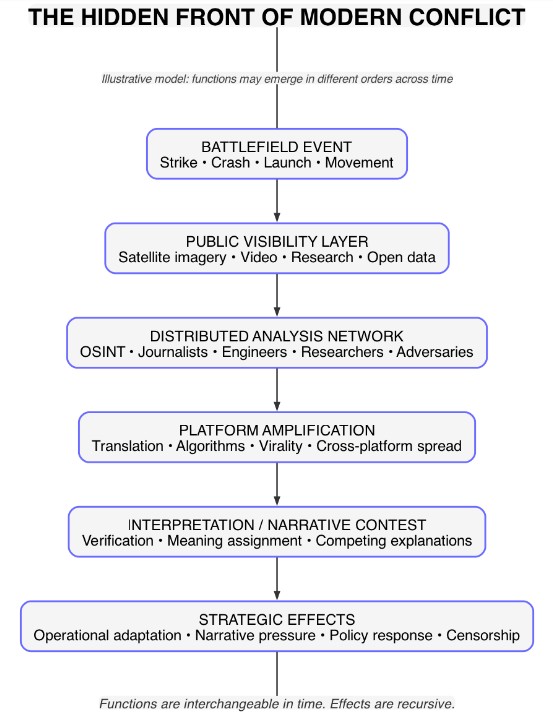
Figure 1. The hidden front of modern conflict: a simplified model of how battlefield events become visible, analyzed, amplified, interpreted, and strategically consequential across a recursive information environment.1
The Rise of the Distributed Red Team
A few days before Iran claimed it had struck a U.S. stealth aircraft, a technical tutorial on how low-cost radar systems might detect and challenge an F-35 circulated widely on Chinese social media. The video was translated and shared across multiple language ecosystems, prompting discussion among engineers, analysts, and defense enthusiasts around the world.
Whether the video influenced any operational thinking is impossible to determine. But the episode illustrates a larger shift in how military knowledge now circulates. Technical insights that once lived primarily inside classified laboratories increasingly appear in public forums, academic papers, engineering channels, and open-source investigations. This is the environment that gives rise to the distributed red team.
Operational activity leads to global technical analysis. Analysis spreads through algorithmic platforms. Observers—including adversaries—watch those discussions unfold in real time.
In effect, the modern internet has unintentionally created the largest open-source military analysis network in history. Portions of the vulnerability analysis once confined to classified defense laboratories now occur in public view, embedded within a globally networked community of investigators, analysts, and technical specialists.
Traditional red teaming inside military and intelligence organizations is deliberate, controlled, and often classified. Its purpose is to challenge internal assumptions without exposing real vulnerabilities to adversaries. The distributed red team emerging online operates very differently. It is decentralized, public, and largely uncoordinated. Engineers, analysts, journalists, hobbyists, and adversaries all examine the same fragments of information simultaneously. Vulnerabilities that once required espionage, classified testing, or specialized access can now be surfaced through collaborative open analysis occurring across public platforms.
Narrative Velocity and the Interpretation Layer
The speed at which interpretations now circulate has become strategically significant. Images, video fragments, and satellite data often appear online within minutes of a battlefield event. Analysts quickly begin comparing terrain features, identifying equipment, and correlating visual evidence with known locations.
As these interpretations spread across social media platforms and messaging channels, they are rapidly amplified by algorithms and global audiences. In many cases, narratives about what has happened begin to form long before governments confirm the facts.
Modern conflict therefore unfolds across several distinct layers. The first is the physical event itself: a strike, a crash, or a troop movement. The second layer is information capture—photos, video, and satellite imagery that document what occurred. The third layer is interpretation, where analysts and observers attempt to assign meaning to those fragments of information.
It is this interpretation layer that has become increasingly decentralized. Engineers, journalists, open‑source investigators, and online communities now participate in reconstructing events in near real time. Their conclusions, hypotheses, and debates circulate globally, shaping how audiences understand the conflict as it unfolds.
The speed of this interpretive cycle is also shaped by platform incentives. Social media algorithms frequently privilege emotionally resonant claims, dramatic imagery, and identity‑reinforcing narratives. As a result, the interpretations that gain the most visibility are not always the most accurate ones. Instead, they are often the interpretations that align most effectively with platform amplification dynamics and audience engagement patterns.
Narrative Meaning and Identity Frameworks
Information alone does not determine how events are understood. Audiences interpret events through existing beliefs about identity, legitimacy, grievance, and historical experience. Facts matter, but facts do not arrive in a vacuum. They are filtered through prior assumptions about who is acting, who is threatened, and what the event is believed to mean.
This is why narrative strategy matters. The same battlefield event can be understood as deterrence by one audience, aggression by another, and proof of technological superiority by a third. Competing actors therefore do not fight only to circulate information. They fight to shape the meaning assigned to that information. The distributed analytical ecosystem accelerates this contest by feeding interpretations into a broader environment where identity alignment, emotional resonance, and social reinforcement help determine which explanations gain legitimacy and spread.
The Cognitive Burden on Institutions
The proliferation of open-source analysis does more than expose battlefield events. It also creates continuous interpretive pressure on governments and institutions responsible for responding to them.
Images, satellite data, and viral claims must be evaluated quickly and often under severe uncertainty. Analysts must determine whether circulating material is authentic, misleading, or deliberately manipulated. Officials must decide whether to respond publicly, investigate further, or allow a narrative to pass without comment.
Each of these decisions consumes attention and time. When interpretations spread globally within minutes, institutions are forced into a cycle of constant monitoring, verification, and response. The result is a persistent form of decision pressure in which leaders must manage rapidly evolving narratives while still directing real-world operations.
This dynamic helps explain why governments attempt to restrict imagery, limit video dissemination, or control information flows during conflict, as NPR documented. These actions are not only about secrecy. There are also attempts to slow the interpretive environment surrounding military operations and to regain initiative in the struggle over what events are taken to mean.
States increasingly experiment with counter‑strategies such as selective leaks, narrative preemption, and coordinated information operations designed to shape interpretation before independent analysts can establish competing explanations. Western governments are also beginning to adapt to this environment by selectively releasing information or accelerating public verification efforts in order to maintain credibility within fast‑moving interpretive ecosystems.
Yet even when information access is constrained, the distributed analytical ecosystem rarely disappears. Instead, it adapts—finding alternative data sources, new verification techniques, and workarounds that allow the interpretive process to continue.
Strategic Implications
Modern conflict now unfolds inside a persistent global interpretive ecosystem. Battlefield events are documented quickly, analyzed publicly, and amplified through digital platforms that connect analysts, journalists, and online communities across the world.
This means military actions are no longer interpreted solely by governments, intelligence agencies, or traditional media institutions. A distributed network of observers now participates in reconstructing events, testing explanations, and proposing competing interpretations in real time.
For policymakers, defense planners, and homeland security professionals, this shift carries significant implications. Attempts to control imagery, restrict information flows, or delay verification may slow the spread of certain details, but they do not eliminate the broader analytical ecosystem surrounding modern conflict. In foreign conflicts and domestic crises alike, this environment can shape public interpretation before official assessments are complete, complicating crisis communication and eroding trust in institutions responsible for response.
The distributed analytical ecosystem also produces asymmetric advantages and risks. Open networks can expose deception, verify battlefield events, and challenge official narratives with remarkable speed. At the same time, the same environment can amplify manipulated fragments of information or misleading interpretations that align with existing identity narratives. In low‑trust information environments, velocity often outpaces verification, allowing incomplete or distorted interpretations to spread widely before careful analysis catches up.
Public information has therefore taken on a new operational significance. What once functioned primarily as transparency or reporting now forms an additional layer of the battlespace—one where analysis, interpretation, and meaning construction shape how wars are understood by global audiences.
Every modern conflict now unfolds not only on the battlefield, but within a distributed system of interpretation that no single actor fully controls. Understanding and operating within this environment has become an essential challenge for states navigating warfare in the information age.
1 This figure is illustrative rather than strictly sequential. These functions may emerge in different orders across time, and their effects are recursive.
This article is written in a personal and analytical capacity. It reflects professional judgment informed by military doctrine, strategic literature, and operational experience in influence and information environments. The views expressed do not represent the official position of the Department of Defense, the U.S. Government, or any affiliated organization.