
Thomas Brzozowski, Adjunct Professor at The George Washington University Law School and U.S. Army Judge Advocate, recently highlighted the critical research of Mauro Lubrano, whose paper “Hidden in Plain Sight: Insurrectionary Anarchism in the Anti-Government Extremism Landscape“ provides an essential framework for understanding one of the most complex and overlooked forms of political violence today: insurrectionary anarchism.
The work, originally published in Perspectives on Terrorism, argues that insurrectionary anarchism should be included in the contemporary scholarly debate on anti-government extremism (AGE), despite its frequent absence from academic discourse.
Bridging the Scholarly Gap
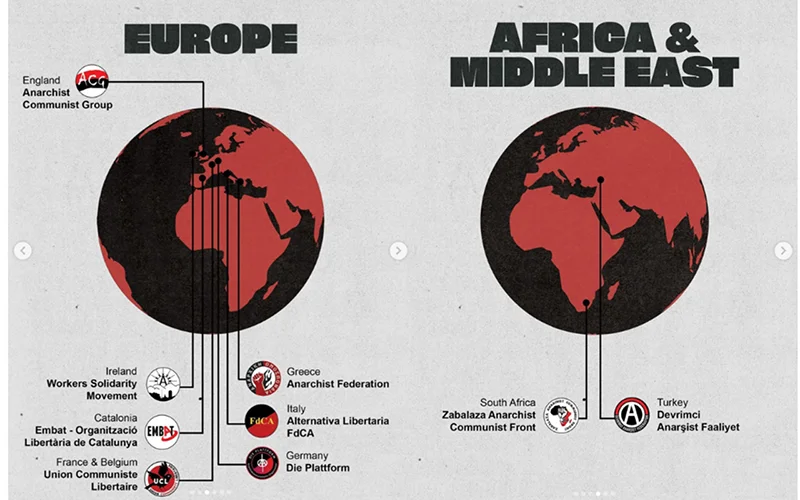
The scholarly focus on pressing security concerns often leaves anarchist extremism understudied, even though it maintains consistent activity levels across Europe and beyond.
The perception that anarchist extremism is a lower threat due to its generally lower lethality is misleading. For example, in 2022, anarchists were responsible for 18 of 28 European Union terrorist attacks, causing millions in damages. Furthermore, anarchist extremism is geographically concentrated in regions like Southern Europe, Latin America, and Asia, which receive less scholarly attention than those where English is the main language.
The Dual Nature of Anarchist AGE and its Operational Characteristics
Brzozowski highlights Lubrano’s analysis and how it demonstrates that insurrectionary anarchism embodies a dual nature within the AGE framework, combining ideological and issue–driven elements. Insurrectionary anarchism distinguishes itself through a focus on decentralized operations and direct action tactics, including leaderless resistance, direct action, affinity groups, and a two-level approach.
The tactical repertoire is broad, including arson, sabotage, assault, bombings, shootings, and property damage. While generally low in operational sophistication, these actions result in substantial economic disruption, with individual attacks causing millions in damages.
Evolving Targets and Narrative Devices
Anarchist AGE shares parallels with broader anti-government movements, including an inclination for conspiracy thinking. Narrative devices often focus on issues such as technological control and linking pandemics to 5G technology or viewing lockdowns as an opportunity to introduce surveillance infrastructure.
Targeting is persistent, including not just high-profile politicians (as seen in the historical “Golden Age of Assassination”) but also judges, prosecutors, police officers, military leaders, and far-right party members. This remains an enduring and complex phenomenon that requires greater scholarly attention.
For a complete look at Brzozowski’s post, click here. Visit Perspectives on Terrorism to read Lubrano’s full paper, “Hidden in Plain Sight: Insurrectionary Anarchism in the Anti-Government Extremism Landscape.“