


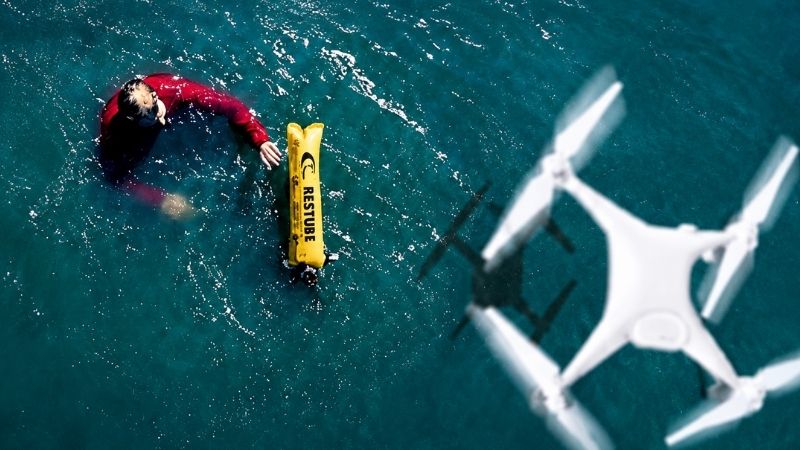
From beach rescues to public safety operations, a coalition of first responders and technologists is turning drone payload delivery into a measurable standard.
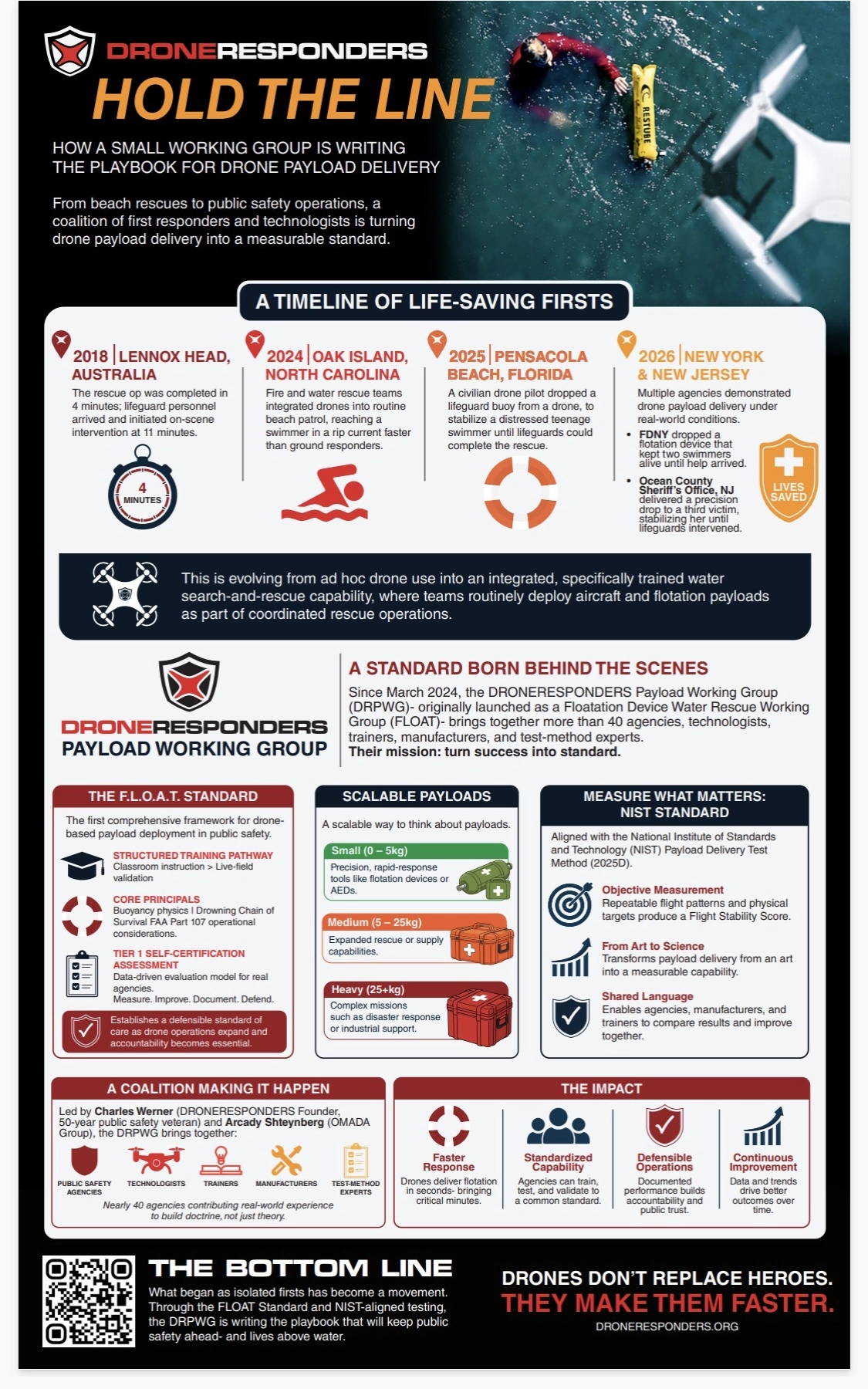
In 2018, off Lennox Head, Australia, a drone reached two struggling teenagers 700 meters offshore in just 70 seconds—delivering an inflatable rescue pod in what became a world-first save. A response that would have taken lifeguards 11 minutes by traditional means was compressed into just over a minute.
At the time, it felt like a breakthrough. Today, it looks more like the beginning of a new standard.
By 2024, drone-deployed flotation had crossed into U.S. operations. Off Oak Island, North Carolina, fire and water rescue teams integrated drones into routine beach patrol, successfully reaching a swimmer caught in a rip current faster than ground responders. In 2025, on an unguarded stretch of Pensacola Beach, a civilian drone pilot made two attempts in high winds to deliver a flotation buoy to a drowning teenager—succeeding just in time to keep her afloat until rescuers arrived.
Then came 2026. Within weeks, multiple agencies demonstrated the same capability under real-world conditions. In New York, FDNYʼs Robotics Unit deployed a drone after lifeguards had gone off duty, dropping a flotation device that kept two swimmers alive until help reached them. In New Jersey, an Ocean County Sheriffʼs Office drone team delivered a precision drop to a third victim during a multi-person rescue, stabilizing her until lifeguards could intervene.
These are no longer isolated saves or improvised heroics. They mark a clear shift: drone payload delivery—specifically life-saving flotation—is becoming a repeatable, expected capability in public safety operations.
What is less visible is the reason why.
A Standard Born Behind the Scenes
Since March 2024, a small but highly focused coalition has been working to ensure that these outcomes are not dependent on luck, individual skill, or one-off ingenuity. Their goal: turn success into standard.
Operating under DRONERESPONDERS, the DRONERESPONDERS Payload Working Group (DRPWG)—originally launched as the Flotation Device Water Rescue Working Group (FLOAT)— brings together nearly 40 agencies, along with technologists, trainers, manufacturers, and test method experts.
Led by Charles Werner, founder of DRONERESPONDERS and a 50-year public safety veteran, and supported operationally by Arcady Shteynberg of OMADA Group, the working group united early adopters already experimenting with drone payload delivery. Agencies such as
FDNY, Snohomish County Sheriffʼs Office, Menlo Park Fire Protection District, and others contributed field experience that could be translated into doctrine.
The mission was straightforward but ambitious: define what “good” looks like—and make it teachable, measurable, and defensible.
From Capability to Doctrine
What emerged is the F.L.O.A.T. Standard, the first comprehensive framework for drone-based payload deployment in public safety.
It is not a single guideline, but a full operational system. The standard establishes a structured training pathway that begins with classroom instruction, advances through simulation, and culminates in live-field validation. It incorporates core principles such as buoyancy physics,
the Drowning Chain of Survival, and FAA Part 107 operational considerations for over-water missions.
Crucially, it also introduces a scalable way to think about payloads:
- Small (0–5 kg): precision, rapid-response tools like flotation devices or AEDs
- Medium (5–25 kg): expanded rescue or supply capabilities
- Heavy (25+ kg): complex missions such as disaster response or industrial support
At the center of the framework is the Tier-1 Self-Certification Assessment—a practical, data-driven evaluation model designed for real agencies operating in real conditions.
Rather than imposing rigid pass/fail thresholds, the assessment emphasizes continuous improvement. Agencies measure their own performance, track trends over time, and build evidence of capability through recorded drops, telemetry, and scoring.
This approach does more than improve performance—it establishes a defensible standard of care. As drone operations expand, agencies will increasingly need to demonstrate how pilots are trained, evaluated, and validated. The DRPWG framework anticipates that future.
Bringing Science to the Drop
To reinforce that standard, the working group aligns with the National Institute of Standards and Technology (NIST) Payload Delivery Test Method (2025D), developed with support from the DHS Science and Technology Directorate.
The NIST methodology introduces something the field has long lacked: objective measurement. Using repeatable flight patterns and physical targets, it produces a Flight Stability Score that quantifies how reliably a drone can carry and deploy payloads.
This transforms payload delivery from an art into a measurable discipline—supporting training, procurement decisions, and future credentialing.
Beyond Water Rescue
While born from water rescue, the implications of this framework extend far beyond the shoreline.
Any mission requiring precise, time-critical delivery shares the same operational DNA:
- Avalanche mitigation, where drones now replace artillery to trigger controlled slides
- Wildfire suppression, with payload drones reaching inaccessible hotspots
- Cardiac arrest response, where AED delivery by drone can cut response times in half
- Medical resupply across rural distances, reducing transport times from hours to minutes
- Blood delivery networks, such as Zipline’s operations serving remote populations
Each of these missions depends on the same core competencies: precision, timing, stability, and decision-making under pressure.
The FLOAT Standard, in effect, provides a blueprint for all of them.
Training for the Real World
Simulation has become a key component of that blueprint. Platforms like the Zephyr Drone Simulator allow pilots to build proficiency in controlled environments before transitioning to live operations.
Programs such as Texas DPS and U.S. Air Force initiatives through AFWERX have already adopted simulation-first approaches, reinforcing the idea that payload delivery is a skill set that must be trained—not improvised.
At the same time, real-world demand is accelerating. Drone as First Responder (DFR) programs have seen a dramatic rise in FAA waiver approvals through 2026, signaling a broader shift toward drones as frontline operational tools.
A Foundation, Not a Finish Line
The DRONERESPONDERS Payload Working Group did not wait for mandates, regulations, or formal requirements. It built the framework first—because the need was already evident in the field.
And that decision is already shaping outcomes.
Every time a drone places a flotation device within meters of a victim, delivers an AED ahead of EMS, or reaches terrain inaccessible to ground crews, it reflects a system that is becoming more predictable, more measurable, and more reliable. The next phase is expansion. The working group continues to invite agencies, operators, and industry partners to contribute data, refine best practices, and extend the standard across new use cases.
Because the goal is not just innovation—it is consistency.
And in public safety, consistency is what saves lives.
Acknowledgments
The DRONERESPONDERS Payload Working Group (DRPWG) recognizes the agencies, organizations, and individuals whose collaboration made this effort possible, including founding agencies such as FDNY Robotics, Snohomish County Sheriff’s Office, Menlo Park Fire Protection District, NYPD TARU/DCO, and many others across the United States and Canada.
Special acknowledgment to Charles Werner (DRONERESPONDERS), Arcady Shteynberg (OMADA Group), the team at Little Arms Studios (Zephyr Simulator), and NIST for advancing the science and structure behind payload delivery.
The standard continues to evolve—and it belongs to the entire public safety community.