
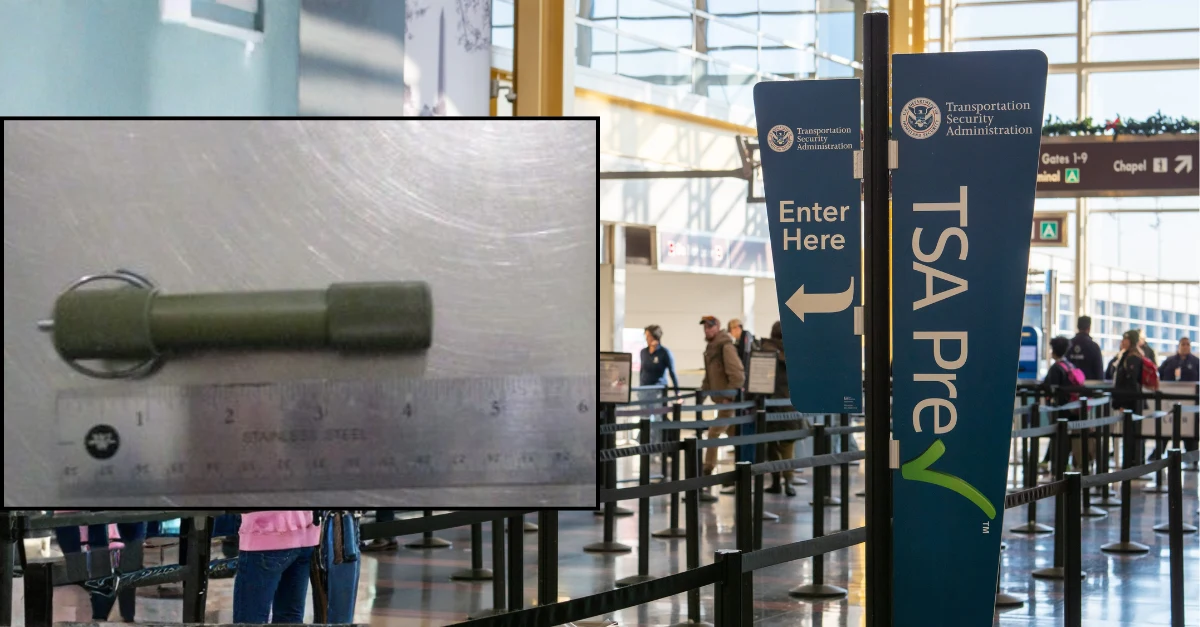
Screeners at Fayetteville Regional Airport (FAY) recently intercepted an item designed to look like an ordinary keychain but was actually a piece of explosives hardware, according to a Transportation Security Administration (TSA) account of the incident.
TSA officer Brady Jackson, who has worked X-ray screening for nine years, spotted the object during a routine carry-on scan. Because FAY sits near Fort Bragg – home to the U.S. Army base that supports over 52,000 military personnel, including the Airborne and Special Operations Forces – Jackson said he’s trained himself to scrutinize keychains and unusual hardware more closely than screeners might in other regions. He recognized the shape as similar to an initiator he’d seen before, though he wasn’t fully certain, and flagged it for a property search.
The passenger told officers he had been converting inert initiators into keychains and said he’d been told that, because the item was inert, it was permissible to carry through security. An incorrect assumption, as such items cannot be brought through TSA checkpoints in either carry-on or checked baggage. The passenger ultimately gave up the item voluntarily.
TSA officials praised the screeners’ work, noting that such initiators are compact enough to fit in a palm and are typically difficult to distinguish on an X-ray monitor within the short window screeners have to evaluate each bag. Jennifer Gordon, TSA’s Federal Security Director overseeing Raleigh-Durham International and the surrounding regional airports including Fayetteville, said the catch highlighted the vigilance of checkpoint staff and reminded travelers that inert or replica explosives are barred from checkpoints regardless of whether they still function.
The Item in Question
TSA’s own LinkedIn post announcing the find referred to the object as a disguised “explosive detonator.” That characterization drew pushback in the comments section from readers with apparent familiarity with military ordnance, who identified the item instead as resembling an M81 fuse igniter, a component distinct from a detonator or blasting cap.
An igniter is a mechanical device used with time fuse or shock tube to start an explosive train for demolition, mining, or training purposes. To function, a user pulls a safety pin and ring, releasing a spring-loaded firing pin that strikes a primer; that primer ignites a length of shock tube crimped into the igniter’s end, and a separate blasting cap – attached to the far end of that tube – is what actually detonates the explosive charge. In other words, the igniter itself doesn’t detonate anything on its own; it starts a chain of components that ends in a detonation elsewhere. Once expended, the item is essentially an inert piece of plastic and metal, though it’s still classified as an energetic component subject to the same carriage restrictions.
Why It’s Prohibited Either Way
Regardless of the precise nomenclature, TSA regulations don’t distinguish between functional and inert versions of this category of item. TSA’s website states that replicas of explosives, including hand grenades, are barred from both checked and carry-on baggage.
That policy traces to a 2003 interpretive rule published in the Federal Register, which spells out categories of “weapons, explosives, and incendiaries” prohibited from aircraft cabins and secure airport areas under federal air-transportation law. The rule explains that partial weapons and weapon components are barred in part because they could be assembled after separate pieces are carried in by different people, and because even non-functional replicas can be used to intimidate passengers or crew. Under that interpretation, blasting caps, dynamite, fireworks, flares, gunpowder, hand grenades, and “realistic replicas of explosives” are all listed as prohibited items; a category broad enough to cover an inert igniter fashioned into a keychain.