
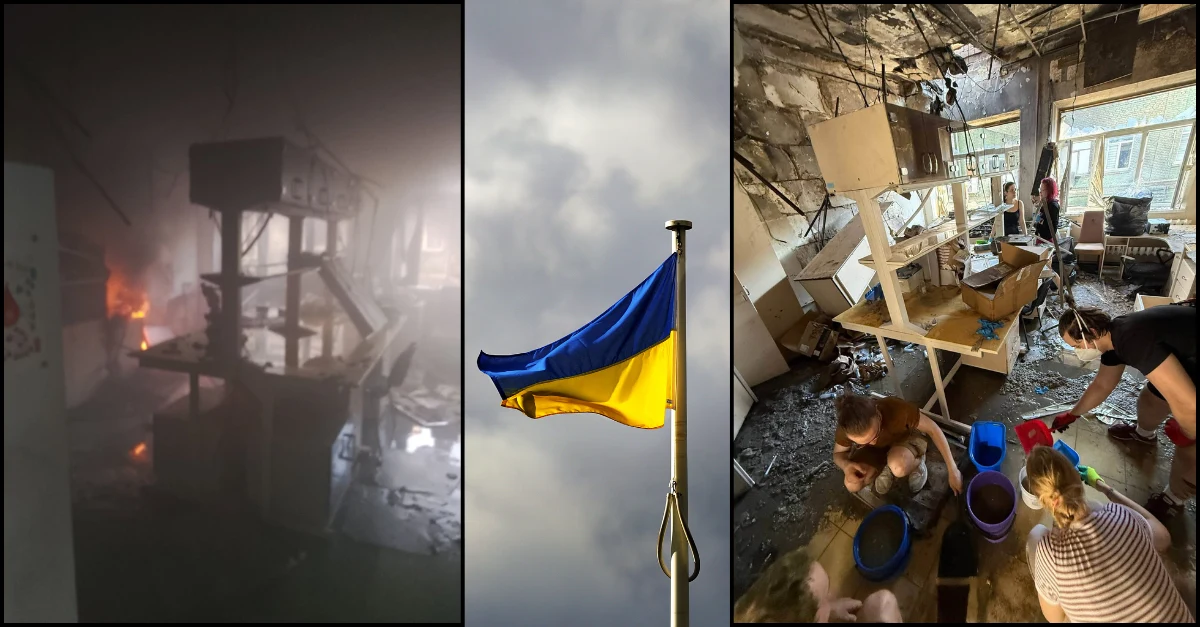
For more than four years, Russia’s full-scale invasion of Ukraine has been destroying more than cities and front lines. It has been systematically dismantling the country’s capacity to accomplish necessary scientific advancements, a loss that Ukrainian researchers say will outlast the war itself.
On July 10, the presidents of Ukraine’s National Academy of Sciences, National Academy of Agrarian Sciences, National Academy of Medical Sciences, National Academy of Educational Sciences, National Academy of Arts, National Academy of Legal Sciences, and the head of the Scientific Committee of Ukraine’s National Council for the Development of Science and Technology issued a joint open letter to the international scientific community. Their message was direct: Ukrainian science is under sustained attack, and researchers around the world can no longer treat that as background noise to the war.
A century of research, gone in a night
The letter’s immediate trigger was a strike on the O.V. Palladin Institute of Biochemistry in Kyiv, which had only just marked its 100th anniversary. Founded in 1925 in Kharkiv by Academician Oleksandr Palladin and relocated to Kyiv in 1931, the institute carries the legacy of a scientist who made foundational discoveries about the biochemistry of muscle and nerve tissue and helped identify the role of vitamins in the body. After the Second World War, Palladin himself led the rebuilding of Ukrainian science from the ruins left by Nazi occupation.
The Palladin Institute is far from alone. According to the signatories, research institutions in Kharkiv, Kyiv, Dnipro, Odesa, Mykolaiv, Kherson, Sumy, Zaporizhzhia and Lviv have all suffered losses in recent strikes. These losses are not just to buildings, many of them historically significant, but to irreplaceable scientific equipment, biological collections, archives and libraries. Once destroyed, decades of research and international collaboration cannot simply be rebuilt.
The toll in numbers and in people
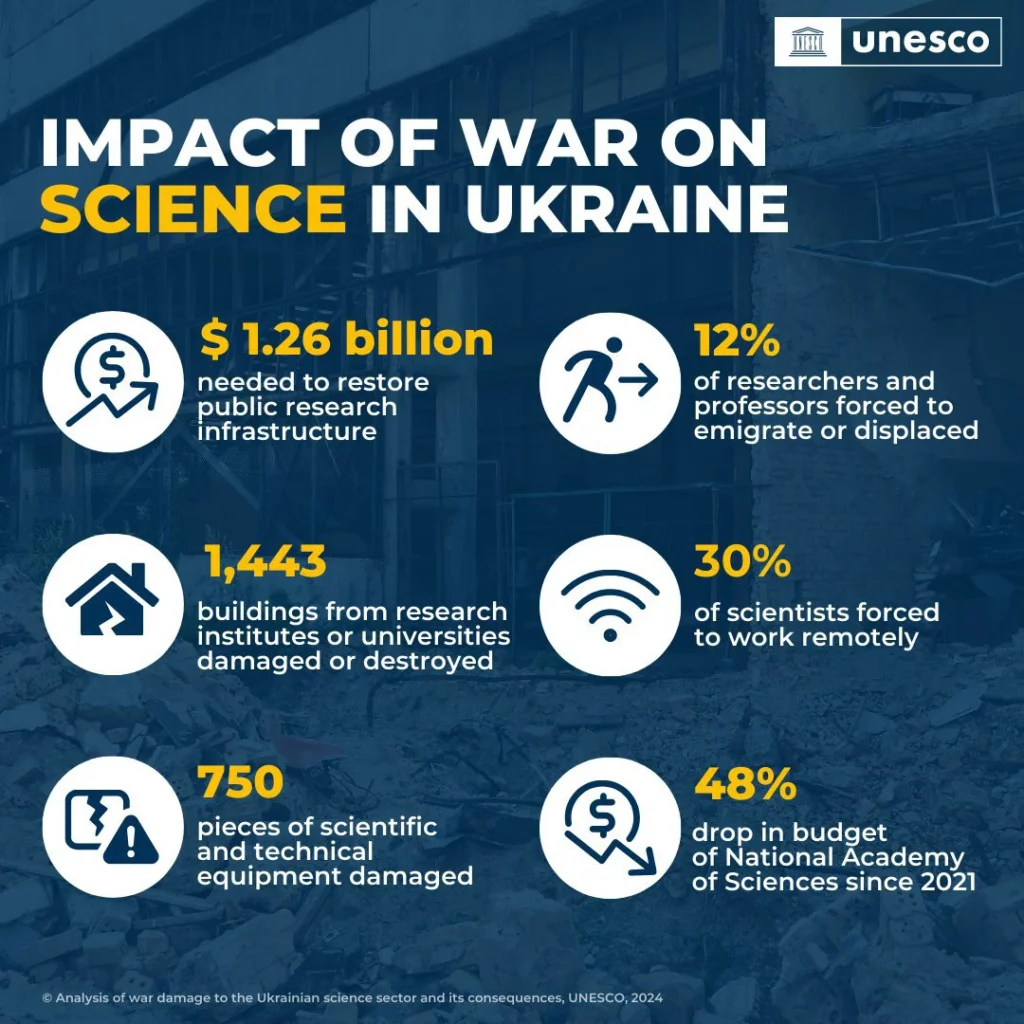
The scale of the damage has been documented for years, and continues to grow. In January 2024, Ukraine’s government had recorded 1,283 damaged or destroyed buildings across 160 scientific institutions, along with 186 damaged engineering structures such as laboratory complexes and experimental sites. Nearly 680 pieces of scientific equipment had been damaged, more than 640 of them beyond repair, with hundreds more urgently needed to keep research going. The estimated cost of restoring public scientific infrastructure at that point already exceeded $1.2 billion.
By this July, reporting in the Kyiv Post put the toll even higher: over 10,000 Ukrainian scientists displaced or killed, and roughly 1,400 research buildings belonging to more than 150 scientific organizations hit since the invasion began, a figure drawn from UNESCO’s own tracking.
Behind those numbers are individual lives. In the early hours of January 1, 2025, cancer biologist Olesia Sokur and neurobiologist Ihor Zyma – a married couple who both worked at the Institute of Biology and Medicine at Taras Shevchenko National University of Kyiv – were killed when drone debris tore through their apartment roof. Their deaths are a reminder that this destruction does not stop at buildings and equipment; it is erasing the people who make the advances in science possible.
What the letter requests
The Ukrainian academies are not simply asking for sympathy. Their letter lays out concrete requests for the global scientific community:
- Publicly condemn the destruction of Ukraine’s scientific infrastructure, and recognize that strikes on civilian scientific institutions amount to war crimes under international humanitarian law.
- Issue formal statements of solidarity with Ukrainian science and scientists.
- Help establish international monitoring and documentation of the damage, as part of a broader effort to protect global scientific heritage.
- Contribute to eventual rebuilding of Ukraine’s labs, equipment and research infrastructure once the fighting ends.
- Expand grants, fellowships, joint research and exchange programs for Ukrainian researchers, especially early-career scientists.
- Push the protection of science during armed conflict onto the agenda of international organizations, governments and donor institutions.
The letter’s authors frame this as more than a humanitarian appeal. Their argument is that science is shared global heritage, and that an attack on any nation’s capacity to produce knowledge is, in a real sense, an attack on everyone’s future.
Why it matters beyond Ukraine
Kyiv Post‘s reporting makes the same point in blunter terms: money alone will not fix this. Reconstruction estimates now run well past $1 billion, but rebuilding a destroyed laboratory is only part of the challenge. Rebuilding a research community – one that has lost colleagues, mentors and, in some cases, entire subfields’ worth of unpublished data and specimen collections – takes far longer, and depends on the kind of sustained international partnership the letter is requesting.
The scientists making this appeal understand there is little to no likelihood that the calculus in Moscow will change because of an open letter. But they are writing for their counterparts abroad who can extend a fellowship, co-sign a statement, or make room in a lab for a displaced Ukrainian researcher. That, they argue, is a form of resistance too.
To read “Open Letter from Ukrainian Scientists to the International Scientific Community” in full, click here.