
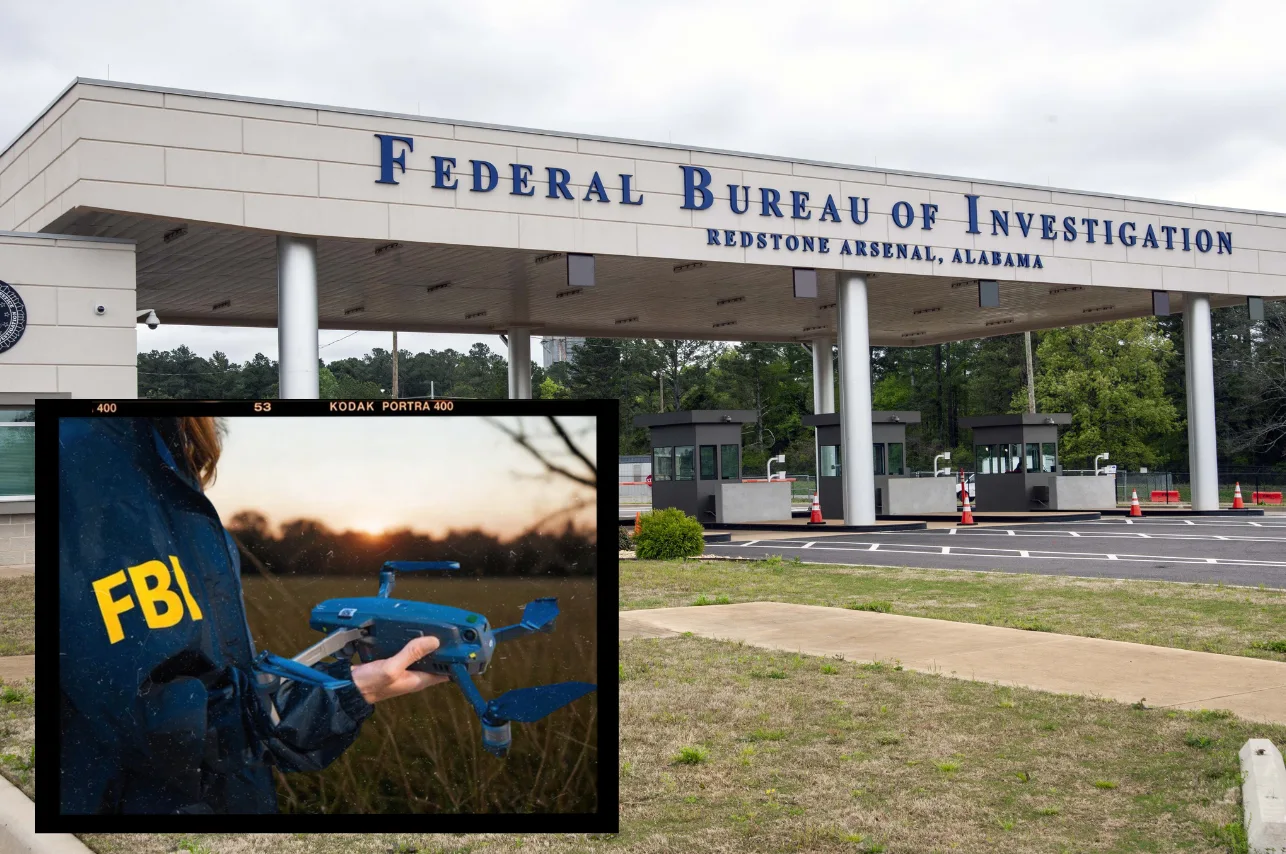
A new federal rule now allows trained and certified state, local, tribal, and territorial (SLTT) law enforcement and correctional agencies to detect – and, with advanced certification, disable – unmanned aircraft (i.e., drones) and unmanned aircraft systems (UAS) that pose a safety threat, under a single set of nationwide standards.
The interim final rule, “Counter-UAS Authority for State, Local, Tribal, and Territorial Law Enforcement and Correctional Agencies,” was issued jointly by the Department of Justice (DOJ) and Department of Homeland Security (DHS), and took effect July 1. It carries out the requirements of the SAFER SKIES Act, which Congress passed in December 2025 as part of the fiscal year 2026 National Defense Authorization Act.
Closing a Legal Gap
Until now, authority to disable a drone in flight was limited to a small number of federal agencies. SLTT agencies that wanted to conduct counter-drone or counter-UAS operations had to do so through the Federal Bureau of Investigation’s (FBI’s) task force model, in which certified local operators were deputized as federal task force officers and operated under federal, rather than local, legal authority.
The SAFER SKIES Act directed the Attorney General to issue formal guidance establishing an independent pathway for SLTT agencies to exercise their own detection and mitigation authority. That guidance had been under development since the law’s passage; the interim final rule (IFR) published this month fulfills that requirement.
The legal mechanism is significant. Certified agencies can act notwithstanding federal aircraft piracy, destruction-of-aircraft, computer fraud, Wiretap Act, and pen register laws, and without violating state, local, tribal, or territorial law. That state-law preemption is what distinguishes independent authority under the new rule from the prior task force model, which only relieved federal legal exposure.
Who the Rule is Meant to Address
DOJ and DHS cited three recurring problem areas in issuing the rule:
- Prisons and jails, where drones are used to drop drugs, cellphones, and weapons over facility walls.
- Stadiums and public events, where crowds face reckless or hostile drone flights.
- Critical infrastructure, including power plants, airports, and government sites that have been probed or surveilled from the air.
How Agencies Qualify
Under the rule, SLTT agencies must complete a four-step process to obtain and maintain authority.
- Adopt safeguards: a written policy governing privacy, safety, and use limits.
- Get accredited: annual attestation through a federal portal operated by the FBI.
- Certify officers: detection training is completed online in roughly an hour at no cost, with certification issued automatically, and resolves the wiretap and pen-register legal exposure agencies previously faced when detecting drone signals. Mitigation authority requires a separate, two-week residential course at the FBI’s National Counter-UAS Training Center at Redstone Arsenal in Huntsville, Alabama, combining classroom instruction with simulated operations. The rule does not set an expiration for certifications; the departments are seeking comment on whether certifications should expire (for example, after 36 or 48 months) and what renewal should require. (*The course does not include training to operate or fly drones.)
- Coordinate and report: operations must be coordinated in advance and reported afterward through the same federal portal.
The National Counter-UAS Training Center is the sole certified training authority under the rule for both detection and mitigation. The rule does allow accredited SLTT agencies to provide counter-UAS support to non-accredited SLTT agencies through mutual aid or other written arrangement (§ 124.4).
Privacy and Accountability Provisions
The IFR includes several restrictions intended to limit the scope of the new authority:
- Agencies may intercept drone signals only to assess whether a threat exists, and records of intercepted communications must generally be deleted within 180 days. Use is limited to safety and security purposes.
- Only certified personnel – not contractors – may exercise detection or mitigation authority, and the rule expressly prohibits “turnkey” or managed-service arrangements in which a vendor operates the equipment. Agencies must report every mitigation action to federal oversight within 48 hours, and knowingly acting without required federal coordination can result in civil fines of up to $100,000 per violation and suspension of an agency’s authority.
- Before disabling a drone, a certified operator must determine that a credible threat exists and that the response is proportionate. The rule also preserves the operator’s independent judgment: a supervisor may not order a mitigation action when the certified operator determines the threat standard is not met.
- Any mitigation activation must be reported to air traffic control within five minutes, and agencies must obtain Federal Communications Commission (FCC) authorization before operating equipment that emits radio waves.
- The rule states that it does not change Federal Aviation Administration (FAA) rules governing lawful drone flight, and the authority may not be used solely to monitor activity protected by the First Amendment.
Defining a Credible Drone Threat
The IFR also addresses the regulatory definition of a drone “credible threat,” a term the SAFER SKIES Act conditioned agency action on but never defined. Under § 124.2:
“The rule’s definition adapts the objective, totality-of-the-circumstances standard
applied in Federal C–UAS operations under 6 U.S.C. 124n(a)(1) since 2018, reflected
in the Attorney General’s April 2020 Guidance 3 and the DOJ objective standards for C–UAS operations,4 and is framed on the reasonable-officer model familiar from use-of-force doctrine, with enumerated indicators drawn from Federal operational experience.”
Supporting indicators could include specific intelligence, behavioral indicators such as flying in restricted airspace or evading warnings, payload anomalies, unauthorized surveillance, and/or repeated incursions. A credible drone threat, therefore, is one that, based on the totality of circumstances known to the operator at the time, would cause a reasonable person in the operator’s position, considering the operator’s training and experience, to conclude that a drone poses an articulable risk to people, facilities, large public gatherings, critical infrastructure, or a correctional facility.
The standard applies differently by tier: a mitigation action requires a contemporaneous indicator that the specific aircraft poses a current, articulable risk (a pattern of past incursions alone never suffices), while detection and warning may rest on a reasonable basis to anticipate a threat. First Amendment-protected activity may not be considered at all. Because the credible threat standard governs when agencies may act, it will be a central reference point for agency engagement policies, training, and technology decisions under the rule, and it remains open for public comment.
Next Steps
To date, approximately 46 agencies (61 individually certified officers) have completed mitigation training through the National Counter-UAS Training Center, and the departments expect roughly 1,500 agencies to certify at the detection tier and 150 at the mitigation tier within two years. The departments cited the ongoing FIFA World Cup, which has seen more than 600 drone incursions into restricted airspace across host cities, and the July 2026 semiquincentennial events as reasons for making the rule effective immediately rather than waiting for public comment.
As an interim final rule, it is legally in effect now but remains open for public comment before the departments issue a final version. The 60-day comment period closes September 4. Comments may be submitted at regulations.gov/docket/FBI-2026-0001. The departments specifically invite comment on certification expiration, mutual aid conditions, the civil penalty framework, and privacy safeguards. The statutory authorities underlying the rule are set to expire in December 2031 unless extended by Congress.
The rule, “Counter-UAS Authority for State, Local, Tribal, and Territorial Law Enforcement and Correctional Agencies,” was published in the Federal Register on July 6 at 91 FR 41466 and is codified identically in both 6 and 28 CFR Part 124.