For years, corporate social responsibility was treated as something companies did after success was achieved. A ceremonial check at a local event. A seasonal food drive. A volunteer day captured in marketing photos.
That era is long over.
Corporate social responsibility has evolved from a peripheral goodwill activity into a core business strategy. Organizations that invest in their communities, support meaningful causes, care for employees, and demonstrate authentic purpose are earning something every sector depends on in both business and crisis: trust.
And trust has operational value.
Consumers increasingly choose companies that reflect their values. Employees, especially younger generations, are making employment decisions based on social and environmental impact as much as compensation and benefits. Research consistently shows that purpose and responsibility now influence hiring, retention, and loyalty at scale.
By 2030, these expectations will define most of the global workforce rather than a subset of it.
But there is a dimension of this shift that is often overlooked in corporate social responsibility discussions. Emergency management.
Why Emergency Management Should Care
In emergency management, trust is not a branding concept. It is operational infrastructure.
When disasters occur, communities do not just need resources. They need to believe in the instructions they are receiving and the institutions delivering them. That trust determines whether people evacuate, whether they follow guidance, and how quickly recovery begins.
Corporate social responsibility, when practiced consistently and authentically, becomes one of the strongest long term trust building mechanisms available to a community. It builds relationships before a crisis occurs that can be relied upon during one.
In practical terms, CSR is not separate from emergency management preparedness. It is part of it.
The Missing Function in Emergency Management
Most emergency management organizations still rely on informal or part time coordination with the private sector. That model no longer matches the complexity or scale of modern disasters.
What is missing in many jurisdictions is a dedicated Private Sector Liaison function.
This is not a ceremonial role. It is an operational one with measurable return on investment.
A full time Private Sector Liaison creates structure where there is currently fragmentation. They build and maintain relationships with corporate partners before disasters occur. They translate corporate social responsibility commitments into actionable emergency support. They align private sector capabilities with real community risk priorities instead of reactive donation streams.
Most importantly, they reduce inefficiency that routinely appears in disaster response. Without coordination, well intentioned support often arrives in forms that are difficult to use. Supplies may not match current needs. Offers may arrive without distribution pathways. Messaging support may be delayed until the critical window for public action has passed.
A Private Sector Liaison converts goodwill into usable capacity.
The return on investment becomes visible in real world activations.
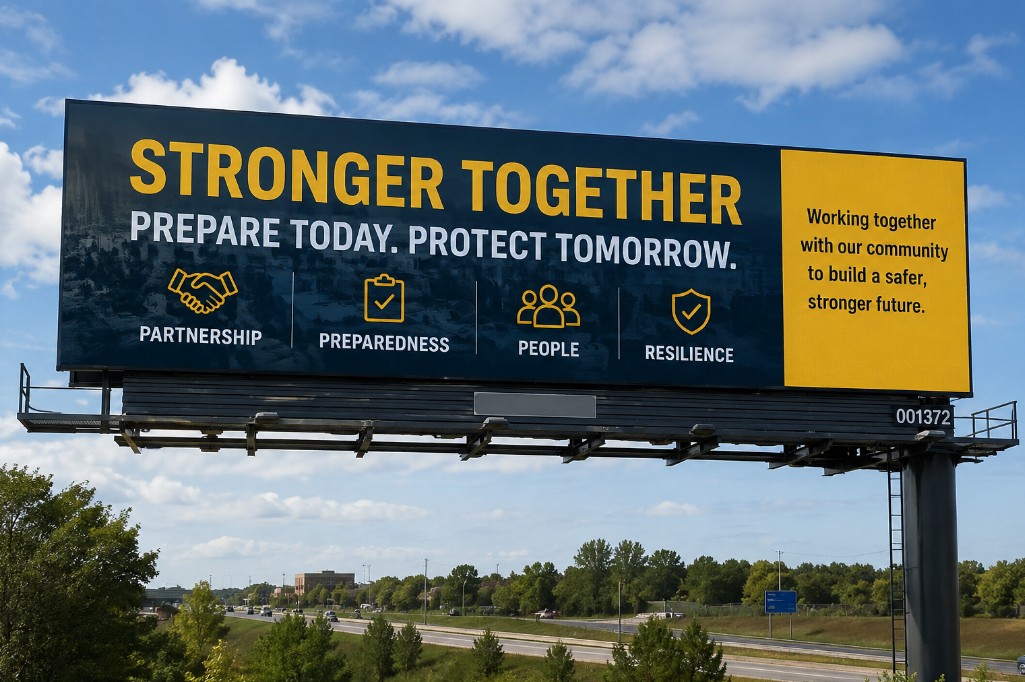
For example, during a coordinated public information effort in 2011, private sector media partners supported survivor assistance messaging through more than 155 digital billboard placements across six states. The campaign ran during a two week period in late April and May and carried an estimated value of more than 350,000 dollars in donated media exposure. That level of reach would not have been possible through traditional emergency management channels alone and required coordination between public sector communicators and private sector owners of critical messaging infrastructure.
That is the operational value of structured engagement. Not abstract goodwill, but scalable delivery capacity at the moment it is needed.
In many cases, the cost of a liaison position is offset many times over by a single coordinated activation of this kind. More importantly, the role strengthens continuity between preparedness, response, and recovery by turning private sector engagement from episodic contact into a standing capability.
This is where corporate social responsibility becomes operational rather than symbolic.
Money, Goods, and the Reality of Disaster Response
Emergency managers consistently emphasize a difficult operational truth. In disasters, money is often more useful than goods.
Physical donations, while well intentioned, can create logistical bottlenecks and divert attention from higher priority needs. Warehousing, sorting, and redistribution all consume limited response capacity.
Federal agencies generally do not serve as direct recipients of unsolicited monetary donations, but state and local governments, along with nonprofit partners, often can serve as effective and trusted channels for financial contributions.
This is where alignment between corporate social responsibility and emergency management becomes critical.
The most effective corporate partners are increasingly shifting from donating goods to funding trusted organizations that can procure and distribute what is actually needed in real time.
What Effective Corporate Engagement Looks Like
The strongest examples of corporate engagement in disasters are not symbolic. They are operational.
Procter and Gamble deployed mobile laundry and hygiene units to disaster zones, addressing a basic but often overlooked survivor need.
Walmart leveraged its logistics network to stage and distribute essential supplies before and after hurricanes, effectively functioning as an extension of the response supply chain.
The Home Depot pre-positioned generators and critical building materials while also supporting recovery through grants and volunteer rebuilding efforts.
Airbnb provided emergency housing for displaced residents and responders through structured disaster relief partnerships.
Verizon and AT&T deployed mobile communications infrastructure and technical teams to restore connectivity when traditional systems failed.
These organizations did not simply donate. They applied core capabilities to real emergency problems.
That distinction matters.
Why This Benefits Corporations
For the private sector, alignment with emergency management through corporate social responsibility is not charity. It is strategic positioning.
It strengthens public trust during high visibility events. It improves brand resilience when communities are under stress. It reinforces employee pride and retention. It creates preferred partnership status with public agencies. And it builds long term community loyalty that extends beyond any single incident.
In short, companies that show up effectively during crises are remembered long after the event ends.
Why This Matters for Emergency Management
For emergency management, structured corporate engagement expands operational capacity without expanding government footprint.
It improves coordination during response. It strengthens preparedness through pre negotiated relationships. It reduces inefficiency caused by unsolicited or misaligned donations. And it reinforces public trust through visible, credible partnerships.
Corporate social responsibility, when connected intentionally to emergency management systems, becomes part of the resilience architecture of a community.
Conclusion
Corporate social responsibility is no longer a peripheral activity. In the context of emergency management, it is part of how communities prepare for, respond to, and recover from disasters.
The most effective organizations are not asking how much they should give.
They are asking how their capabilities align with community need before the need arises.
Emergency management is asking the same question from the public sector side.
When those two perspectives align, corporate social responsibility stops being symbolic.
It becomes operational.
And resilience becomes measurable.
Dan Stoneking is the Owner and Principal of Stoneking Strategic Communications, the Author of Crisis Communications and Emergency Management, the Founder and Vice President of the Emergency Management External Affairs Association, the Founder of Message Prism, and an Adjunct Professor in the Communications Department at West Chester University.
Shannon Stoneking is Principal and Vice President of Stoneking Strategic Communications, Director of Development and Corporate Social Responsibility for the Emergency Management External Affairs Association (EMEAA), Co-Founder of Message Prism, and a corporate communications leader with experience leading communications for Fortune 500 organizations. She specializes in internal communications, corporate social responsibility, and strategic communications that help organizations navigate complex challenges and build stronger stakeholder relationships.