
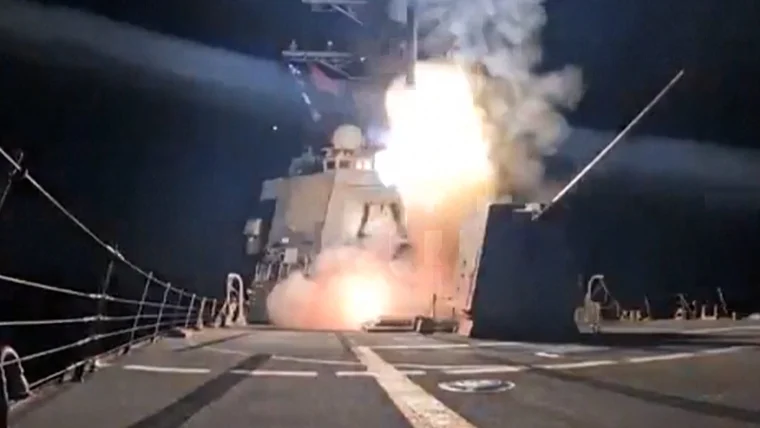
The United States military carried out airstrikes against Islamic State targets in northwestern Nigeria on Christmas Day, following months of warnings from President Donald Trump regarding violence against Christians in the country. The strikes, confirmed by U.S. Africa Command (AFRICOM), were conducted at the request of Nigerian authorities and killed multiple militants, according to official statements.
The Strikes and Official Response

In a Christmas Day post on Truth Social, President Trump announced that he had directed the military to launch what he described as a “powerful and deadly strike against ISIS Terrorist Scum in Northwest Nigeria.” Trump stated the group had been “targeting and viciously killing, primarily, innocent Christians, at levels not seen for many years.”
U.S. Africa Command confirmed on X that it had carried out strikes against ISIS targets in Sokoto State. A video released by the Pentagon showed at least one projectile launched from a warship. A U.S. defense official said the strikes targeted known ISIS camps. The Associated Press reported it could not independently confirm the full extent of the strikes’ impact.
“I have previously warned these Terrorists that if they did not stop the slaughtering of Christians, there would be hell to pay, and tonight, there was,” Trump wrote, adding that the Pentagon conducted “numerous perfect” strikes.
Secretary of Defense Pete Hegseth thanked the Nigerian government for its cooperation and stated there was “more to come.” Republican Representative Addison McDowell of North Carolina praised the action, posting that “the situation for Christians in Nigeria has been reaching a breaking point.”
Nigerian Government Response
Nigeria’s foreign ministry stated that the strikes were carried out as part of ongoing security cooperation with the United States, involving intelligence sharing and strategic coordination to target militant groups. “This has led to precision hits on terrorist targets in Nigeria by air strikes in the North West,” the ministry posted on X.
Nigerian Air Marshal Kelvin Aneke, the air force chief of staff, had urged forces in a Christmas message to “not leave any stone unturned in the quest to subdue terrorism, banditry and other forms of criminality within the northwest region,” according to local broadcaster Channels TV.
Background: Trump Administration’s Focus on Nigeria
The strikes follow months of escalating language from the Trump administration regarding religious violence in Nigeria. In early November, Trump posted on Truth Social that he had directed the Pentagon to “prepare for possible action” in Nigeria, accusing the Nigerian government of not doing enough to protect Christians. Trump threatened to cut all aid to Nigeria and warned that the U.S. military might go in “with guns-a-blazing” to “completely wipe out the Islamic Terrorists.”
On October 31, the Trump administration designated Nigeria as a “Country of Particular Concern” under the International Religious Freedom Act, with the president stating that “Christianity is facing an existential threat in Nigeria.”
Representative Riley Moore of West Virginia, a House Appropriations Committee member who visited Nigeria in November with a congressional delegation, said the group had “positive conversations” with the Nigerian government and that he believed they were “close to a strategic security framework to address both the ISIS and Boko Haram threat in the north-east, as well as the genocide against Christians by the radical Fulani Muslims in the Middle Belt.”
Nigerian Government’s Position

The Nigerian government has pushed back against characterizations that frame the country’s security challenges as primarily anti-Christian persecution. Following the U.S. designation in October, President Bola Ahmed Tinubu stated that characterizing Nigeria as “religiously intolerant does not reflect our national reality, nor does it take into consideration the consistent and sincere efforts of the government to safeguard freedom of religion and beliefs for all Nigerians.”
Bayo Onanuga, press secretary to President Tinubu, called Secretary of State Marco Rubio’s condemnation of the “slaughter of thousands of Christians” a “gross exaggeration of the Nigerian situation,” adding that “Christians, Muslims, churches and mosques are attacked randomly.”
Nigerian officials have long characterized much of the violence in the country as a local “farmer-herder conflicts” rather than religious persecution. However, affected communities have rejected this framing. One community leader in Benue State described recent killings as a “full-scale genocidal invasion and land-grabbing campaign by herder terrorists and bandits.”
Nigeria’s Security Landscape is a Complex Picture
Nigeria faces multiple, overlapping security threats that defy simple categorization. Over the past 15 years, Boko Haram, an extremist Islamist armed group, has terrorized northeastern Nigeria, killing tens of thousands of people. Human rights experts have noted that more Muslims have been killed by Boko Haram than Christians.
Data from Friedrich Ebert Stiftung (FES) Nigeria and Nextier’s Nigeria Violent Conflicts Bulletin illustrates the scale and nature of the crisis. In a single month (April 20–May 20, 2024), 25 Nigerian states recorded 94 violent incidents resulting in 313 casualties and 124 kidnap victims. The Northwest, where the U.S. struck, was confirmed as the country’s most violent region, recording 166 casualties, 41 kidnap victims, and 27 incidents. Zamfara State alone saw 69 casualties from 12 banditry incidents during that period.
Nextier’s analysis also provides insight into how violence in Nigeria is categorized. Of the 94 nationwide incidents documented that month, only 6 were categorized as “terrorism.” “Gunmen attacks” accounted for 39 incidents, “banditry” for 29, and “farmer-herder conflict” for 7.
Some analysts have questioned whether U.S. counterterrorism frameworks fully account for the scope of threats facing Nigerian communities. Counterterrorism expert Sarah Adams, former intelligence analyst and targeter with the Central Intelligence Agency (CIA), posted on X: “Fulani militias are responsible for 55% of Christian deaths in Nigeria. Boko Haram and ISIS combined killed just under 8%.”
Data from the Observatory for Religious Freedom in Africa (ORFA), as reported in an analysis by researcher Steven Kefas, provides additional context. According to ORFA documentation covering October 2019 through September 2024: 2.4 Christians were killed for every Muslim during the period studied, and in states where attacks occur, Christians were killed at a rate 5.2 times higher than Muslims relative to their population size. By the end of 2024, the International Displacement Monitoring Centre reported that 3.4 million Nigerians had been forcibly displaced by conflict and violence.
The Global Terrorism Index, produced by the Institute for Economics & Peace, ranked armed Fulani militants as the fourth deadliest terror group in the world in 2015, but analysts have noted that the group has since disappeared from international terrorism rankings despite reportedly becoming more lethal. A discrepancy that some attribute to the categorization of Fulani militia violence as communal conflict rather than terrorism.
Dr. Mahmut Cengiz – Associate Professor and Research Faculty with Terrorism, Transnational Crime and Corruption Center (TraCCC) and the Schar School of Policy and Government at George Mason University and Homeland Security Today Editorial Board Member and Columnist – analyzed this very issue in his June 2024 column, “Terrorist Threat Assessment: Boko Haram and ISWAP in Nigeria.” Dr. Cengiz analysis of the Global Terrorism and Trends Analysis Center (GTTAC) Records of Incidents Database (GRID) from January 2018 to October 2023 found Fulanis perpetrated 780 attacks versus Boko Haram’s 632 and ISIS-West Africa’s 412.

**UPDATE: Additional Data on Armed Group Activity**
Additional data obtained since the initial reporting provides further context on armed group activity in Nigeria.
Longer-term data compiled by GTTAC’s Dr. Eoin B. Healy documents terrorism incidents in Nigeria by perpetrator between 2018 and June 2025. The findings show that Fulani militants were responsible for 856 documented terrorism incidents during this period, more than Boko Haram (757 incidents) and significantly more than ISIS-West Africa or ISWAP (595 incidents). Lakurawa, who first showed up in the database in 2024 and is affiliated with Islamic State Sahel, are at 37, and Zamfara militants, operating primarily in the Northwest, accounted for an additional 699 incidents.
However, the GTTAC data also reveals an increase in ISWAP and Boko Haram terrorism incidents from 2023 to 2024 (56 in 2023 to 90 in 2024 for ISWAP, and 48 in 2023 to 68 in 2024 for Boko Haram) while Fulani incidents decreased (106 in 2023 to 61 in 2024). In addition, geographic patterns reveal total numbers of incidents also don’t tell the whole story: The highest concentration of Fulani militant attacks occurred in Benue State in the Middle Belt, with 211 documented incidents.
By contrast, Sokoto State, where the U.S. strikes occurred, recorded only 4 Fulani militant incidents over the entire period. But a total of 3,600 incidents leading to 9,380 fatalities were recorded from 2023 to November 2025 in northwest Nigeria, according to an acaps report. A closer look at the data adds further dimension to the picture when specifying the targeting of Christians, which, according to GTTAC data from 2019 to June 2025, puts Fulani perpetrators at 101 incidents; ISWAP at 24; and Boko Haram at 8.
Recent Incidents
Recent months have seen numerous attacks highlighting the scale of Nigeria’s security crisis. In November, incidents included Islamic State fighters killing a brigadier general in the northeast and attacks on public schools in the north. Armed gunmen stormed Christ Apostolic Church, killing two people and kidnapping 38 worshippers, who were freed nearly a week later.
Days before that church attack, gunmen kidnapped 25 girls from a boarding school in Kebbi State and killed at least one staff member. The girls were later rescued. Days after the church attack, armed attackers raided Saint Mary’s School and kidnapped more than 300 students and staff. As of recent reports, 253 students and 12 teachers remain in captivity.
Security analysts have noted that the absence of state presence in remote communities creates opportunities for non-state actors to fill the vacuum.
Questions That Remain
The U.S. strikes raise questions that extend beyond the immediate military action. Can a counterterrorism framework designed for jihadist insurgencies address violence rooted in land disputes, ethnic tensions, and resource scarcity? Why have Fulani militias vanished from global terrorism rankings? Does focusing on Islamic State groups produce meaningful protection for the vulnerable communities? And if the stated goal is safeguarding Nigerian Christians, do current methodologies capture the full scope of threats?