


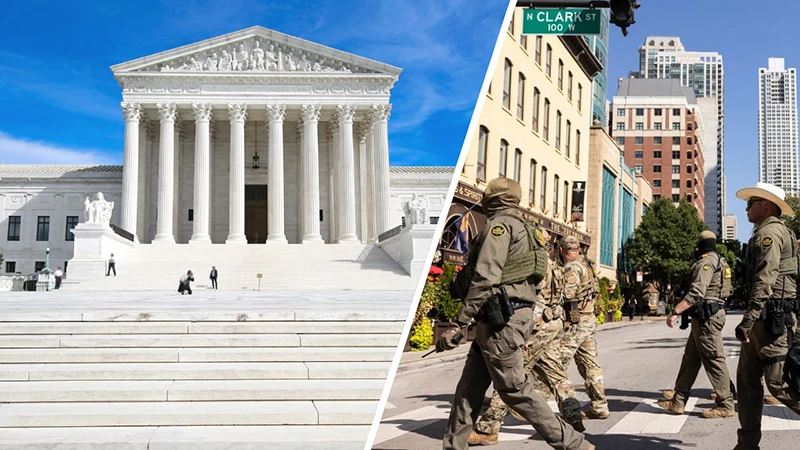
On December 23, 2025, six Justices of the U.S. Supreme Court denied the federal government’s request to deploy Illinois and Texas National Guard troops to protect Immigration and Customs Enforcement (ICE) personnel and federal property. The Court’s order and three-page opinion establishes important limits on presidential authority to federalize state National Guard units under Title 10 of the U.S. Code, with implications extending far beyond the Chicago case.
The decision blocks the Trump administration from ordering the state-based military force to the Chicago area, where an immigration crackdown led to thousands of arrests and confrontations between residents and federal agents. State governors who have obtained similar injunctions in California, Oregon, and Illinois now have significant Supreme Court precedent supporting their objections to federal Guard activations.
Background: Presidential Call-Up of State Guard Units
On October 4, 2025, President Trump called 300 members of the Illinois National Guard into active federal service to protect federal personnel and property in and near Chicago. The following day, he called up the Texas National Guard for similar purposes. Both activations were executed under 10 U.S.C. Section 12406(3), which empowers the President to federalize members of the Guard if he is “unable with the regular forces to execute the laws of the United States.”
The key legal question: What does “regular forces” mean? The administration argued it referred to civilian federal agencies like ICE or the Federal Protective Service. Illinois and other states argued it meant U.S. military forces, triggering additional constitutional constraints under the Posse Comitatus Act.
The Posse Comitatus Act: Military Execution of Civilian Laws
The 1878 Posse Comitatus Act, as amended, provides: “Whoever, except in cases and under circumstances expressly authorized by the Constitution or Act of Congress, willfully uses any part of the Army, the Navy, the Marine Corps, the Air Force, or the Space Force as a posse comitatus or otherwise to execute the laws shall be fined under this title or imprisoned not more than two years, or both.”
This law was passed after Reconstruction to prevent federal military intervention in civilian law enforcement. As the Brennan Center for Justice explains, when National Guard are called into federal service, “they become part of the federal armed forces, which means they are bound by the Posse Comitatus Act until they are returned to state control.”
Congress in November 2018 issued a report: “The Posse Comitatus Act and Related Matters: The Use of the Military to Execute Civilian Law.”
“Case law indicates that ‘execution of the law’ in violation of the Posse Comitatus Act occurs (a) when the Armed Forces perform tasks assigned to an organ of civil government, or (b) when the Armed Forces perform tasks assigned to them solely for purposes of civilian government. Questions concerning the act’s application arise most often in the context of assistance to civilian police. At least in this context, the courts have held that, absent a recognized exception, the Posse Comitatus Act is violated when (1) civilian law enforcement officials make ‘direct active use’ of military investigators; or (2) the use of the military ‘pervades the activities’ of the civilian officials; or (3) the military is used so as to subject ‘citizens to the exercise of military power which was regulatory, prescriptive, or compulsory in nature.’ The act is not violated when the Armed Forces conduct activities for a military purpose.”
Supreme Court Majority Opinion
The Court’s 6-3 decision in Donald J. Trump, President of the United States, et al. v. Illinois, et al. was issued on the emergency docket. The majority concluded:
“We conclude that the term ‘regular forces’ in Section 12406(3) likely refers to the regular forces of the United States military. This interpretation means that to call the Guard into active federal service under Section 12406(3), the President must be ‘unable’ with the regular military ‘to execute the laws of the United States.’ Because the statute requires an assessment of the military’s ability to execute the laws, it likely applies only where the military could legally execute the laws. Such circumstances are exceptional: Under the Posse Comitatus Act, the military is prohibited from ‘executing the laws’ ‘except in cases and under circumstances expressly authorized by the Constitution or Act of Congress.’ So before the President can federalize the Guard under Section 12406(3), he likely must have statutory or constitutional authority to execute the laws with the regular military and must be ‘unable’ with those forces to perform that function.”
Practical Impact of the Ruling
The Court’s interpretation creates a two-step test for federalizing the National Guard under Section 12406(3):
- First, the President must have statutory or constitutional authority to use regular military forces to execute the laws in question
- Second, even with such authority, the President must be “unable” with regular military forces to perform that function
Since the Posse Comitatus Act generally prohibits military execution of civilian laws except where expressly authorized, circumstances permitting Guard federalization under this provision are “exceptional.”
Dissenting Opinion: Presidential Inherent Authority
Three dissenting Justices (Samuel A. Alito Jr., Neil M. Gorsuch, and Clarence Thomas) urged caution. They noted that because this case was decided on the emergency docket seeking a stay of an injunction, there had not been full briefing by the parties or oral argument before the Justices. Instead, the Court on October 29 had requested only letter briefs on what Congress meant by the term “regular forces.”
Justice Alito wrote: “On top of all this, the Court fails to explain why the President’s inherent constitutional authority to protect federal officers and property is not sufficient to justify the use of National Guard members in the relevant area for precisely that purpose.”
Justice Gorsuch emphasized procedural concerns: “Under these circumstances, caution seems to me key, and I would decide this application narrowly, based only on those few arguments the parties preserved and the evidentiary record as it stands.”
National Guard Activations: Understanding the Three Types
National Guard members serve under a dual-enlistment structure with three different active operational statuses:
State Active Duty: Guard members serve under state authority, typically for state emergencies like natural disasters or civil disturbances. The governor maintains command and control.
Title 32 Federal Active Duty: Guard members remain under state command but are federally funded. This status has been used for disaster relief, border security operations, airport security after September 11, and COVID-19 response efforts. Guard members in Title 32 status are not subject to the Posse Comitatus Act restrictions.
Title 10 Federal Active Duty: Guard members are federalized and come under direct federal command. In this status, they are subject to the Posse Comitatus Act and generally prohibited from domestic law enforcement activities.
The Supreme Court’s December 23 decision addresses Title 10 activations and establishes significant constraints on presidential authority to federalize state Guard units for domestic operations.
Other Guard Deployments and Legal Challenges
D.C. Circuit Ruling on Title 32 Deployment
The National Guard in the District of Columbia, along with State Guards from South Carolina, West Virginia, Mississippi, Louisiana, Tennessee, Ohio, Georgia, Alabama, and South Dakota, have operated since August 2025 under Title 32 status. On December 17, 2025, the D.C. Circuit Court of Appeals granted the U.S. Government’s stay of an injunction that had blocked these deployments.
The different treatment of Title 32 versus Title 10 deployments reflects the distinct legal frameworks: Title 32 deployments keep Guard units under state command and avoid Posse Comitatus Act restrictions, while Title 10 deployments federalize the Guard and trigger constitutional constraints on military involvement in civilian law enforcement.
Prior State-Level Injunctions
Before the Supreme Court’s December 23 decision, governors in California, Oregon, and Illinois had already obtained federal court injunctions prohibiting Title 10 deployment of their state guards:
December 10, 2025 – Los Angeles: A federal judge ordered Trump’s National Guard deployment in Los Angeles to end.
November 8, 2025 – Portland, Oregon: A federal judge permanently blocked Trump from deploying National Guard to Portland.
October 16, 2025 – Chicago: An appeals court upheld a federal judge’s temporary order blocking National Guard deployment in the Chicago area. This is the injunction that the Supreme Court declined to stay on December 23.
These state-level victories now have the backing of Supreme Court precedent, significantly strengthening governors’ ability to resist unwanted federalization of their Guard units.
Implications for Emergency Management and Homeland Security
Impact on State-Federal Relations
The Supreme Court’s decision reinforces principles of federalism and state sovereignty over National Guard forces. State governors retain significant authority to resist federal takeover of their Guard units absent clear statutory authority and demonstrated inability of regular military forces to accomplish the mission.
For emergency management professionals, this decision clarifies the legal framework governing National Guard availability for state emergencies and disasters. While the Guard remains available for state active duty and Title 32 missions, federal authorities face substantial legal barriers to Title 10 federalization for domestic operations.
Future Legal Developments
The Court’s December 23 order is preliminary, decided on the emergency docket without full briefing or oral argument. Three dissenting Justices emphasized the need for more careful consideration. Several paths forward exist:
- The Supreme Court may accept an appeal in another case for full briefing and oral argument (requires votes of four Justices to grant certiorari)
- Congress could enact clarifying legislation defining “regular forces” and conditions for Guard federalization
- The administration could pursue Guard deployments under different statutory authorities, including the Insurrection Act (10 U.S.C. Sections 331-335)
Until further clarification occurs, lower federal courts must follow this opinion. As Georgetown University Professor Marty Lederman, who filed an influential amicus brief in the case, explained in a November 13 podcast, the administration’s legal defeat represents a critical oversight in reasoning about presidential authority to deploy military forces domestically.
Conclusion: Separation of Powers and Guard Federalism
The Supreme Court’s December 23 decision represents a significant check on executive authority to federalize state National Guard units. By interpreting “regular forces” to mean regular military forces rather than civilian federal agencies, the Court established that Guard federalization under Section 12406(3) requires both statutory authority to use military forces for domestic law enforcement and demonstrated inability of regular military forces to accomplish the mission.
This decision reflects longstanding constitutional principles limiting military involvement in civilian affairs, rooted in the Posse Comitatus Act’s prohibition on using military forces to execute domestic laws. While the opinion is preliminary and three Justices dissented, it provides important protection for state sovereignty and the traditional federal-state partnership in National Guard operations.
As litigation continues and potentially returns to the Supreme Court for fuller consideration, state and federal officials must navigate a complex legal landscape. The decision underscores that National Guard forces remain primarily instruments of state authority, available for federal missions through cooperative arrangements that respect constitutional constraints on military power.
Co-authored with Megan Norris
This article provides information on recent legal developments. State and federal officials should consult with their legal counsel for guidance specific to their circumstances.