
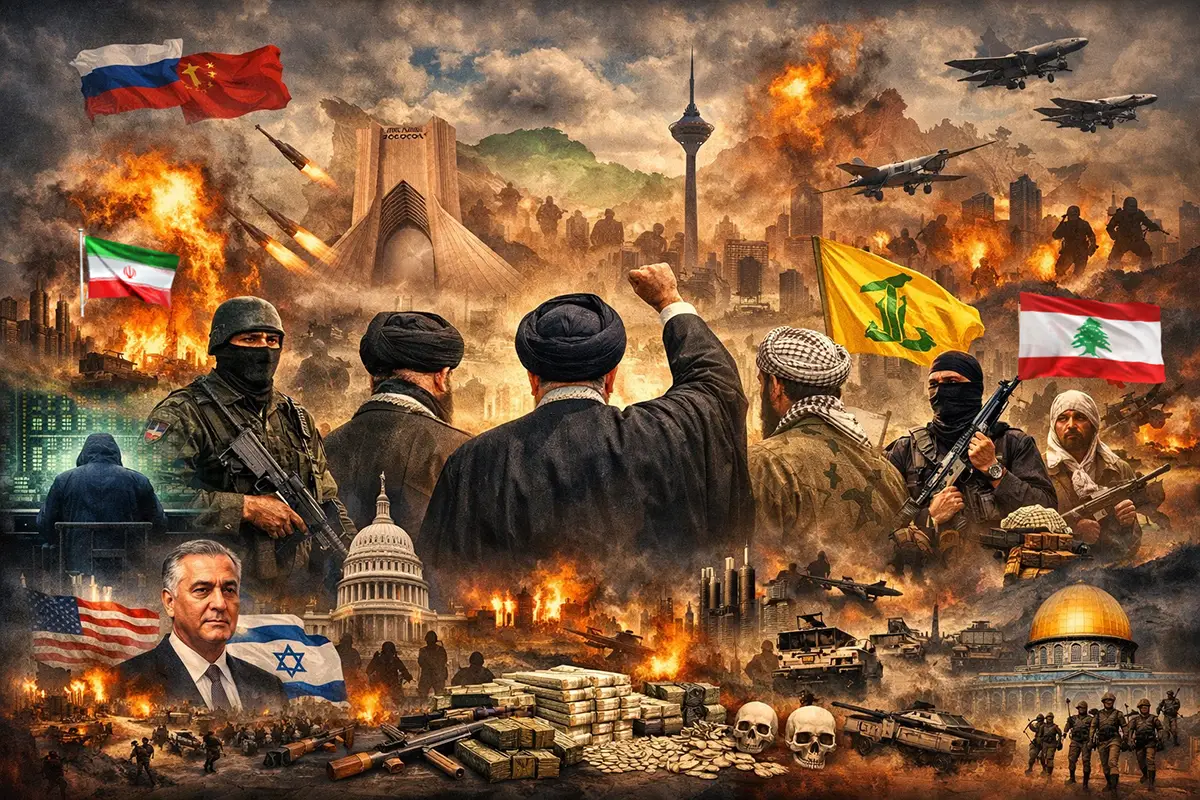
The modern Mad Mullah Movement was born in the fateful year of 1979. That year saw the so-called “Islamic Revolution” in Iran, a dramatic seizure of state power by clerical revolutionaries who promised moral renewal but delivered ideological absolutism. It also witnessed terrorists storming and hijacking Islam’s holiest sanctuary in Makkah, an unprecedented act of sacrilege that shocked the Muslim world.
Meanwhile, the Soviet Union invaded Afghanistan, triggering a joint U.S.-Saudi-Pakistan response in what came to be known as the Afghan Jihad. The mobilization of fighters, money, ideology, and global networks during that war would have consequences far beyond expelling Soviet troops. Jihadist empowerment became transnational. Armed mobilization became normalized. The region would never be the same.
Within a year, the Iran-Iraq War erupted, grinding on for eight years and costing over a million lives. Soon after, the Israel-Lebanon war ignited another front. In that crucible, a new militant actor emerged. The progenitor of Hezbollah – armed, trained, and financed by Tehran – would go on to conduct one of the deadliest terrorist attacks against U.S. forces, the 1983 Marine barracks bombing in Beirut, killing 241 American servicemen. The “Islamic Revolution” had not only reshaped Iran; it had exported a militant doctrine that fused clerical absolutism with proxy warfare.
Axis of Adversaries: Tehran, Moscow, Beijing
Over the decades, the Mullah Regime consolidated power internally while seeking strategic depth externally. Its anti-Western posture aligned it naturally with America’s principal geopolitical adversaries. Russia became its primary military partner, sharing battlefield coordination in Syria and technology transfers. China became its economic lifeline, investing in Iranian energy and infrastructure while offering diplomatic cover at the United Nations.
This axis did not stop at conventional geopolitics. Iran’s external security apparatus, particularly the Islamic Revolutionary Guard Corps (IRGC) and its Quds Force, cultivated relationships far beyond the Middle East. Tehran’s networks have been documented in parts of South America, where alliances with organized crime syndicates and cartels facilitated drug trafficking, money laundering, and human trafficking routes that extended into North America and Europe. They represented a strategic use of asymmetric tools, leveraging criminal enterprises to raise funds, build influence, and embed operational capabilities in distant theaters.
The Mullah Regime demonstrated a willingness to instrumentalize instability. Organized crime and illicit finance became another front in its hybrid warfare strategy, blurring the lines between ideological militancy and transnational criminality. Even in Muslim-majority states across the Middle East, Tehran-backed actors exploited sectarian grievances, promoted drug trafficking, and implemented corruption networks to expand influence.
The Architecture of Proxy Warfare
The development of the Mullah Regime’s proxy model is perhaps its most enduring legacy. Tehran recognized early that direct confrontation with superior conventional militaries would be costly. Instead, it cultivated non-state actors as force multipliers.
In Lebanon, Hezbollah evolved from a militant faction into a state-within-a-state, heavily armed and politically entrenched. In Yemen, Iranian support for Houthi insurgents enabled a sustained campaign that destabilized Saudi Arabia’s southern flank and threatened international shipping lanes. Across the Levant, Tehran-backed militias weaponized the Palestinian cause, transforming legitimate political grievances into platforms for terrorist violence.
One of the most controversial aspects of this networked strategy was Iran’s pragmatic relationship with Sunni jihadists. While ideologically at odds with Sunni extremism, Tehran recognized common enemies: the United States and what jihadists termed “apostate regimes” in the Gulf. Iran provided refuge and transit facilitation to senior Al Qaeda figures. Among them was a son of Osama bin Laden, who reportedly spent time under Iranian custody. The relationship was transactional, not theological. It underscored the Mullah Regime’s willingness to subordinate sectarian divides to strategic calculus.
This approach, allying tactically with ideological rivals, illustrates the regime’s core operating principle: anti-Western militancy above all else as if it’s the regime’s only reason for existing.
Syria, Iraq, and the Weaponization of Chaos
Nowhere was this principle more devastatingly applied than in Syria. When the Assad regime faced mass protests in 2011, Tehran intervened decisively. Iranian advisors, Hezbollah fighters, and a constellation of Shia militias flowed into the conflict. Russia’s subsequent intervention complemented Tehran’s ground operations with airpower. The result was catastrophic: over 600,000 Syrians killed and approximately 13 million displaced.
The refugee exodus destabilized neighboring countries and strained Europe’s political fabric. The flow of displaced Syrians, exacerbated by indiscriminate bombardment and siege tactics, became a geopolitical lever. Russia and Iran both facilitated social fractures within the European Union that followed.
In Iraq, the Mullah Regime’s influence had been entrenched for decades. Iranian-backed militia units, some integrated into official security structures, retained autonomous command-and-control channels. These forces provided Tehran with leverage over Baghdad and a latent capacity to mobilize against U.S. or allied interests if required. Iraq had become both a buffer zone and a strategic corridor linking Iran to Syria and Lebanon known as the Shia Crescent.
No more.
A Theocratic Project at Home and Abroad
Domestically, the Mullah Regime enshrined its governance model under the doctrine of Vilayet al-Faqih, Guardianship of the Jurist, positioning a supreme cleric as ultimate authority. The regime presents this as the apex of Islamic governance, akin in ambition to a Sunni caliphate model. It was in competition ideologically with Sunni Gulf monarchies and with Türkiye’s assertive Sunni political identity. This tripolar rivalry, Shia Iran, Sunni Gulf states, and Sunni Türkiye, shapes much of the Muslim world’s political landscape.
Yet the regime’s internal practices betray its moral claims. Compulsory hijab and chador laws are enforced with coercion, sexual torture in prisons and brutal crackdowns on dissent became normalized. Iranian dissidents abroad described intimidation campaigns and threats, including assassination attempts. Meanwhile, the same apparatus that polices women’s dress codes had been implicated in facilitating global drug trafficking and organized crime.
The regime sought to portray itself as the most authentically Islamic of governments, yet its actions often mirror the authoritarian excesses it condemns. Its model fuses clerical absolutism with intelligence-state repression, exporting instability while suppressing pluralism at home.
A Regional Reset
February 28, 2026, marked a decisive escalation: joint U.S.-Israel strikes hit key elements of Iran’s military infrastructure, missile sites, air defenses, and IRGC-related nodes, signaling that the confrontation with Tehran was no longer confined to the shadow war. The Mullah Regime’s response was immediate and deliberately regional: missiles and drones were launched not only toward Israel and U.S. assets, but into the Gulf: Bahrain, Kuwait, Qatar, Saudi Arabia, and the UAE, states whose sovereignty Tehran violated in order to impose costs, create fear, and fracture the coalition forming against it. Instead, the effect appears to be the opposite: Gulf governments publicly condemned the strikes on their territory and, having now been directly targeted, are newly galvanized against the regime’s doctrine of coercion-by-missile.
Tehran is promising a long war. Security professionals should translate that plainly: the Mullah Regime will look for endurance pathways that bypass conventional battlefield disadvantages. Some of that will be regional, proxy activation, militia pressure, and attempts to stress U.S. basing and logistics across the Gulf. Much will be asymmetric and deniable: cyber operations; targeted violence through recruited or coerced operatives abroad; and “messy” attacks designed to create public panic rather than military effect. Open-source reporting and expert commentary already point to Tehran’s likely turn toward cyber and allied networks as the conflict widens.
I have warned to expect cyberattacks and low-signature violence abroad and it will be more difficult for the remnants of the Regime to follow through. I suspect they may still try to go after soft targets, public venues, and symbolic locations. If the so-called “Islamic Revolution” sold itself as moral governance, February 28 shows what it has always been in practice: coercive theology married to an intelligence-state model that exported instability as strategy. Now that the Mullah Regime expanded the battlespace by striking Gulf neighbors directly, it has accelerated its demise. With the Supreme Leader reported killed, as well as much of the senior leadership, it will now rest with an unarmed Iranian public to “take over the government” while Reza Pahlavi mobilizes to be the new leader, promising a new era for the Persian people.
Today marks the end of the Mad Mullah Movement, and the region, the religion, and the world is better for it.