
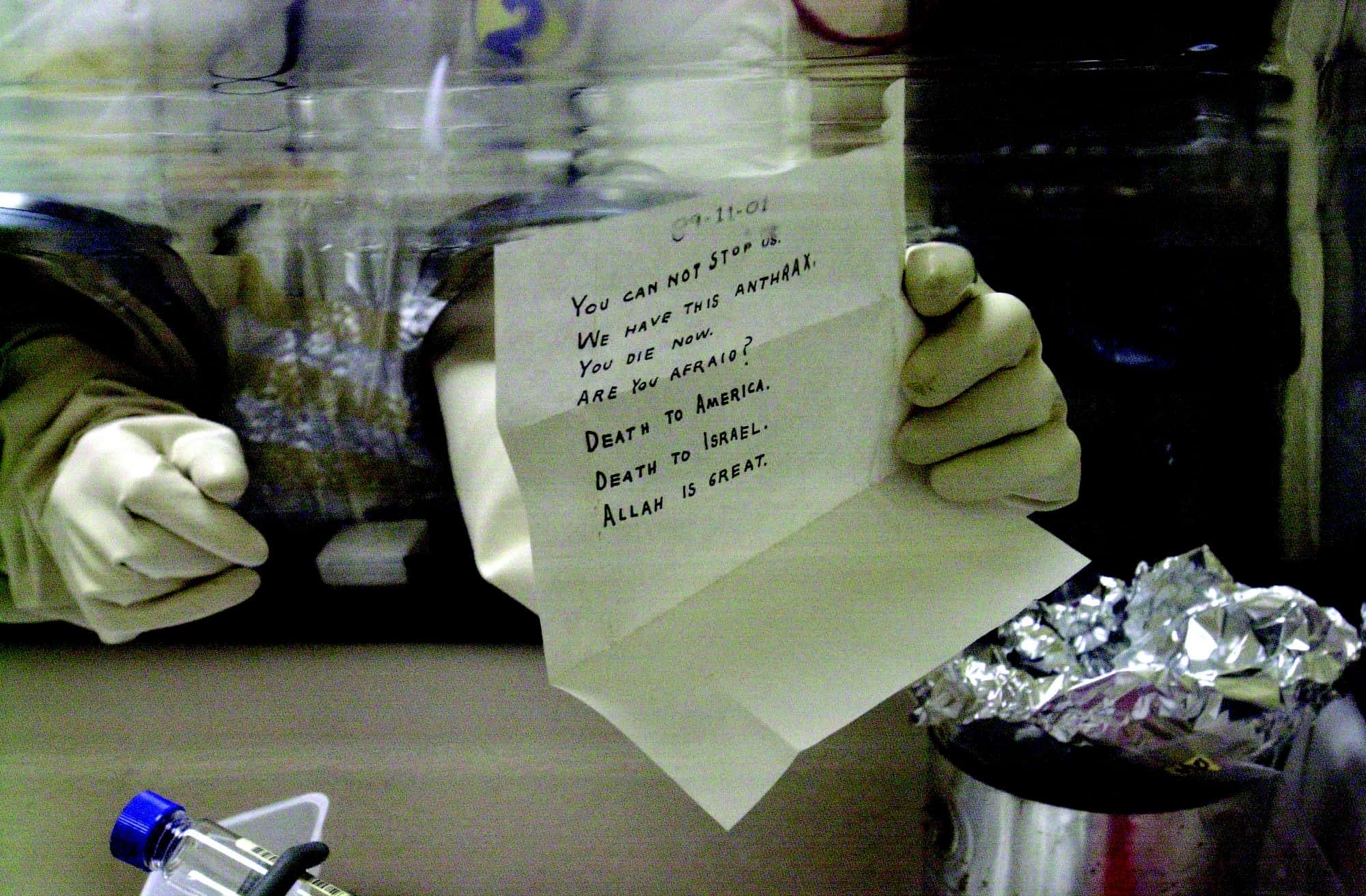
Twenty-four years ago, just one week after the September 11 attacks that forever changed the nation, a second wave of terror was beginning to take shape. This time in the form of bioterrorism, and it began unfolding through one of the most trusted institutions in American life: the U.S. Mail.
On September 18, 2001, the first anthrax-laced letter arrived at media outlets in New York and Florida, postmarked from Trenton, New Jersey. What followed was a campaign of terror that would claim five lives, sicken seventeen others, and fundamentally transform how the United States approaches biodefense and emergency preparedness.
The Unfolding Crisis
Initially thought to be sick with the flu when he visited a medical center on October 2, 2001, Robert Stevens, a tabloid photo editor at American Media, Inc. (the publisher of The Sun), shocked medical staff when diagnosed with pulmonary anthrax. Even when two of Stevens’ coworkers fell ill and anthrax spores were discovered throughout their workplace, the connection to terrorism hadn’t yet been made. On October 5, when it was announced that Robert Stevens had died, it was the first such case in the United States in 25 years.
The gravity of the situation only became clear when a similar pattern emerged in New York City and Washington, D.C., where victims had come into direct contact with letters containing a mysterious powder. Among the five people ultimately killed were two United States Postal Service employees: Thomas Morris, who died on October 21, and Joseph Curseen, Jr., who died the following day.
The Targets and the Toll
Four anthrax-laced letters were identified, each accompanied by threatening messages. The targets were carefully chosen for maximum psychological impact: U.S. Senators Tom Daschle and Patrick Leahy, NBC News anchor Tom Brokaw, and the New York Post. As these letters moved through the postal system’s automated sorting equipment, deadly spores escaped and spread throughout the facilities.
The two postal facilities – the Brentwood Postal Facility in Washington, D.C., and the Trenton Postal Distribution Center in New Jersey – bore the brunt of the contamination. Both facilities were shuttered for years during extensive decontamination efforts. When the Brentwood facility finally reopened, it was renamed the “Curseen-Morris Mail Processing and Distribution Center” in honor of the two postal workers who gave their lives.
In total, 22 people were infected with anthrax: 11 with the more dangerous inhalational form and 11 with cutaneous cases.
The Investigation
The response was unprecedented in scope and complexity. The U.S. Postal Inspection Service joined forces with Federal Bureau of Investigation (FBI) Special Agents to create the Amerithrax Task Force, launching what would become a nine-year investigation involving experts in microbiology, chemistry, and bio-weapons from government agencies, universities, and commercial laboratories.
The investigation’s scale was staggering: 10,000 witnesses interviewed across six continents, over 6,000 pieces of evidence recovered, 5,750 grand jury subpoenas issued, 5,730 environmental samples gathered from 60 locations, and more than 1,000 possible suspects scrutinized. The case finally closed in 2010 when investigators concluded that the attacks were the work of a single individual, Army scientist Bruce Ivins, who had taken his own life in 2008.
Lasting Changes
The anthrax attacks exposed critical vulnerabilities and spurred significant reforms. At the time, even experts didn’t fully understand how spores could spread through postal facilities and escape from sealed envelopes. The investigation led to crucial improvements: enhanced mail screening procedures, better intelligence gathering capabilities, and comprehensive training for thousands of Postal Inspectors.
Perhaps most importantly, Biohazard Detection Systems were installed in mail processing facilities across the United States and its territories. New investigative protocols and strategies were developed specifically to address biological threats.
The healthcare system also underwent dramatic changes. Before 2001, there was little formal coordination among hospitals and no dedicated strategy for responding to biological threats. The anthrax attacks prompted hospitals to develop comprehensive emergency operations plans covering scenarios from bioterrorism to pandemic influenza. National exercises were instituted to train top officials and first responders at federal, state, and local levels in coordinated responses to weapons of mass destruction attacks.
The Ongoing Challenge
As we mark this somber anniversary, experts continue to grapple with the lessons learned. Dr. Asha M. George, Executive Director of the Bipartisan Commission on Biodefense, has addressed the state of our nation’s biodefense initiatives here at Homeland Security Today, including the ongoing struggle to find direction and provide actionable steps to strengthen national biodefense in last week’s “U.S. Biodefense: Turning Chaos Into Opportunity.”
Jeffrey D. Simon, PhD, President of Political Risk Assessment Company, also has highlighted how the anthrax attacks exemplify the formidable challenge posed by lone-wolf terrorists. In Homeland Security Today’s 2025 Threat Forecast, he reminded readers that the novelty of using the postal system as a weapon of terror in 2001 should serve as a warning. Lone offenders will continue to seek innovative ways to perpetrate attacks.
Twenty-four years later, the anthrax letter attacks remain a stark reminder of America’s vulnerability to bioterrorism and the critical importance of preparedness. While the nation has made significant strides in biodefense capabilities, the threat continues to evolve, demanding constant vigilance and adaptation.