
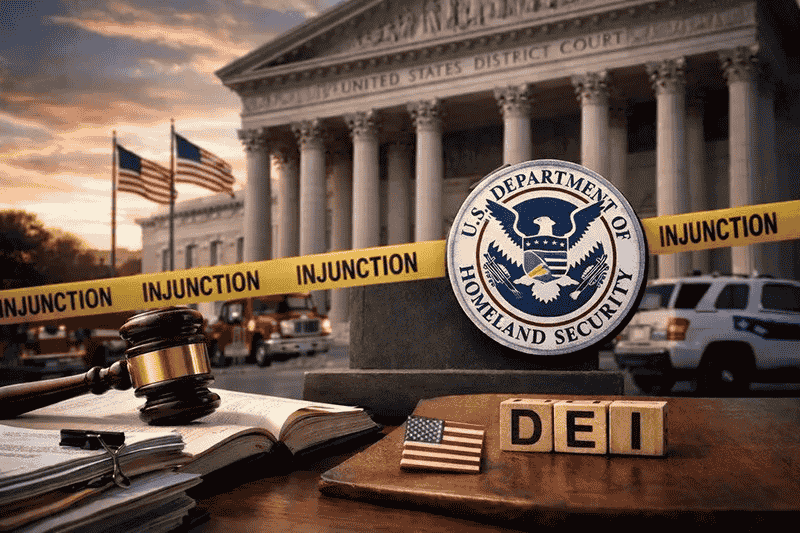
On November 21, 2025, federal judges in Chicago and California issued preliminary injunctions blocking the Department of Homeland Security (DHS) and Federal Emergency Management Agency (FEMA) from enforcing diversity, equity, and inclusion (DEI) certification requirements on homeland security grant recipients. These rulings provide immediate relief to state and local agencies facing uncertainty about compliance with ambiguous anti-DEI provisions while the cases proceed through the courts.
These grant programs have been authorized by Congress without any DEI provisions. They are critical to states, counties, and local agencies, including funding for fire departments, emergency management agencies, law enforcement, and critical infrastructure protection. For example, the National Association of Counties advised its members on June 20, 2024:
“On June 18 [2024] Congress took a significant step in supporting local fire departments across the nation by passing the Fire Grants and Safety Act (S. 870). Pending President Biden’s signature, final passage ensures the continuation and enhancement of the Assistance to Firefighters Grant (AFG) and Staffing for Adequate Fire and Emergency Response (SAFER) grant programs. These crucial programs, facing a statutory termination date of September 30, 2024, have now been extended to September 30, 2030…. For counties, the reauthorization of these grants is crucial. Without AFG and SAFER, local fire departments would lose approximately $700 million annually in federal assistance, which is indispensable for maintaining the safety and readiness of local fire services and the protection and well-being of county residents.” https://www.naco.org/news/congress-reauthorizes-critical-safer-and-afg-grants-until-2030
What Emergency Management Professionals Need to Know
The Contested DEI Certification Requirements
Based on two Presidential Executive Orders issued on January 20 and January 21, 2025, FEMA and other DHS agencies added new standard terms and conditions requiring all grant recipients to certify that:
(i) They do not, and will not during the term of this financial assistance award, operate any programs that advance or promote DEI, DEIA, or discriminatory equity ideology in violation of Federal anti-discrimination laws; and
(ii) They do not engage in and will not during the term of this award engage in, a discriminatory prohibited boycott.
Grant Programs Subject to Both Injunctions
- FEMA Emergency Management Performance Grant Program
- FEMA Homeland Security Grant Program
- FEMA Assistance to Firefighters Grant Program
- FEMA Staffing for Adequate Fire and Emergency Response (SAFER) Grant Program
- FEMA Fire Prevention and Safety Grants
- FEMA Hazard Mitigation Assistance Program
- FEMA Port Security Grant Program
- FEMA Transit Security Grant Program
- DHS Securing the Cities Grant Program
Chicago Injunction: U.S. District Court for Northern District of Illinois
Legal Background
On November 21, 2025, U.S. District Court Judge Manish S. Shah granted a preliminary injunction in a lawsuit brought by the cities of Chicago, Boston, New York, Baltimore, Minneapolis, New Haven, Connecticut, and Ramsey County, Minnesota.
Court’s Key Findings
Judge Shah acknowledged plaintiffs’ substantial concerns about the government’s unilateral interpretation of “illegal DEI.” The court wrote: “Plaintiffs make much of their fear that the government will unilaterally use its understanding of ‘illegal DEI’ to withhold money, or worse, penalize plaintiffs with False Claims Act lawsuits threatening treble damages…. The preliminary injunction does not order the payment of money that the government might not be able to recoup; it only limits the conditions DHS can impose on a grant.”
This reasoning highlights a critical concern: the risk of retroactive enforcement actions based on the government’s evolving interpretation of prohibited “DEI” activities, potentially exposing agencies to triple damages under the False Claims Act.
California Injunction: U.S. District Court for Northern District of California
Legal Background
Also on November 21, 2025, U.S. District Court Judge William H. Orrick issued a preliminary injunction in a lawsuit brought by San Francisco, numerous other California municipalities, and the City of Tucson, Arizona.
Court’s Rationale
Judge Orrick’s decision emphasized that the contested provisions fundamentally redefine long-established federal anti-discrimination standards. The court noted: “Plaintiffs have agreed to comply with federal antidiscrimination laws as a condition to their funding in the past. But they assert that ‘the federal government has now called the meaning of those laws in question by purporting to interpret them far differently than previously understood by Congress, the executive, or the courts – leaving it unclear what is expected under the terms.'”
The court found this ambiguity unacceptable and that “the balance of the equities and public interest favor granting plaintiffs’ request for injunctive relief.”
Scope of Relief Granted
Judge Orrick’s order specifically enjoins defendants and their agents from “directly or indirectly taking any action to withhold, freeze, or condition funds from the plaintiffs based on (1) Section C.XVII of the Standard DHS Terms (the ‘Discrimination Condition’); and (2) Section C.XXXI of the Standard DHS Terms (the ‘EO Condition’).”
Legal Support and Advocacy
According to court filings, the Public Rights Project, an Oakland, California-based organization, provided litigation support in both successful cases. The organization helps local government officials work with communities to protect and expand civil rights through litigation support, legal representation, and training.
Related Litigation
BRIC Program Protection (August 2025; December 2025)
On August 5, 2025, U.S. District Court Judge Richard G. Stearns of the District of Massachusetts issued an injunction prohibiting FEMA from terminating the Building Resilient Infrastructure and Communities (BRIC) pre-disaster mitigation program. The lawsuit was brought by 18 states and the order prevents FEMA “from spending the funds allocated to BRIC for non-BRIC purposes until the court is able to render a final judgment on the merits.”
Over the past four years, FEMA has selected nearly 2,000 BRIC projects to receive roughly $4.5 billion in funding nationwide. The program funds critical projects like constructing levees and floodwalls and generating backup electricity for hospitals and school districts during emergencies.
On December 11, 2025, Judge Stearns granted summary judgment to the states, holding: “In sum, this is not a case about judicial encroachment on the discretionary authority of the Executive Branch. This is a case about unlawful Executive encroachment on the prerogative of Congress to appropriate funds for a specific and compelling purpose, and no more than that.” The Court in its Order wrote: “The court vacates and sets aside the termination of the BRIC program pursuant to 5 U.S.C. § 706(2).”
Fourth Circuit Stays Nationwide DEI Injunction (March 2025)
On March 14, 2025, a three-judge panel of the United States Court of Appeals for the Fourth Circuit granted the government’s request to stay a nationwide preliminary injunction that had been issued by a Maryland district court. This means the broad nationwide protections from that case are currently not in effect, though the Chicago and California injunctions remain active in their respective jurisdictions.
The Maryland case was brought by the National Association of Diversity Officers in Higher Education, the American Association of University Professors, Restaurant Opportunities Centers United, and the City of Baltimore. U.S. District Court Judge Adam B. Abelson had issued a preliminary injunction on February 21, 2025, prohibiting federal agencies from pausing, freezing, or terminating awards based on the DEI Executive Orders.
Practical Implications for Grant Recipients
Immediate Actions for State and Local Agencies
Consult Legal Counsel: Before accepting any FEMA or DHS grants containing DEI certification requirements, agencies should consult with their legal counsel to understand jurisdiction-specific protections and potential risks.
Understand Geographic Scope: The Chicago and California injunctions provide clear protection to plaintiffs in those cases. Agencies in other jurisdictions should determine whether similar protections apply to them.
False Claims Act Risk: The preliminary injunctions do not prevent the U.S. Department of Justice from launching investigations for false certifications under the False Claims Act or other statutes. Agencies must carefully consider certification requirements in light of this continuing risk.
Document Internal Policies: Agencies should maintain clear documentation of their programs and policies to demonstrate compliance with federal anti-discrimination laws as traditionally understood.
Current Legal Status
It is critical to understand that preliminary injunctions represent temporary relief pending full resolution of the underlying cases. These orders can be stayed or overturned on appeal (as occurred with the Maryland nationwide injunction), modified as litigation proceeds, or dissolved if circumstances change.
The Public Rights Project has confirmed that the U.S. Government has not filed appeals in either case as of December 10, 2025.
Grant recipients should not assume these protections are permanent and should continue monitoring legal developments closely.
Congressional Intent for Fire Service Grants
The contested DEI provisions particularly affect firefighter assistance programs, which have strong bipartisan congressional support. When Congress reauthorized the Assistance to Firefighters Grant (AFG) and SAFER grant programs through fiscal year 2028 on July 9, 2024, the Congressional Fire Services Institute reflected on the program’s origins 25 years ago.
The Congressional Fire Services Caucus fought for two years to establish federal support for local fire departments, “affirming that the nation’s safety demands federal investment in the fire service.” President Bill Clinton signed the FIRE Act into law on October 30, 2000. This history underscores that fire service grants were created to support local fire departments in their life-saving mission, not to serve as vehicles for implementing executive branch policy initiatives unrelated to fire safety and emergency response.
Connection to Immigration-Related Grant Litigation
In September 2025, federal courts blocked similar attempts to condition the same homeland security grants on immigration enforcement cooperation. The legal principles established in those cases – requirements for clear standards, avoidance of unconstitutional coercion, and consistent agency action – appear to be influencing courts’ approach to DEI-related conditions.
Both sets of cases reflect a consistent judicial concern: emergency preparedness funding authorized by Congress for specific public safety purposes should not be converted into a mechanism for implementing unrelated executive branch policy initiatives without clear congressional authorization.
Broader Context: Grant Administration and Separation of Powers
These DEI-related cases raise important questions about the extent of executive branch authority to impose policy conditions on congressionally authorized grant programs:
- Can the executive branch unilaterally reinterpret federal anti-discrimination statutes in ways that substantially depart from decades of precedent?
- May the executive impose certification requirements so vague that grant recipients cannot determine compliance?
- Should emergency preparedness funding be conditioned on compliance with Executive Orders addressing domestic policy matters beyond the scope of the authorizing legislation?
- When funding conditions are unclear enough that recipients face potential False Claims Act liability for good-faith mistakes, do such conditions violate due process?
Federal courts are now weighing these questions, with outcomes that will shape grant administration across the federal government for years to come.
Conclusion
State and local communities should be able to access congressionally authorized FEMA and DHS grants without fear of retroactive enforcement actions based on ambiguous certification requirements. Congress created these grant programs – from firefighter assistance to emergency management performance grants to pre-disaster mitigation – for the benefit of all communities.
The preliminary injunctions issued in Chicago and California provide important immediate protections, but the ultimate resolution of these disputes remains uncertain. As litigation continues, emergency management professionals, fire departments, and other grant recipients must carefully navigate an uncertain legal landscape while continuing their essential missions of protecting communities and saving lives.
Regardless of one’s views on DEI policies, there is broad consensus that emergency preparedness funding should flow based on demonstrated need, capability gaps, and statutory criteria, not as leverage for implementing policy objectives unrelated to the core mission of protecting Americans from disasters and emergencies.
Resources and Further Information
Chicago case decision:
U.S. District Court, Northern District of Illinois ruling (PDF)
California case decision:
U.S. District Court, Northern District of California ruling (PDF)
BRIC case decision:
August 2025 Preliminary Injunction (PDF)
December 2025 Summary Judgment (PDF) – Kentucky
December 2025 Summary Judgment (PDF) – California
Public Rights Project:
www.publicrightsproject.org
FEMA grant programs:
FEMA.gov/grants
Congressional Fire Services Institute:
cfsi.org/legislation-advocacy
Co-authored with Megan Norris
This article provides information on recent legal developments affecting homeland security grant programs. Grant recipients should consult with their legal counsel and state administrative agencies for guidance specific to their circumstances.