

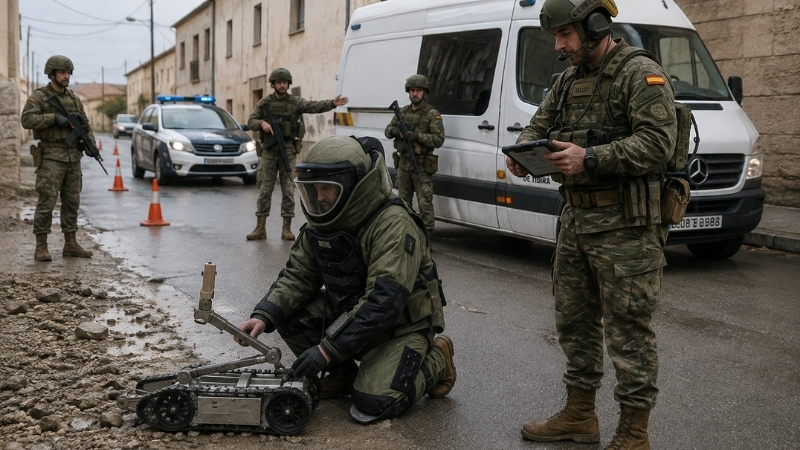
A new article in ASPIS Medical, a publication of Counter-Terrorism Medicine Europe (CTM-E), examines how secondary explosive and hazardous devices are used to target police, firefighters, paramedics, bomb disposal teams and civilians after an initial attack.
The piece, “Secondary Device Recognition: Threats to First Responders in Modern Terrorism and Insurgency,” was written by retired Brigadier General Ioannis Galatas and Hellenic Police Colonel Nikolaos Rallis. It defines a secondary device as an explosive or hazardous mechanism deliberately positioned to detonate after an initial incident, using the first blast to create confusion and draw responders into a concentrated area.
The authors explain that the tactic exploits predictable emergency procedures, crowd convergence and the urgency to reach casualties. Its wider purpose is not only to increase casualties but also to delay lifesaving intervention, undermine public confidence and create fear and hesitation among responders.
The article reviews the use of secondary devices and “double-tap” attacks. Examples include follow-on explosives placed near evacuation routes, delayed devices intended to target investigators and bomb technicians, and subsequent strikes reported while emergency personnel were assisting victims.
It also notes that chemical components have occasionally been combined with explosives, including chlorine vehicle bombs used in Iraq. However, the authors say verified examples involving biological agents are difficult to identify in the available literature.
For emergency services, the article emphasizes controlled scene stabilization, layered security perimeters, visual sweeps, remote observation, bomb detection resources and managed casualty extraction. Responders must balance the urgency of medical treatment against the risk that premature entry could expose additional personnel to a follow-on attack.
The authors also examine the psychological burden placed on bomb disposal personnel and other responders, including hypervigilance, decision fatigue, sleep disruption and post-traumatic stress. They argue that training, rest cycles, mental health support and reliable communications are important parts of sustaining operational performance.
The article, beginning on page 41 of the July 2026 issue, concludes that secondary-device recognition is now an essential part of emergency-response doctrine and should be understood as a broader approach to operational caution, situational awareness and coordinated scene management rather than only a technical bomb-disposal skill.