

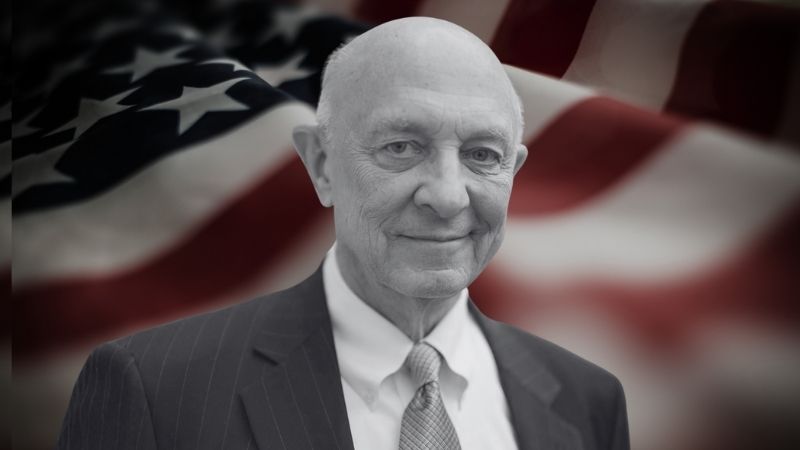
Former Director of Central Intelligence R. James Woolsey Jr., who led the CIA as the U.S. intelligence community adjusted to the end of the Cold War, died July 21 at his home in Washington, D.C. He was 84.
His wife, Conchita Sarnoff Woolsey, said the cause was a stroke.
Woolsey served as the 16th Director of Central Intelligence from February 5, 1993, to January 10, 1995, under President Bill Clinton. In that position, he led the CIA and coordinated the broader U.S. intelligence community during a period when agencies were shifting their attention from the Soviet Union toward terrorism, weapons proliferation, regional conflict and other emerging threats.
Born in Tulsa, Oklahoma, on September 21, 1941, Woolsey graduated from Stanford University in 1963 and studied at the University of Oxford as a Rhodes Scholar. He later attended Yale Law School, where he served as managing editor of the Yale Law Journal before graduating in 1968.
Woolsey began his government career working on arms control issues and served as general counsel to the Senate Armed Services Committee. He later became Under Secretary of the Navy during the Carter administration and held negotiating and advisory roles involving strategic and conventional arms reduction under both Democratic and Republican presidents.
Outside government, Woolsey remained active in national security, foreign policy and energy security organizations. His work included senior and advisory roles with Booz Allen Hamilton, the Foundation for Defense of Democracies, Freedom House, the Jamestown Foundation and the United States Energy Security Council. He also continued writing and participating in intelligence and defense policy debates, including as co-author of the 2021 book Operation Dragon.
Woolsey’s career spanned intelligence, defense policy, diplomacy, law and energy security, with government service that extended from Cold War arms negotiations through the post-Cold War transformation of the U.S. intelligence community.