


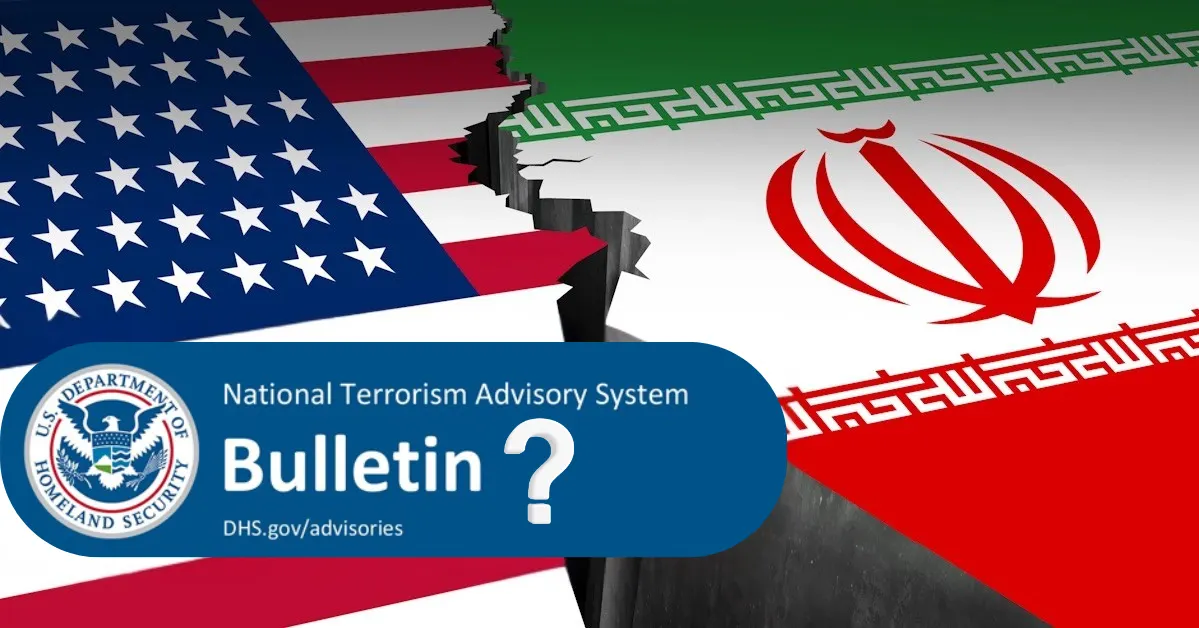
Operation Epic Fury, the joint U.S.-Israeli military operation targeting key elements of Iran’s internal security apparatus, entered its second day on March 1, 2026, and the Department of Homeland Security has still not issued a National Terrorism Advisory System (NTAS) alert.
The operation launched in the early hours of February 28, 2026, marking a sharp escalation in direct military action against the Iranian regime. Yet, as the threat of retaliation grows with each passing hour, the American public has received no formal terrorism warning from DHS, the FBI, or the National Counterterrorism Center.
That silence is becoming harder to explain and harder to justify.
In June 2025, following U.S. and Israeli strikes on Iranian nuclear facilities—known as Operation Midnight Hammer—DHS issued an NTAS bulletin warning of a heightened threat environment driven by expected Iranian retaliation. NTAS exists to provide timely, actionable information to the American public when terrorism‑related threats increase. That alert was grounded in well‑established concerns that Iran or its proxies could respond asymmetrically, including through actions affecting the U.S. homeland.
Today’s operation presents comparable—if not greater—risk.
Operation Epic Fury and the Retaliation Risk
Public reporting indicates that Operation Epic Fury is intended to dismantle key elements of the Iranian regime’s internal security apparatus. While analysts differ on whether such actions could accelerate broader regime destabilization, there is little disagreement that the operation sharply raises the likelihood of retaliation.
When a regime’s leadership, legitimacy, and survival are placed at risk, the incentive to respond through asymmetric means increases substantially. Iran has a long history of employing indirect and deniable methods—including proxy actors, cyber operations, and clandestine networks—to impose costs on adversaries while avoiding conventional escalation.
Despite this elevated threat environment, no updated NTAS bulletin has been issued as of this writing. Neither the Federal Bureau of Investigation (FBI) nor the National Counterterrorism Center (NCTC) has released public advisories addressing potential homeland threats tied to the operation.
The DHS Funding Gap Is Not a Sufficient Explanation
The NTAS website currently displays a notice stating that, due to a lapse in federal funding, the site is not being actively managed and has not been updated since February 17, 2026. DHS further notes that information may not be current until appropriations are enacted.
Even so, the absence of public counterterrorism warnings during an active international conflict raises serious policy and priority concerns. Threat communication has long been treated as an essential national security function, particularly during periods of heightened geopolitical tension. The idea that such warnings could be suspended during a partial government shutdown undermines public confidence, awareness and operational readiness.
At minimum, this situation underscores the need for Congress to restore full DHS funding without delay. The American public—and the security professionals who protect it—require timely, authoritative information during moments of increased risk.
Sleeper Cells and the Homeland Threat Environment
Concerns about retaliation are not theoretical. Following last year’s strikes on Iran, senior U.S. officials warned publicly about the potential presence of Iranian sleeper cells operating inside the United States. Sleeper cells consist of foreign actors who maintain low profiles while preparing to conduct attacks against pre‑planned targets or targets of opportunity once activated by external handlers.
In a memo reported by multiple news outlets, U.S. Customs and Border Protection Commissioner Rodney Scott warned that thousands of Iranian nationals had been documented entering the United States illegally during the previous administration, with additional unknown “got‑aways” whose identities and intentions remain unresolved. While presence alone does not equate to imminent action, the operational uncertainty such gaps create is a legitimate homeland security concern.
Iranian sleeper cells are not the only risk factor. Recent U.S. actions against Venezuelan interests and Mexican cartels, along with the possibility of regime instability in Cuba, have aligned several U.S. adversaries around a shared objective: survival through asymmetric retaliation. These actors possess both the capability and the motivation to conduct kinetic and non‑kinetic attacks designed to create disruption, fear, and political pressure.
Likely Targets and Required Focus
Iranian, Cuban, and cartel‑linked operatives bring diverse skill sets, including experience with explosives, improvised explosive devices, drones, small arms, sabotage, subversion, and cyber operations. High‑probability targets include mass transit systems, entertainment venues, major places of worship, government buildings, schools, and critical infrastructure facilities. Prominent political figures, civic leaders, and industry executives also remain attractive targets.
Individually, these actors pose serious challenges. In combination—or through informal cooperation—their ability to disrupt daily life in the United States could be significant.
What Needs to Happen Now
This threat environment demands immediate coordination across federal, state, and local law enforcement agencies, as well as private‑sector security and protective services. DHS, the FBI, and NCTC should promptly update and reissue the June 2025 NTAS bulletin to reflect the current risk landscape associated with military operations in Iran.
Public vigilance, informed by timely and credible government warnings, remains a critical layer of national resilience. Major metropolitan counterterrorism units should prioritize detection and prevention efforts focused on both kinetic and non‑kinetic threats to key infrastructure and public gathering places.
This is an all‑hands‑on‑deck moment. Institutional silence is not a strategy. Clear communication, decisive leadership, and sustained coordination are essential to protecting lives and maintaining public trust during a period of extraordinary global risk.