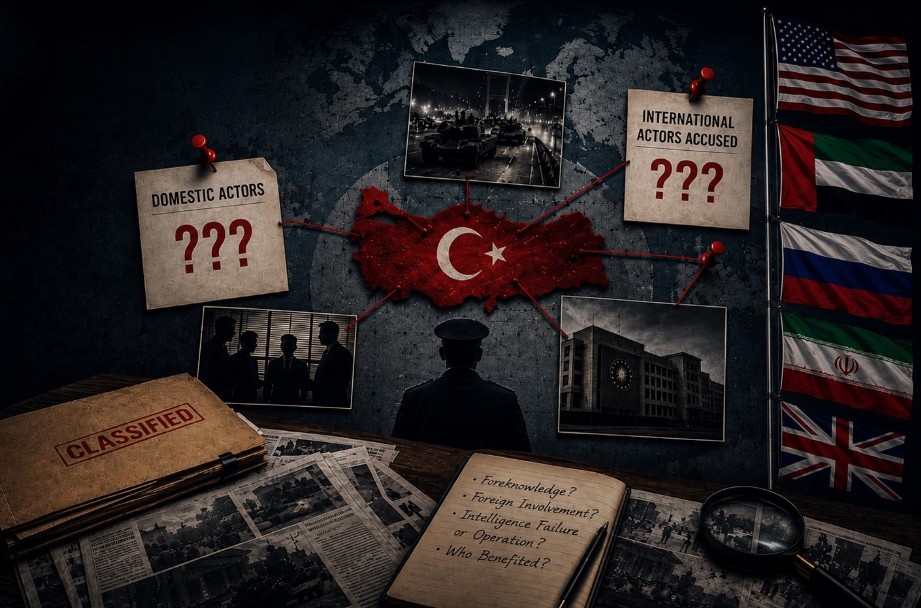
Ten years after the July 15 coup attempt, perhaps no question remains more controversial than who was ultimately responsible. In the immediate aftermath of the events, the Turkish government quickly identified the perpetrators, accusing the Gülen movement of orchestrating the operation through a network of military officers and civilian operatives. At the same time, the scope of responsibility expanded beyond Türkiye’s borders as allegations emerged involving foreign governments, intelligence agencies, academics, and regional rivals. Yet, despite years of judicial proceedings, extensive indictments, and persistent public debate, important inconsistencies and unanswered questions continue to surround these accusations.
As the second installment of this three-part series (read Part I here) built around ten questions and ten analytical answers, this article addresses two of the most contentious issues surrounding July 15: who were the domestic actors allegedly responsible for the coup attempt, and which international actors were accused of supporting, facilitating, or benefiting from it? By examining the evidence presented, the responses of those accused, and the contradictions embedded within competing narratives, this article explores why the search for responsibility remains unfinished and why the question of who stood behind July 15 continues to divide scholars, policymakers, and Turkish society.
Question 5. Who Were the Domestic Actors Allegedly Responsible for the Coup Attempt?
According to the AKP government, the primary domestic actors behind the July 15, 2016 coup attempt were members of the Gülen movement. From the first hours of the coup attempt, government officials and pro-government media outlets asserted that the operation had been directed by Fethullah Gülen from the United States and coordinated within Türkiye by Adil Öksüz, an academic who was portrayed as one of the movement’s most senior civilian operatives. Official investigations, indictments, and state media reports identified a network of military officers, civilians, former police officials, and alleged Gülen-affiliated actors as participants in the planning and execution of the operation.
The government’s case rested on several categories of evidence. Prosecutors cited witness testimonies, confessions from detained military officers, flight records, digital communications, security camera footage, and court findings. According to official accounts, Adil Öksüz and other alleged Gülenist civilians held planning meetings in Ankara prior to the coup attempt and maintained communication with Fethullah Gülen. Authorities also pointed to Öksüz’s travel records, including visits to the United States shortly before July 15, as evidence of coordination. Additional evidence included encrypted WhatsApp communications among military personnel, testimony from officers involved in the coup attempt, and footage allegedly showing civilian figures exercising authority at Akıncı Air Base, which served as the operational center of the coup. Based on these materials, the government concluded that the coup attempt was a centrally coordinated operation directed by the Gülen movement.
Fethullah Gülen consistently rejected these allegations. In interviews with international media, he denied ordering, planning, or supporting any effort to overthrow the government. Gülen described claims linking him to the coup as politically motivated and argued that an independent international commission should investigate the events. He maintained that if any individuals associated with his movement participated in the coup attempt, they acted independently and in violation of the movement’s principles. Gülen further stated that he would accept the findings of a genuinely impartial international inquiry and reiterated his opposition to military interventions against elected governments.
Among all individuals accused by the government, Adil Öksüz remains the most controversial figure. Officially presented as a central coordinator of the coup attempt, he was detained near Akıncı Air Base on July 16, 2016. Despite being identified by authorities as one of the most important civilian suspects, he was released two days later by a court that found he posed no flight risk. His release stood in stark contrast to the treatment of thousands of other suspects who remained in detention for extended periods. Öksüz subsequently disappeared and has never been apprehended. The circumstances surrounding his release generated widespread suspicion across the political spectrum. The AKP government seemed reluctant to bring him before the courts. Opposition politicians, journalists, and former officials questioned how an individual portrayed as a key organizer could be allowed to walk free. Additional controversies stemmed from reports that senior government figures visited him while he was in custody, allegations that he may have had intelligence connections, and the absence of publicly available forensic evidence conclusively placing him at the center of the operation. These unresolved questions have continued to fuel debate about both Öksüz’s role and the broader credibility of the government’s narrative.
Another prominent figure in the government’s narrative was former Air Force Commander General Akın Öztürk, who prosecutors portrayed as a principal military leader of the coup attempt and a senior member of the so-called Peace at Home Council. His presence at Akıncı Air Base, widely regarded as the operational center of the coup attempt, was cited as key evidence of his involvement. However, Öztürk consistently denied participating in the coup and maintained that he had gone to the base at the request of Chief of General Staff Hulusi Akar to persuade those involved to abandon the operation. According to his testimony, he spent the night attempting to de-escalate the situation, communicating with senior commanders, and assisting in the release of military officials held at the base. His defense was partially supported by accounts indicating that Air Force Commander Abidin Ünal instructed him by telephone to proceed to Akıncı Air Base and assume control of the situation. Despite these claims, Turkish courts identified Öztürk as one of the coup’s central figures and sentenced him to aggravated life imprisonment. The case nevertheless remained controversial. Critics pointed to the absence of publicly available evidence directly linking him to operational decision-making, the failure of key witnesses such as Hulusi Akar and Yaşar Güler to testify in court, allegations of torture during detention, and the withholding of potentially relevant surveillance footage. These controversies intensified in August 2024, when the United Nations Working Group on Arbitrary Detention concluded that Öztürk’s imprisonment lacked a sufficient legal basis and called for his release. As a result, while the Turkish government continued to portray him as the leading military architect of the coup attempt, his case remains one of the most disputed aspects of the post–July 15 prosecutions.
The government’s narrative identified three principal domestic actors: Fethullah Gülen as the alleged mastermind, Adil Öksüz as the alleged civilian coordinator, and Akın Öztürk as the alleged military leader. Yet significant questions remained about the evidentiary basis for these claims, particularly given the unresolved circumstances surrounding Öksüz’s release, the controversies surrounding Öztürk’s prosecution, and the continued absence of a fully transparent account of how the alleged civilian and military components of the coup were coordinated. These unresolved issues continue to shape debates over responsibility for July 15 nearly a decade later.
Question 6. Who Were the International Actors Allegedly Responsible for the Coup Attempt?
Beyond domestic actors, the July 15 coup attempt quickly took on an international dimension. In the aftermath, the AKP government and various political commentators alleged that several foreign states had either supported, financed, had prior knowledge of, or benefited from the attempted coup. These accusations reflected Türkiye’s broader geopolitical rivalries and domestic political dynamics, often extending beyond the publicly available evidence. Although no definitive proof has emerged linking any foreign government directly to the events of July 15, allegations involving the United States, the United Arab Emirates, Iran, Russia, and the United Kingdom became central to competing narratives surrounding the coup attempt and its aftermath.
United States
Among foreign actors, the United States occupied a central place in the AKP government’s narrative following the July 15 coup attempt. Government officials and pro-government commentators frequently argued that the coup could not have occurred without at least the knowledge, if not the support, of elements within the United States. In the immediate aftermath of the events, segments of the Turkish media closely aligned with the government portrayed the U.S. Central Intelligence Agency (CIA) and American academic Henri Barkey as key figures behind the coup plot, despite the absence of publicly available evidence substantiating these claims. Then-Minister of the Interior Süleyman Soylu went even further by directly accusing the United States of responsibility for the coup attempt, stating publicly that “America is behind the July 15 coup.” These allegations became a recurring theme in the post-coup discourse and contributed to growing anti-American sentiment within Türkiye. The claims were also reinforced by Fethullah Gülen’s residence in Pennsylvania, where he lived from 1999 until his death in 2024. Turkish authorities repeatedly demanded Gülen’s extradition, arguing that he directed the coup attempt from U.S. territory. Additional suspicion was directed toward American military personnel stationed at Incirlik Air Base, particularly after some Turkish officers assigned to the base were accused of involvement in the coup attempt.
Despite these allegations, neither Turkish courts nor international investigations produced conclusive evidence demonstrating direct involvement by the U.S. government in planning or supporting the coup. American officials consistently condemned the coup attempt and expressed support for Türkiye’s elected government. Successive U.S. administrations rejected accusations of involvement and maintained that extradition requests regarding Gülen would be evaluated according to legal and judicial standards rather than political considerations. As a result, while the United States became one of the most frequently accused foreign actors in public discourse after July 15, allegations of direct U.S. involvement remain unproven.
This skepticism was echoed by a CIA officer stationed in Türkiye during the coup attempt, who questioned both the operational logic of the events and the allegations directed at Washington. According to the officer, “The Turkish military is well-trained, well-experienced in coups, and has advanced weapons. It would not have closed just one lane of the Bosphorus Bridge and called that a coup.’ He further argued that the Turkish government failed to provide legal evidence meeting U.S. judicial standards for Gülen’s extradition, saying, “From a legal standpoint, the Turkish government did not present the United States with any shred of legal evidence that proves Gülen was involved in the alleged coup attempt. Most of the documents presented would not stand a chance in any court of law. The documents were filled with emotional tirades and assumptions, which would not have been enough to indict Gulen, let alone extradited to Turkiye.” He maintained that accusations of direct American involvement were “amateurish and baseless.” In his assessment, a destabilized Türkiye would have undermined U.S. strategic interests, particularly given the ongoing conflicts in Syria, the threat posed by ISIS, PKK violence within Türkiye, and the importance of NATO cooperation. While this perspective reflects the views of a single intelligence professional rather than an official U.S. position, it illustrates why many Western observers remained unconvinced by claims that Washington orchestrated or supported the coup attempt.
United Arab Emirates
The United Arab Emirates (UAE) was among the foreign actors most frequently accused by the AKP government of involvement in the July 15 coup attempt. According to Turkish officials and pro-government media outlets, the UAE allegedly provided financial support for anti-government activities and participated in information operations aimed at undermining President Erdoğan’s administration. Although no court ruling or publicly available investigation produced conclusive evidence linking the UAE to the coup attempt, Turkish authorities pointed to several circumstantial indicators. These included reports published by UAE-linked media outlets that were highly critical of the AKP government, claims that some regional media prematurely announced the success of the coup attempt, and allegations regarding the activities of Mohammed Dahlan, a Palestinian political figure with close ties to Abu Dhabi. As a result, pro-government circles increasingly portrayed the UAE as a key external sponsor of anti-Erdoğan initiatives in the region.
The allegations intensified in the years following the coup attempt. Then-Minister of the Interior Süleyman Soylu publicly described the UAE as one of the principal actors behind July 15 and referred to it as a financial backer of the operation. Pro-government commentators also highlighted alleged contacts between Mohammed Dahlan, individuals associated with the Gülen movement, and U.S.-based policy organizations critical of Türkiye, particularly the Foundation for Defense of Democracies (FDD). However, these claims were never substantiated through formal judicial proceedings, and no publicly available evidence demonstrated direct UAE participation in planning or executing the coup attempt. Moreover, the subsequent normalization of relations between Ankara and Abu Dhabi—including President Erdoğan’s official visit to the UAE in 2022 and the rapid expansion of economic and diplomatic cooperation—significantly reduced the prominence of these accusations.
Iran
Iran occupies a unique place among the foreign actors discussed in relation to the July 15 coup attempt. Unlike the United States and the United Arab Emirates, which AKP officials accused of supporting or facilitating the coup, Iran was generally portrayed as actively supporting the Erdoğan government during the crisis. Nevertheless, Iran’s long history of political, ideological, and intelligence activities in Türkiye has led some analysts to question whether Tehran had prior knowledge of the events or exerted influence over key developments surrounding the coup attempt. Historically, Iran has maintained extensive networks inside Türkiye, particularly through political movements associated with Necmettin Erbakan’s Islamist tradition. During the 1990s, Iranian authorities reportedly provided financial support to elements within the Welfare Party (Refah Partisi) and later the Virtue Party (FP). Iran was also linked to several covert activities in Türkiye, including support for Turkish Hezbollah and the activities of the Salam Tawhid Quds Force network, which Turkish authorities accused of conducting espionage operations and cultivating influence among politicians and bureaucrats. These historical precedents have contributed to ongoing debates regarding the extent of Iran’s influence within Turkish political and security circles.
During the night of July 15, Iranian officials were among the first foreign actors to express support for the Erdoğan government. Iranian Foreign Minister Javad Zarif reportedly maintained direct communication with Turkish authorities throughout the night, while senior Iranian officials, including Ali Shamkhani and Revolutionary Guard commander Qassem Soleimani, were described by some sources as closely monitoring developments and offering assistance. In subsequent years, pro-Iranian figures claimed that Soleimani played an important role in helping ensure the coup’s failure. Nurettin Şirin, a controversial figure associated with Iranian-aligned media, went so far as to state that “whoever did anything to stop the July 15 coup, Qassem Soleimani did even more.” Additional speculation emerged from reports that some officials allegedly considered fleeing to Iran during the coup attempt and from discussions regarding Iran’s close contacts with certain political and military actors after July 15.
Russia
Russia became one of the most discussed foreign actors in the aftermath of the July 15 coup attempt, though, unlike the United States and the United Arab Emirates, it was generally not accused by the AKP government of organizing or supporting the plot. Instead, Moscow was portrayed as one of the first major powers to condemn the coup attempt and to express support for the Erdoğan government. Nevertheless, questions arose about whether Russian intelligence had prior knowledge of the events. These suspicions were fueled by reports that Russian officials may have warned Turkish authorities before July 15 and by claims that contingency plans existed to facilitate President Erdoğan’s escape if the coup succeeded. The broader geopolitical context also contributed to these discussions. Following years of tension over Syria and the 2015 downing of a Russian military aircraft, Ankara and Moscow had begun repairing relations, creating an environment in which intelligence cooperation and political coordination became increasingly plausible.
Much of the speculation regarding Russia’s foreknowledge centers on Aleksandr Dugin, a Russian political theorist often described as an informal channel of Kremlin geopolitical thinking. Dugin claimed that during a visit to Türkiye on July 14, 2016, he warned Turkish contacts that a military intervention against Erdoğan was being prepared. According to his account, he met with various political figures, military contacts, and Eurasianist circles and conveyed information suggesting that a coup was possible. Russian officials later emphasized Moscow’s support for the Turkish government, while President Vladimir Putin publicly condemned attempts to interfere in the internal affairs of sovereign states. Putin also noted that if Fethullah Gülen had indeed been involved in the coup attempt, it would be difficult to imagine that American intelligence agencies were completely unaware of such activities. Despite these statements, no publicly available evidence demonstrates that Russia participated in planning, financing, or directing the coup attempt. Rather, the available evidence suggests that Moscow closely monitored developments, may have possessed advance intelligence regarding instability within the Turkish military, and ultimately viewed the survival of the Erdoğan government as beneficial to Russian strategic interests.
United Kingdom
The United Kingdom adopted a comparatively cautious yet supportive position toward the Turkish government following the July 15 coup attempt. Unlike the United States and the United Arab Emirates, the UK was not accused by Turkish authorities of directly participating in the plot. Instead, attention focused on the unusually clear statements made by British diplomats regarding responsibility for the coup attempt. Shortly after the events, the British Ambassador to Ankara, Richard Moore, publicly stated that, in his view, the Gülen movement was behind the coup attempt. While emphasizing that the United Kingdom had not formally designated the movement as a terrorist organization—a determination requiring a legal process—Moore argued that the evidence available to him pointed to Gülenist involvement. His remarks were widely cited by Turkish officials and pro-government media as international validation of Ankara’s position regarding the identity of the perpetrators.
A similar perspective was later expressed by former British Ambassador Peter Westmacott in his 2021 memoir, They Call It Diplomacy: Forty Years of Representing Britain Abroad. Reflecting on tensions surrounding the Gülen movement before July 15, Westmacott noted that he had warned American officials that Gülen-affiliated networks were damaging the United States’ image in Türkiye. At the same time, he rejected claims that Washington had orchestrated the coup attempt, calling them unfounded. The British position, therefore, differed from that of many Western governments and intelligence services, which generally refrained from publicly endorsing Ankara’s interpretation of events because of limited transparency about the coup’s organization and the evidence presented afterward. While no credible evidence has ever linked the United Kingdom to planning, financing, or supporting the coup attempt, the willingness of prominent British diplomats to publicly endorse the view that Gülenist actors were responsible led some observers to question whether London possessed information not publicly disclosed. Consequently, the United Kingdom occupies a distinctive place in the international debate surrounding July 15, not as an alleged participant, but as one of the few Western actors that openly expressed confidence in the Turkish government’s attribution of responsibility.
As a whole, the allegations against domestic and international actors reveal both the breadth of the official narrative and its unresolved contradictions. The AKP government accused domestic figures such as Fethullah Gülen, Adil Öksüz, Akın Öztürk, and numerous military officers of orchestrating the coup attempt, while also pointing to foreign actors, including Henri Barkey, the United States, and the United Arab Emirates, as external supporters or facilitators. Yet fundamental questions remain about how these diverse domestic and international actors allegedly coordinated such a complex operation and why publicly available evidence has failed to clearly establish these connections. Adding to these uncertainties, a 2024 Turkish court ruling reportedly concluded that no comprehensive coup plan could be identified in the evidence presented to it. Ten years later, the challenge is therefore not merely determining who was responsible for July 15, but understanding why competing explanations continue to leave critical gaps in the historical record.
If Part I explored what happened on the night of July 15 and Part II examined who was blamed for it, Part III turns to a different but equally important question: what did July 15 do to Türkiye? Regardless of where responsibility ultimately lies, there is far less disagreement about the profound consequences that followed. The coup attempt and its aftermath reshaped the military, transformed the country’s political and media landscape, extended repression beyond Türkiye’s borders, and accelerated a process of democratic erosion whose effects continue to shape Turkish society a decade later.