
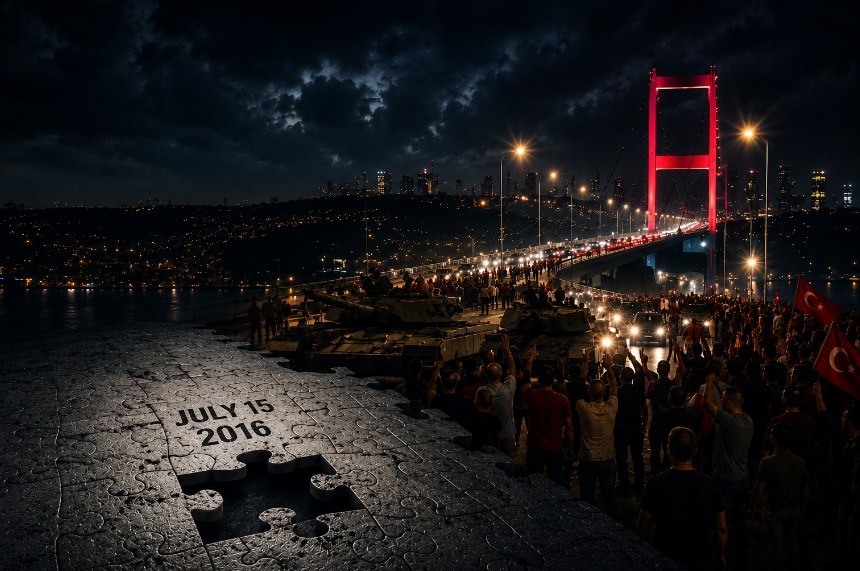
On the night of July 15, 2016, Türkiye witnessed one of the most consequential and controversial events in its modern history. Tanks rolled onto the streets of Ankara and Istanbul, fighter jets flew low over major cities, parliament was bombed, and more than 250 people lost their lives. Yet, ten years later, the most fundamental questions surrounding that night remain unresolved. Was it a genuine coup attempt? Was it a controlled operation, an intelligence failure, a staged intervention, or a crisis that was strategically exploited by those in power? Despite thousands of investigations, numerous court proceedings, and an extensive body of literature, there is still no broad consensus regarding the origins, organization, and meaning of July 15.
Marking the tenth anniversary of the July 15 coup attempt, this three-part series revisits Türkiye’s most contested political crisis through ten enduring questions and ten analytical answers. The first installment addresses four questions about the events themselves: how July 15 should be classified, how it differed from previous coups in Türkiye and beyond, whether it was preceded by strategic preparations and foreknowledge, and how post-coup narratives and knowledge production emerged with remarkable speed. Rather than claiming to resolve every controversy, this article seeks to explain why July 15 remains one of the most disputed episodes in contemporary Turkish history and why the struggle to define what happened that night continues to shape public memory a decade later.
Question 1. What Was July 15? Coup, Staged Coup, Intelligence Operation, or Something Else?
The events in Türkiye on July 15, 2016, have been described in markedly different ways by political actors, journalists, scholars, and participants. The ruling Justice and Development Party (AKP) characterized the incident as a military coup orchestrated by followers of Fethullah Gülen. Kemal Kılıçdaroğlu, then leader of the main opposition Republican People’s Party (CHP), controversially called it a “controlled coup.” Then-U.S. Vice President Joe Biden said he watched the events unfold “like a video game” from Washington. Then-Prime Minister Binali Yıldırım described the operation as a “project” that the AKP government had mishandled and clumsily executed. Selahattin Demirtaş, then co-chair of the Peoples’ Democratic Party (HDP), argued that President Erdoğan had prior knowledge of the plot and was prepared to capitalize on its consequences. Meanwhile, many military officers prosecuted as participants claimed the events were the product of an intelligence operation, while others described them as a “staged coup.”
To determine whether July 15 qualifies as a coup or a coup attempt, it is useful to turn to the academic literature. The Center for Systemic Peace (CSP) defines a coup as “a forceful seizure of executive authority and office by a dissident or opposition faction within the country’s ruling elites that results in a substantial change in executive leadership and policies.” This definition excludes social revolutions, foreign military interventions, natural transitions of power, and so-called presidential coups. Other datasets employ broader criteria. For example, the Cline Center at the University of Illinois defines coups as organized efforts to remove executive authority or displace the highest levels of government through sudden and irregular means. Many scholars further emphasize that coup perpetrators are typically members of the state apparatus, particularly military officers or government elites, acting outside constitutional procedures.
Based on these comparative datasets and coding criteria, the events of July 15 meet the definition of a failed coup attempt. Military personnel used coercive and unconstitutional means to challenge the sitting government. Tanks were deployed in major cities, the parliament was bombed, and attempts were made to capture or neutralize the country’s political leadership. However, because the operation failed to remove the government and did not establish effective control over the state, leading datasets classify it as an unsuccessful coup. The widely used Powell and Thyne dataset, for example, records the July 15 events as a failed coup.
At the same time, these academic classifications have not resolved the controversy surrounding the event. The persistence of competing interpretations—ranging from “controlled coup” and “staged coup” to intelligence operation or genuine military uprising—reflects ongoing political and judicial disputes over what actually happened on July 15. Many military officers prosecuted after the coup attempt argued that they had been mobilized under the pretext of responding to an imminent terrorist threat and later claimed that the events constituted an intelligence operation or a staged intervention. Several maintained that they genuinely believed they were participating in a military operation to remove the government. Critics of the official narrative have similarly argued that the government manipulated, facilitated, or exploited the events for political purposes. Ten years later, the coexistence of these competing narratives illustrates why July 15 remains one of the most contested events in contemporary Turkish history.
Question 2. How Does the July 15 Coup Attempt Differ from Previous Coups in Türkiye and Beyond?
The July 15, 2016 coup attempt differs significantly from earlier military interventions in Türkiye and from many classic coup cases in comparative politics. Unlike the coups of 1960, 1971, and 1980 in the country, which stemmed from prolonged political polarization, mass social unrest, or civil-military crises, the July 15 attempt occurred in a context in which the ruling AKP already held strong control over state institutions, maintained significant electoral legitimacy, and had recently demonstrated its capacity to suppress large-scale protests, such as the Gezi Park events in 2013. This makes the July 15 case unusual, as traditional Turkish coups were typically justified, at least by their perpetrators or segments of society, as responses to systemic instability and breakdowns in public order.
Another key difference lies in the organizational coherence and strategic execution of the actors involved. Previous coups in Türkiye were generally marked by centralized planning, clear command structures, and the rapid seizure of key state institutions and political leaders. In contrast, the July 15 attempt appeared fragmented and poorly coordinated across regions. Reports indicate that some units lacked clear operational intelligence. For example, soldiers sent to detain President Erdoğan reportedly did not even know the exact location of his hotel in Marmaris. This stands in sharp contrast to earlier coups, in which detaining or neutralizing the political leadership was among the first and most efficiently executed steps.
Equally important was the broader social context in which the intervention unfolded. Earlier military interventions in Türkiye, particularly those in 1971 and 1980, were preceded by intense street violence, ideological polarization, and widespread public anxiety about the state’s inability to maintain order. Daily clashes between right- and left-wing groups had created a profound sense of insecurity, leading some segments of society to view military intervention as a means of restoring stability and public safety. By contrast, despite concerns about democratic backsliding and political polarization, the period immediately preceding July 15 was not marked by widespread street battles or a comparable breakdown of public order. The public did not experience the same acute security anxieties that had shaped perceptions of earlier coups, making the social environment surrounding July 15 fundamentally different from that of previous military interventions.
Timing and tactical logic also distinguish July 15 from historical patterns. Traditional coups in Türkiye typically began in the early morning (around 3:00–4:00 a.m.), when civilian resistance was minimal, and institutional disruption could be maximized. However, the July 15 operation began around 9:00 p.m., an unusually early and exposed time that immediately heightened visibility and public reaction. Similarly, the initial move to close only one lane of the Bosphorus Bridge appeared limited and symbolically weak compared to the comprehensive and decisive moves seen in earlier interventions.
A further distinction concerns public and political response. Historically, Turkish coups often succeeded, at least initially, because political actors were fragmented, and civilian resistance was either limited or absent in the early stages. On July 15, however, multiple political parties, including opposition groups, rejected the intervention from the outset, and President Erdoğan’s call for citizens to take to the streets transformed the dynamics of resistance. This mass civilian mobilization, facilitated by modern communication technologies and live media broadcasting, played a decisive role in undermining the coup attempt in real time, something largely absent in earlier coup episodes.
International and analytical perspectives also underscore the event’s atypical nature. Some observers, including scholars of comparative coups and intelligence analysts, have noted that the coup plotters’ operational behavior did not align with established coup models. Rather than a swift, disciplined takeover, the attempt unfolded in a disorganized manner across multiple provinces, suggesting fragmented decision-making and weak coordination. This further distinguishes July 15 from both Turkish historical precedents and broader global coup patterns.
Finally, the aftermath of July 15 also marks a major departure from previous coups. While earlier Turkish military interventions led to limited purges and relatively short-term institutional restructuring, the post-2016 period saw an unprecedented scale of investigations, dismissals, and legal reforms. Combined with the rapid consolidation of a dominant narrative framing the event, this distinguishes July 15 not only as a failed coup attempt but also as a turning point in Türkiye’s political transformation, with consequences far exceeding those of earlier military interventions.
Question 3. To What Extent Were There Strategic Preparations and Prior Foreknowledge of the Coup Attempt?
The question of whether the July 15, 2016, coup attempt was preceded by strategic preparations and foreknowledge remains highly contested in both academic and political discussions. Although definitive evidence of prior knowledge has not emerged, multiple sources point to heightened readiness and unusual activity in the days and weeks preceding the events. These indications include military preparedness shaped by an ongoing counterterrorism environment, intelligence warnings issued shortly before the coup attempt, organizational and logistical changes within the armed forces, preparatory activities within certain political and municipal structures, questions about the extent of President Erdoğan’s prior knowledge, and inconsistencies in early official documentation. Taken together, these developments have fueled ongoing debates over whether July 15 was preceded by varying degrees of anticipation among state and political actors.
Based on the author’s interviews with more than 50 military personnel who were either on duty the night of the coup attempt or purged afterward, the Turkish Armed Forces were already in a state of elevated alert due to frequent terrorist incidents in the months preceding July 2016. Between 2015 and mid-2016, a series of approximately 15 significant attacks attributed to ISIS and the PKK contributed to a sustained perception of insecurity within the country. Many military personnel later stated that they believed they were responding to a possible terrorist threat rather than participating in a coordinated coup attempt, underscoring how counterterrorism concerns shaped operational expectations.
This sense of urgency was further reinforced by a formal warning from the National Intelligence Organization (MIT) on July 11, 2016, just four days before the coup attempt. The message, sent to the General Staff Headquarters, warned of potential high-impact terrorist attacks and recommended increased security measures, including restricting civilian access near the General Staff gate and establishing police checkpoints. These measures heightened vigilance and anxiety within military institutions, strengthening the perception of an imminent terrorist threat.
In addition to intelligence warnings, several organizational and logistical changes within the military structure in the days immediately preceding July 15 have been interpreted as indicators of heightened preparedness or possible foreknowledge. Graduation ceremonies for officer and non-commissioned officer candidates were reportedly moved from Friday to Thursday, July 14, and the usual post-graduation leave period was canceled. These adjustments left more personnel on bases, unintentionally placing them within the operational environment during the events.
Additional accounts also point to unusual movements and meetings among senior military and intelligence officials. Military academy cadets were reportedly placed on standby, and senior commanders, including then-Air Force leadership, made remarks that some interpret as suggesting anticipated mobilization. On the day of the coup attempt, high-level meetings involving senior naval commanders took place under unusually confidential circumstances. Similarly, the presence of then-National Intelligence Organization Director Hakan Fidan at a Special Forces graduation ceremony, followed by private meetings with top military officials on July 14, has been noted as an atypical occurrence under standard protocol.
Beyond the military, there are also indications of preparatory activity within certain local political structures. Reports from AKP-affiliated municipal organizations suggest that some local units held anti-coup readiness meetings on the evening of July 15, before the public unfolding of events. Although officially described as precautionary measures, the timing of these actions has been interpreted by some as suggestive of prior awareness.
Questions have also been raised about the extent of President Erdoğan’s prior knowledge of the coup attempt. Multiple testimonies and journalistic accounts suggest that warnings about a possible coup may have reached the presidency weeks before July 15. According to statements later included in court records, a non-commissioned officer and a military physician allegedly conveyed information about coup preparations to AKP Member of Parliament Şirin Ünal, who reportedly delivered these documents to President Erdoğan at Topkapı Palace on June 11, 2016. Although these claims have never been conclusively verified, none of the individuals alleged to have participated in this process publicly denied that such a meeting took place. Further controversy stems from Erdoğan’s own varying accounts of when he first learned of the coup attempt. In different interviews, he stated that he had been informed in the afternoon, around 8:00 p.m., by his brother-in-law, and later around 9:30 p.m. Additional questions emerged after Erdoğan disclosed that multiple aircraft had been strategically deployed on the night of the coup to create diversions and protect his movements, suggesting a level of logistical preparation that some observers argue would have been difficult to organize within the narrow timeframe described in the official narrative. While none of these claims independently establishes prior knowledge, the inconsistencies and unresolved questions surrounding the timeline have contributed to ongoing debates over whether senior political leaders possessed forewarning of the events that unfolded on July 15.
Finally, inconsistencies in early official documentation, including a prosecutor’s report dated only hours after the coup attempt began, have also been cited in discussions regarding the timeline of knowledge and response among state institutions.
Question 4. How Rapidly Did Post-Coup Narratives and Knowledge Production Emerge?
The July 15 coup attempt represents a critical case in which interpretive frameworks and public narratives were constructed at remarkable speed. In the immediate aftermath of the events, multiple forms of knowledge production emerged almost simultaneously, including books, media commentaries, reports, and commemorative accounts. A striking feature of this process is the near-immediate publication of multiple works within weeks of the coup attempt, many of which displayed strong linguistic and moral convergence in their framing of the events.
Across these early publications, a consistent narrative pattern quickly became visible. The coup attempt was overwhelmingly portrayed as a coordinated and centrally planned operation attributed to Gülenist networks, often framed in moralized and absolutist terms. These accounts frequently emphasized heroic civilian resistance, including symbolic acts such as standing in front of tanks or blocking military aircraft. Rather than offering competing analytical explanations, the early post-coup literature largely reproduced a unified storyline, suggesting that crisis interpretation was rapidly stabilized into a single dominant narrative.
This rapid narrative formation did not occur in a vacuum. In the months preceding July 15, 2016, public discourse already contained circulating rumors of a potential coup attempt, despite official denials by the Turkish General Staff in March 2016. At the same time, some pro-government commentators suggested that elements within the state were already aware of possible coup preparations and were monitoring them closely. Such pre-existing discursive signals contributed to a context in which the coup attempt could be quickly interpreted, framed, and closed into an established narrative structure.
Following the events, this interpretive closure was reinforced through multiple channels of knowledge production. The government not only relied on judicial and administrative measures but also actively shaped public understanding through publishing, the media, and commemorative practices. Within this environment, critical or alternative interpretations were significantly constrained and, in some cases, criminalized, as illustrated by the prosecution of journalists who explored non-official accounts of the events. This helped establish a highly uniform discursive field in which deviation from the dominant narrative was limited.
By the first half of 2026, the scale of post-coup publishing further illustrates this dynamic. A search for “15 July” on Türkiye’s largest online book retailer yields approximately 123 titles, suggesting a broad literary response. However, this numerical expansion masks a high degree of qualitative homogeneity. Most works reiterate similar themes with limited analytical divergence, differing primarily in ideological tone rather than in explanatory depth. Importantly, a significant portion of this literature emerged very rapidly after the coup attempt, particularly in August 2016, when multiple books were published within days or weeks. As shown in Table 1 below, nine books were published from July 15, 2016, until November 7, 2016. Three of the books were published within the first month of the coup attempt. This accelerated timeline highlights not only the speed of narrative production but also the early stabilization of interpretive frameworks.
Table 1: Turkish-Language Books Published Immediately After July 15, 2016
| Book Title (Turkish and English) | Author | Publication Date | Type |
| Küfür Fedaisi 15 Temmuz Kalkışmasına Mesnevi’den Bakış (The Guardian of Faith: A Masnavi-Based Reading of July 15) | M. F. Çıtlak | August 1, 2016 | Religious-cultural |
| Ya Devlet Başa, Ya Kuzgun Leşe (Either the State Prevails or the Vultures Feast: July 15) | Kazım Yurdakul | August 15, 2016 | Political-narrative |
| Milletin Darbesi 15 Temmuz (The Coup of the Nation: July 15) | Kazım Yurdakul | August 15, 2016 | Popular-political |
| 15 Temmuz ve FETÖ: Bir Terör Örgütünün Anatomisi (July 15 and FETÖ: Anatomy of a Terrorist Organization) | K. Tayanç Çalışır | August 25, 2016 | Organizational analysis |
| 15 Temmuz Öncesi ve Sonrası (Before and After July 15) | İlker Başbuğ | September 24, 2016 | Institutional-military |
| 17–25 Aralık’tan 15 Temmuz’a FETÖ (FETÖ from December 17–25 to July 15) | Ramazan Akkır | September 26, 2016 | Investigative-political |
| Bir Darbe Analizi ve Sistem Krizi: 15 Temmuz Hıyanetinin Gizemi (Coup Analysis and Systemic Crisis) | Ahmet Akgül | October 12, 2016 | Political analysis |
| Hannas’ın 15 Temmuz İşgal Girişimi (Hannas and the July 15 Occupation Attempt) | Abdülkerim Cantürk | October 21, 2016 | Interpretive essay |
| 15 Temmuz Bir Devrimin Eşiğinde (July 15: On the Threshold of a Revolution) | Abdurrahman Üzülmez | November 7, 2016 | Commentary |
To conclude, ten years after the July 15 coup attempt, the most striking feature of the event is not the abundance of explanations but the persistence of unanswered questions. Comparative coup datasets classify July 15 as a failed coup attempt, yet alternative interpretations continue to portray it as a staged intervention, an intelligence operation, or a crisis strategically exploited for political purposes. The unusual characteristics of the operation, the debates surrounding prior knowledge and preparedness, and the remarkable speed with which a dominant narrative emerged have only deepened the controversy rather than resolved it. Rather than producing a historical consensus, a decade of investigations, publications, and public debate has reinforced the contested nature of July 15 itself.
If Part I asks what happened and how the events came to be understood, Part II turns to an equally contentious issue: who was responsible? It examines the domestic and international actors accused of orchestrating, facilitating, or benefiting from the coup attempt and explores why the search for accountability continues to generate as many questions as answers. Ultimately, the enduring puzzle of July 15 lies not only in the events of that night but also in the competing narratives that continue to shape Türkiye’s collective memory and political life.