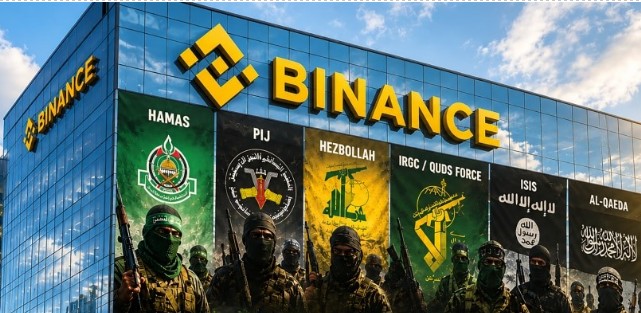
On November 24, 2025, 306 victims and relatives of victims of the October 7, 2023 Hamas attacks filed a lawsuit in federal court, under the Justice Against Sponsor Of Terrorism provision of the Anti-Terrorism Act (ATA). The suit alleged that Binance, the world’s largest cryptocurrency exchange, and its former CEO Changpeng Zhao and senior executive Guangying Chen had facilitated transactions that aided terrorist organizations.
The Binance litigation and related government enforcement actions comprise one of the most significant public examinations to date of how cryptocurrency platforms can be exploited by terrorist organizations and state-sponsored terror networks.
The legal and regulatory backdrop to this lawsuit was shaped by Binance’s November 2023 settlement with U.S. authorities. In it, Binance agreed to pay approximately $4.3 billion in penalties after authorities found widespread anti-money laundering and sanctions compliance failures. Founder Changpeng Zhao pleaded guilty to violations of the Bank Secrecy Act and later served a prison sentence; he was released early, in September 2025.
At the center of the case were allegations that Binance had facilitated financial activity involving Hamas, Palestinian Islamic Jihad (PIJ), Hezbollah, and Iran’s Islamic Revolutionary Guard Corps (IRGC), including “knowingly facilitating” crypto transactions by Hamas prior to its October 7, 2023 attack on Israel.
On May 29, 2026, U.S. District Judge Carl J. Nichols granted Binance’s motion to dismiss the case in full, and also dismissed ATA claims with prejudice. The ruling represented a significant legal victory for Binance. Yet the case itself brought the issue of terrorist exploitation of cryptocurrency infrastructure to the attention of the public. It also highlighted years of research documenting this activity.
The complaint – which, notably, included MEMRI research on Hamas cryptocurrency fundraising networks – revealed that Hamas-linked actors had used Binance accounts and cryptocurrency wallets to raise, transfer, and store funds. As early as 2019, Hamas had publicly promoted cryptocurrency fundraising campaigns, directing supporters to pay using it. Palestinian Islamic Jihad (PIJ) facilitators were alleged to have used Binance to transfer cryptocurrency connected to operational and logistical support activities within the broader Iran-backed terrorist financing ecosystem. Likewise, Hezbollah-linked financiers were accused of using cryptocurrency to move funds internationally, evading traditional banking restrictions and sanctions enforcement. The complaint also alleged that IRGC-linked entities had used Binance to facilitate sanctions evasion and support financial networks tied to all three of these designated terror organizations.
In addition to asserting that Binance allowed actors linked to Hamas, PIJ, Hezbollah, and the IRGC to operate on its platform while failing to implement effective anti-money laundering (AML) and Know Your Customer (KYC) controls, the complaint further alleged that it had ignored repeated warnings. These warnings concerned terrorist-linked activity and inadequately screened cryptocurrency deposits, allowing customers to create sub-accounts that obscured beneficial ownership, and its maintaining of platform structures that concealed fund movements through off-chain transactions and omnibus wallets. It also alleged that Binance had processed transactions involving sanctioned jurisdictions, including Iran, arguing that these were not isolated compliance failures but reflected a broader business strategy that prioritized growth over regulatory compliance.
The Binance case illustrates how terrorist organizations have increasingly incorporated cryptocurrency into their financial operations. Historically, such groups relied on banks, money exchangers, hawala networks, and cash couriers – but after 9/11, when scrutiny of traditional financial systems intensified, and once cryptocurrency was created, many terror organizations adopted it as an additional mechanism for fundraising, transferring funds, and evading sanctions.
The lawsuit referenced numerous financial facilitators and networks allegedly connected to terrorist financing activities. These included BuyCash, a Gaza-based money transfer company; Dubai Company for Exchange; Al-Markaziya/Al-Mutahadun Exchange; Tawfiq Muhammad Sa’id al-Law; IRGC-Qods Force financial facilitators; and pro-Hamas and pro-PIJ Gaza-based cryptocurrency brokers – and, according to the complaint, hundreds of millions of dollars in cryptocurrency transactions involving these networks flowed through Binance.
Also highlighted in the case was Iran’s growing use of cryptocurrency to evade sanctions and maintain regional proxy networks. According to allegations and public reporting cited in the complaint, Iran has developed a significant domestic cryptocurrency ecosystem, with Nobitex emerging as the country’s largest cryptocurrency exchange. Reportedly, Iranian officials promoted cryptocurrency as a mechanism to reduce the impact of sanctions, while digital assets became increasingly important tools for IRGC-linked financial networks. Approximately $7.8 billion in cryptocurrency transactions flowed between Binance and Nobitex between 2018 and 2022.
MEMRI Cyber & Jihad Lab (CJL) research documenting Hamas cryptocurrency fundraising and terrorist use of digital assets featured prominently in the complaint – specifically an October 23, 2023 report on Hamas and other Gaza jihadi organization’s raising of over $100 million in cryptocurrency to fund their jihad against Israel. This report documented Hamas-linked fundraising campaigns, cryptocurrency wallets, donation mechanisms, and online appeals following the October 7, 2023 attacks. Also cited was a MEMRI CJL report published in March 2019 documenting one of the earliest publicly identified Hamas cryptocurrency fundraising campaigns, which provided detailed instructions for supporters seeking to donate through Bitcoin and cryptocurrency exchanges.
Additional MEMRI research referenced in the complaint concerned the use of cryptocurrency wallets associated with Hamas-linked fundraising campaigns, donation mechanisms promoted through Telegram and other online platforms, and Hamas-affiliated media outlets soliciting donations in Bitcoin, Ethereum, Tether (USDT), Tron (TRX), and Binance-linked cryptocurrency infrastructure.
Despite the dismissal, the Binance case highlights several important national security concerns – notably, that cryptocurrency has become an established component of terrorist financing ecosystems, and that terrorist organizations increasingly combine digital assets with traditional financial mechanisms, rather than replacing them entirely.
The case underscores the importance of compliance systems at major cryptocurrency exchanges, which can become critical points of vulnerability when controls are weak or inadequately enforced. It also illustrates how state sponsors of terrorism, particularly Iran, may leverage cryptocurrency to support sanctions evasion and proxy organizations.
Also highlighted by the case is the continued importance of open-source monitoring and intelligence collection in identifying emerging terrorist financing methods – before they become widely recognized by regulators and law enforcement agencies.
It should be noted that in January 2024, Binance researchers approached the MEMRI Jihad and Terrorism Threat Monitor (JTTM)-Cyber & Jihad Lab for access to research on activity by terrorist organizations, during which they were provided with some 100 reports.
The plaintiffs in the case may or may not try again to seek justice for the Binance’s role in aiding terrorists. Other crypto companies are surely waiting to see if it will be held accountable – and if it is, it can be expected that the crypto industry will be compelled to work to stop terrorist groups from using cryptocurrency to finance their operations. Future digital asset regulation is likely to focus increasingly on counterterrorism financing, sanctions enforcement, and exchange accountability.
But if there is no accountability, and Binance is allowed to continue its practices with impunity, terrorist use of cryptocurrency can be expected to increase. As it stands now, terrorist groups continue to use crypto every day to facilitate their operations.