In December 2024, Syria entered a new chapter when Bashar al-Assad fled the country, and Hayat Tahrir al-Sham (HTS) took control of Damascus. Led by Ahmed al-Sharaa, HTS dissolved the old regime and formed a transitional government, marking a significant shift from years of civil war and authoritarian rule. One year later, the world is still watching closely: can a former rebel group transform into a functioning state authority, stabilize the economy, manage sectarian tensions, and prevent a return to chaos? While HTS has been removed from the U.S. Foreign Terrorist Organization list, concerns remain about extremist elements, minority protection, and regional security implications. Those concerns were sharply reinforced by a recent alleged ISIS attack near Palmyra that killed two U.S. soldiers and a civilian U.S. interpreter during a counterterrorism engagement, underscoring both the persistence of jihadist violence and the fragility of Syria’s post-Assad security environment. At the same time, supporters see opportunities for Syria to re-engage with international partners, counter outside influence, and rebuild its fractured society. This article assesses the first year of the al-Sharaa government, focusing on governance, economic recovery, security, refugee returns, Kurdish integration, and Syria’s changing relations with neighboring and global powers.
HTS’s evolution from an al-Qaeda affiliate to Syria’s governing authority remains one of the key questions the country faces a year after the takeover. The organization emerged in 2017 from a merger of several anti-Assad factions, most notably Jabhat al-Nusra, led by Ahmed al-Sharaa, who is now Syria’s interim president. Initially founded in 2012 as an al-Qaeda affiliate, Jabhat al-Nusra’s legacy ties HTS’s leadership directly to global jihadism, and although al-Sharaa has repeatedly emphasized his government’s distance from al-Qaeda, the coming years will test how genuine and lasting that separation truly is. After officially breaking from al-Qaeda in 2016, HTS consolidated control over Idlib by defeating rival jihadist groups such as Hurras al-Din and Ahrar al-Sham, signaling a shift away from transnational jihadist agendas. Yet elements of Salafi-Jihadist ideology remain within the movement, with factions like Jama’at Ansar al-Islam, Katibat Imam al-Bukhari, and Katibat al-Tawhid wa-l-Jihad still operating within HTS’s structure.
From authoritarianism to a so-called break with the past, the new Syrian government has spent the year since Assad’s ouster trying to demonstrate it represents an apparent change from the previous regime’s entrenched authoritarianism. Shortly after taking power, HTS issued a constitutional declaration that highlighted protections such as freedom of belief, freedom of expression, and equality before the law—an intentional effort to showcase moderation and signal a new political era. Yet, the same document grants Interim President Ahmed al-Sharaa broad executive powers, including the ability to declare a state of emergency and override weak institutional checks, raising doubts about how far the government has actually moved away from Assad-style centralization. These concerns are intensified by HTS’s past abuses against minority communities and ongoing reports of humanitarian violations targeting Alawite populations, violence that al-Sharaa has publicly condemned but has not decisively stopped. Meanwhile, the government’s strong centralization reflects both practical necessity and potential risk: with Syria still divided and several regions resisting integration, strong executive control could help prevent renewed collapse but also risk sparking new conflict. Tensions with Kurdish forces, briefly erupting into clashes before a negotiated pause, highlight how fragile the new government’s legitimacy remains across the country. One year after the transition, HTS claims to have broken from Assad’s authoritarian rule, but its governing structure and ongoing internal divisions show that real political change is still far from guaranteed.
The Sharaa government has taken a pragmatic approach to its relationships with neighboring and regional powers, aiming to balance influence while securing strategic support. Turkiye has welcomed the rise of HTS and the al-Sharaa administration, seeing its allied group’s leadership in Syria as an opportunity to maintain influence over the new government. For years, Ankara publicly denied supporting jihadist rebel factions, but the HTS takeover revealed a more complex reality. Meanwhile, Russia, which has long backed the Assad regime to protect its Mediterranean military presence and broader regional interests, has opened channels of cooperation with al-Sharaa, who has responded positively and offered assurances that Russian strategic assets will be respected. Israel has remained cautious since the regime change, yet al-Sharaa seems to be carefully avoiding confrontation, aware of Western backing for Israel and the importance of regional stability. Gulf states, for their part, have extended cautious engagement, recognizing that cooperation with al-Sharaa is essential to combat illicit trade in captagon and to counterbalance Iranian influence in Syria. While they remain wary of Syria’s current weaknesses, Gulf leaders prefer an administration that maintains distance from Tehran rather than one that is hostile or fragmented.
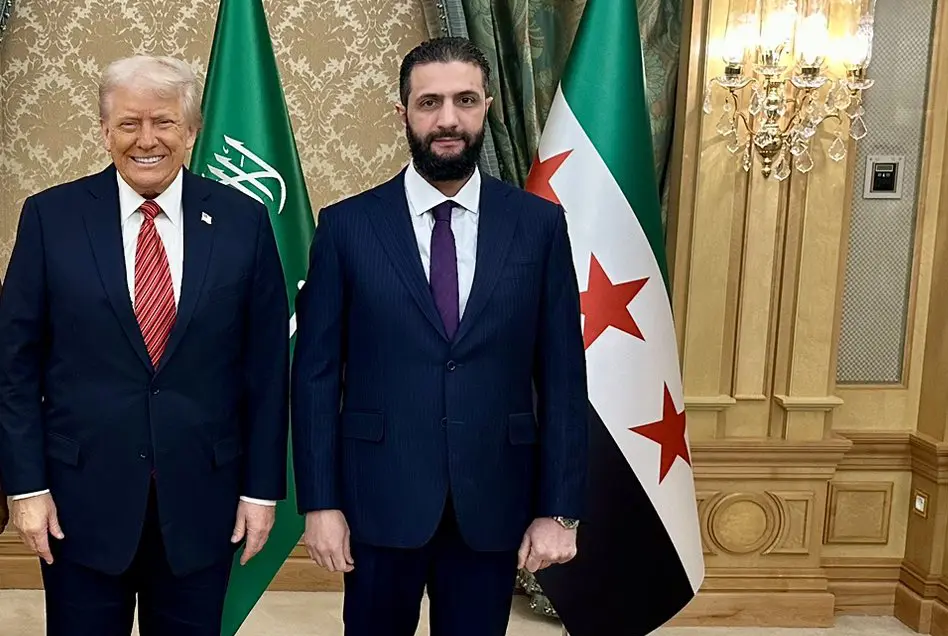
The United States plays a key role in al-Sharaa’s foreign policy, reflecting both historical grievances and strategic interests. When al-Sharaa led the al-Qaeda-linked Jabhat al-Nusra, the U.S. placed a bounty on his head and imposed sanctions on Syria, making his current position highly sensitive. Today, U.S. engagement with the al-Sharaa government focuses on three main priorities: first, preventing Syria from becoming a safe haven for al-Qaeda and ISIS and ensuring that al-Sharaa keeps his commitments to fight both groups; second, avoiding leaving the new government isolated, which could push it closer to Russia; and third, protecting Israel’s security in a volatile region. A major step in this evolving cooperation occurred in July 2025 when HTS was removed from the U.S. Foreign Terrorist Organization (FTO) list, opening the door for potential normalization of relations and lifting sanctions against the Assad regime. This move allowed Western countries, including the U.S., to provide humanitarian aid to a population where over 90% live below the poverty line. While the United Kingdom was quick to offer support, the U.S. took a cautious approach due to HTS’s controversial history and alleged human rights abuses. Engagement deepened over the following months, with the U.S. brokering a truce in October 2025 between Kurdish forces and the Syrian government—an important step toward integrating the Kurds into the new administration. In November 2025, President Trump met with al-Sharaa in the United States, with discussions centered on cooperation, regional stability, and fighting the Islamic State. The meeting was described as positive, indicating that al-Sharaa is willing to align with U.S. priorities to gain support. Moving forward, American-Syrian relations are likely to grow, focusing on maintaining regional security—including protecting Israel—preventing a return to civil war, and countering the influence of Russia, Iran, al-Qaeda, and ISIS in a fragile post-Assad Syria.
The al-Sharaa government has responded actively to domestic issues such as the economy, the illegal drug trade, the return of Syrian refugees, and the ISIS threat. After more than a decade of war and severe international sanctions, Syria’s economy has been severely affected. In 2011, before the Arab Spring uprisings, the country’s GDP was about $67 billion, but now it is only around $20 billion, an 80% decrease in real terms. Inflation and currency devaluation have worsened the economic crisis, with the Syrian pound losing over 99.5% of its value over the last decade. About 90% of Syrians live below the poverty line, and roughly 16.7 million people, almost 70% of the country’s population, are in urgent need of humanitarian aid. A World Bank report released in early July highlighted a bleak outlook for the Syrian economy after months of efforts by the al-Sharaa government: oil production has dropped 90%, foreign currency reserves are nearly exhausted, and the illegal drug Captagon remains the country’s top export. Rebuilding Syria is estimated to cost between $250 billion and $400 billion, far exceeding the country’s current economic capacity and the international aid promised. Syria’s interim government is urgently trying to attract foreign direct investment (FDI), reintegrate into the global economy, and secure the funds needed for postwar reconstruction, to create economic opportunities for its citizens and to strengthen its domestic and international legitimacy.
Under the new Syrian transitional government, the fight against the Assad-era captagon empire has become a top security focus, causing major disruptions but leaving significant issues unresolved. Damascus has stepped up raids on production sites, uncovered large labs, including millions of pills found in Douma, and started arresting key figures in the old trafficking networks, showing increased intelligence capability. However, captagon operations still continue in areas outside government control, especially in Suwayda and Daraa, where Druze and Bedouin militias keep smuggling routes open, and figures like Imad Abu Zureiq, who was sanctioned by the U.S. in 2023 for running a smuggling militia, continue to operate with little consequence. Rising sectarian tensions increase the risk that opposition groups will use drug money to fund their campaigns. Meanwhile, drug seizures have increased across the border, with Jordan intercepting at least ten shipments in August, thwarting two large smuggling efforts on September 1, and reporting a 150 percent rise in interdictions compared to the previous month. Former regime-linked traffickers have spread out to Lebanon, Russia, Iraq, and West Africa, expanding the trade’s infrastructure internationally, with families like the Mazhars in Suwayda still running factories amid lawlessness, clashes leaving over a thousand dead, and Israel preventing Syrian security forces from operating in the south. Lebanon’s Beqaa Valley remains a potential major hub for post-Assad production. Despite progress, the captagon trade remains tough, with its networks adapting to new political realities while ongoing demand and high prices give strong incentives for both criminal and militant groups to stay involved.
Over the past year, nearly 1.5 million Syrian refugees—about a quarter of those who fled during the 13-year civil war—have voluntarily returned home since Bashar al-Assad was overthrown. Their decision is driven by both hope and worsening conditions in neighboring host countries, including economic crises, violence, and reduced aid in Turkiye, Lebanon, and Jordan. However, the return process remains difficult due to widespread destruction of homes and infrastructure, fragmented governance, ongoing violence, and insecure property rights, especially in inland provinces like Aleppo, Idlib, and Homs. Minority communities, including Alawites, Christians, Druze, and Kurds, are particularly hesitant because of targeted attacks and sectarian conflict. The combined issues of security, governance, reconstruction, and illegal economies highlight the complex realities affecting both refugee returns and Syria’s broader effort to recover from conflict.
Under the new Syrian government, ISIS remains a persistent but weakened threat, operating mainly as a low-level insurgency that takes advantage of security gaps and transitional vulnerabilities. In 2025 alone, the group claimed thirty-three attacks by mid-May, with a notable increase in activity around the U.S. military drawdown from 2,000 to about 700 troops, including a high-profile car bomb on May 18 in Mayadin that killed five and marked the first attack on government-controlled territory since Assad’s fall. Most attacks have happened in areas controlled by the U.S.-backed, Kurdish-led Syrian Democratic Forces (SDF), showing ISIS’s strategy of exploiting administrative and territorial gaps.
This threat was underscored by a recent deadly attack near Palmyra, where a lone gunman described by U.S. Central Command as an ISIS operative ambushed U.S. and Syrian personnel during a key leader engagement, killing two U.S. soldiers and a civilian U.S. interpreter, and wounding three others. U.S. officials indicated the attacker may have had past links to Syrian security forces, highlighting the dangers posed by residual extremist infiltration within fragile state institutions. The gunman was killed by partner forces during the exchange. President Ahmed al-Sharaa publicly condemned the attack and signaled imminent retaliation, while U.S. President Donald Trump described the incident as evidence of the continuing ISIS threat despite the group’s territorial defeat. Marking the first U.S. combat deaths since Trump’s return to office, the incident reinforced Washington’s insistence that counter-ISIS cooperation remain central to any deepening engagement with Damascus.
The transitional authorities have responded by arresting ISIS operatives in Damascus, Deraa, and Aleppo, disrupting plots against Shia and Christian sites, and capturing key figures such as Abu al-Harith al-Iraqi. Despite these efforts and ISIS’s overall decreased operational capacity, the group remains a significant threat, especially in the northeast, where incomplete SDF-government integration, thousands of imprisoned fighters, and ongoing appeals to foreign jihadists create opportunities for a resurgence. The situation highlights the need for continued counterterror cooperation, effective integration of the SDF into central authority, and ongoing vigilance to prevent ISIS from exploiting Syria’s transitional instability.
The integration of the Kurdish-led Syrian Democratic Forces (SDF) in the northeast remains a crucial yet unresolved challenge. Although a roadmap for unifying the region with Damascus was agreed upon in March, its implementation has stalled, partly due to concerns over minority protections, Turkiye’s pressure, and lingering tensions from post-Assad violence. The northeast, home to over 10% of Syria’s population and key natural resources, has stayed relatively stable and economically active under SDF/DAANES control. Still, disagreements over secularism, governance, and security have slowed progress. U.S. officials have stepped in to help facilitate talks, emphasizing the SDF’s vital role in fighting ISIS and managing detention camps for thousands of fighters and their families. What further complicates the situation is that, after Turkiye’s negotiations with the PKK, the terrorist group appears to have laid down its weapons; however, official statements suggest some members could redeploy to northern Syria, potentially increasing tensions and challenging the fragile stability in the northeast.
To conclude, after one year of the HTS-led transitional government, Syria faces a mix of achievements and ongoing challenges. Domestically, the al-Sharaa administration has made progress in tackling economic collapse, combating the Captagon trade, encouraging refugee returns, and reducing ISIS activity, although each area still encounters significant obstacles. The integration of the Kurdish-led Syrian Democratic Forces in the northeast remains a major challenge, with the implementation of the March roadmap stalled, lingering post-Assad tensions, and the possible redeployment of PKK members complicating efforts for national unity. Regionally, Syria under al-Sharaa has maintained pragmatic relationships, balancing ties with Turkiye, Russia, Gulf states, Israel, and the United States, while carefully managing international concerns about security and extremism. The recent deadly attack near Palmyra that killed two U.S. soldiers and a civilian interpreter serves as a stark reminder that ISIS remains capable of lethal violence and that security consolidation remains incomplete. As the transitional government seeks legitimacy both domestically and internationally, its success will rely on maintaining stability, fostering inclusive governance, and navigating complex regional issues. While progress over the past year provides cautious optimism, Syria’s future remains uncertain, and the upcoming months will be crucial in determining whether al-Sharaa’s administration can solidify control, unify the country, and establish a presence in the global community.