
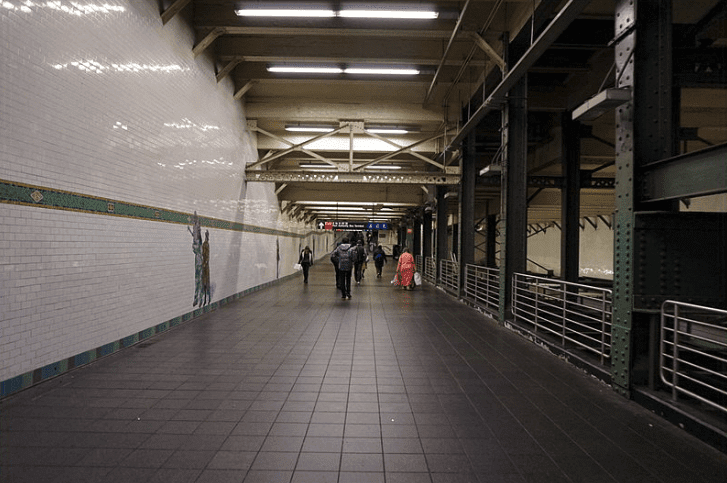
Akayed Ullah walked into one of the busiest transit hubs in the country at 7:18 on a December morning in 2017. Hundreds of commuters moved around him beneath the Port Authority bus terminal. Strapped to his chest, under a puffer jacket, was a pipe bomb he’d built over weeks out of nails, wiring, sugar, a battery, and Christmas tree lights.
He set it off.
It mostly failed. A few people lost hearing. Shrapnel caught one man in the leg. Ullah survived – so when officers pulled him out, he was alive to explain himself. “I did it for the Islamic State,” he told them. He’d scrawled an ISIS slogan across his passport. From his cell, he warned a guard: “You started this war, we will finish it. More is coming.”
A jury convicted him on every count. A judge gave him life, and he is serving it today.
Then this April, a federal appeals court looked at the same man and ruled that on one charge – the one that says he “supported” ISIS – the government never proved it. He’s not going anywhere. But the reasoning is going to follow us into every case that comes next.
Stay with me, because this isn’t the cable-news version. The judges aren’t soft, and they aren’t wrong. The truth is more uncomfortable than that – and I spent thirty years on the other side of this exact problem.
The law everyone leans on
I found the full case in Court Watch, where reporter Peter Beck laid it out in his column “The Rabbit Hole.” I read his reporting for the courtroom blow-by-blow. I’m here to tell you what it means from inside the fight.
The statute at the center is 18 U.S.C. § 2339B – the “material support” law. For nearly thirty years it has anchored terrorism prosecutions. It makes it a crime to knowingly give “material support or resources” to a designated foreign terror group: money, training, weapons, expertise, and people. Prosecutors have used it against everyone from men wiring cash overseas to men planning mass shootings at home.
The law carries a catch almost nobody noticed until now. To count as giving yourself as “personnel,” you have to act under the group’s “direction or control.” Congress wrote in a plain exception: anyone who “acts entirely independently” to advance a group’s goals is not working under its direction.
Ullah’s lawyers drove straight through that door. Their argument was simple. Ullah never talked to anyone in ISIS. No handler. No chat room. No orders. He stewed alone in Brooklyn, watched propaganda, and built a bomb. You can’t take orders from an organization that doesn’t know you exist. And you can’t “join” a group by blowing yourself up – a dead man follows no one’s direction.
Two of the three judges agreed. Judge Myrna Pérez put it plainly: ISIS wanted people to do exactly what Ullah did, but wanting it isn’t the same as directing it. ISIS didn’t know his name. It had no way to stop him if he’d quit. So how could it have “controlled” him?
The third judge, Steven Menashi, dissented. He called the result counterintuitive and said the jury had it right – Ullah handed ISIS the very thing the law forbids. Hold onto that disagreement. It’s the whole fight in miniature.
Under a plain reading of the words Congress wrote, the majority’s argument holds. The judges didn’t invent a loophole. They found one sitting there the whole time.
My lessons coordinating the defeat ISIS coalition

I spent years helping lead the global coalition against ISIS, in rooms with more than 80 nations working to stop this exact kind of attack. So let me tell you what the ruling misses.
The man who acts alone, contacts no one, absorbs the propaganda and strikes – he isn’t a gap in the ISIS playbook. He is the playbook.
A week before the attack, Ullah watched an ISIS video called “Flames of War II.” The message ran blunt: if you can’t come to us, take the fight where you are. That doesn’t recruit soldiers who take orders. It recruits soldiers who never will. ISIS built its entire online machine to mass-produce attackers it never meets, never trains, never commands – precisely so no one can trace a line back to headquarters.
The terror group engineered the exact situation the court just called innocent. The “loophole” isn’t an accident of the law. It’s the enemy’s strategy working as intended.
The strategy is older than ISIS – and a spy built it
Fighting through “phantom cells” that take no orders and make no contact has a name: leaderless resistance. Most people peg it as a modern internet trick. It isn’t. A Klansman named Louis Beam made it famous, publishing an essay called “Leaderless Resistance” in 1992. Beam told extremists to ditch the top-down structure and operate in tiny independent cells, so the FBI couldn’t infiltrate the movement or tie anyone to the leadership.
Now the spy-history lesson. Beam didn’t invent it. He credited Col. Ulius Amoss, a U.S. intelligence officer who wrote it up in 1962 as a way for Americans to resist a feared Communist takeover. A Cold War intelligence man dreamed it up to fight tyranny. A white supremacist turned it against his own government. ISIS perfected it online to kill Americans on a Tuesday-morning commute.
Same idea, sixty years apart: make your fighters look like they act alone, so the law can never prove anyone gave the order. The Second Circuit just confirmed the design works.
So what now
Here is how I’d brief a room of policymakers – on one hand, and on the other.
On one hand, the judges read the statute honestly. The words say “direction or control,” and Congress carved out people who act “entirely independently.” A man who never contacted ISIS fits that exception. Pretending otherwise sets its own bad precedent.
On the other hand, a law can read correctly and still fall dangerously behind the threat. Section 2339B took shape when terrorism meant a handler giving orders. No one wrote it for do-it-yourself radicalization, where the “order” is a video watched by ten thousand strangers and acted on by one. The threat evolved. The statute froze.
We’re already paying for it. On New Year’s Day 2025, a U.S. Army veteran who had pledged himself to ISIS drove a truck into a crowd on Bourbon Street in New Orleans and killed fourteen people. He had no handler. He didn’t need one. This March, two young men from Pennsylvania allegedly hurled homemade bombs at an anti-Muslim rally outside the New York mayor’s residence and declared their allegiance to ISIS. Prosecutors charged them with attempting to provide material support to the group – the same count the Second Circuit just hollowed out. If they never reached anyone inside ISIS, that charge now rests on cracked ground.
So the honest takeaway isn’t “blame the judges.” The enemy built a strategy to slip between the lines of our law, and it worked. The fix doesn’t live in a courtroom. It lives with the people who write the laws – and they need to catch up to an enemy that stopped taking orders a long time ago.
Whether a man who straps a bomb to his chest for ISIS counts as a terrorist in the eyes of the law is now, somehow, an open question.
I spent my career making sure it wasn’t.