

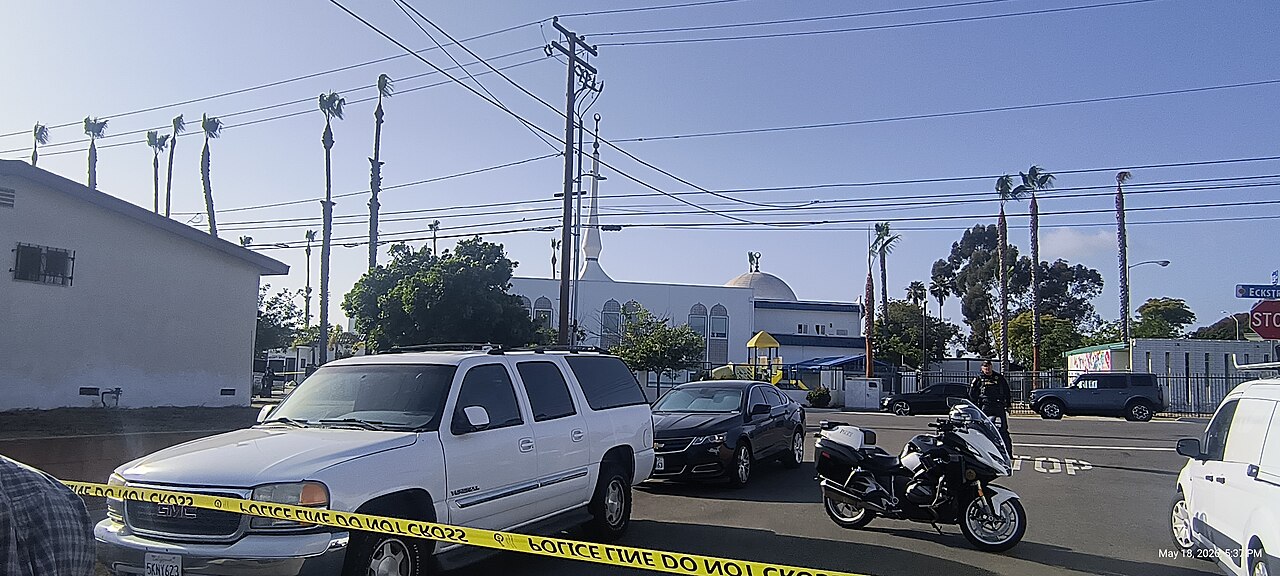
On May 18, 2026, two male teenagers, Caleb Liam Vazquez, 18, and Cain Lee Clark, 17, attacked the Islamic Center of San Diego (ICSD) in Clairemont Mesa East, San Diego, California, with firearms, killing three members of the ICSD community. Later the pair shot at a landscaper, who was struck on the helmet he was wearing and escaped serious injury. The ICSD houses the lower campus of Bright Horizon Academy, a pre-K through 12 Islamic school. According to the Counter Extremism Project (CEP), there were 140 children inside the facility at the time of the attack. According to the Center for Strategic and International Studies (CSIS), the killings at the ICSD marked the first ideologically motivated lethal mosque attack in the United States this century.
Initially, the attackers exchanged gunfire with the armed security guard outside. Before he was killed, the security guard radioed the lockdown procedures, and the children and staff reached a protected area. The attackers then entered the mosque and went door to door in one area, finding it unoccupied. When the shooters observed two congregant men in the parking lot, they exited the mosque and shot and killed them, then fled in their vehicle.
For more context, the mosque’s armed security guard, Amin Abdullah, was killed at the entrance. His decision to trigger the lockdown before he died meant the children and staff at the school were physically unharmed. Mansour Kaziha, who ran the mosque’s gift shop, was killed in the parking lot. Nadir Awad, who lived across the street from the ICSD and whose wife worked there as a teacher, was killed while running to the complex. Kaziha and Awad confronted the shooters in the parking lot and died doing so. Viewed as heroes and martyrs of the community, these three victims’ actions appear to have prevented further bloodshed. The initial officers arrived four minutes after the first shots-fired call.
The perpetrators live-streamed the attack via a head-mounted camera on one attacker. Their 10-minute streaming video portrayed Clark shooting and killing Vazquez before turning the weapon on himself. Both attackers were found dead in Clark’s car at 12:03 p.m., in the 3800 block of Hatton Street, about 21 minutes after the first shots-fired call. A gas can with a Nazi insignia was found in the car with them.
The attackers had various firearms, tactical gear, plate carriers, German flektarn camouflage, and skull masks. Moreover, the Federal Bureau of Investigation (FBI) confiscated 30-plus guns across three homes, including pistols, rifles, ammunition, and a crossbow. The weapons were registered to the parents of one suspect. Multiple weapons were inscribed with “Race War Now.” One perpetrator conducted a live Signal call with a user identified only as “Noelle,” who recorded it on a second phone. That recording was posted to WatchPeopleDie alongside the manifesto PDF.
The San Diego Police Department (SDPD) produced a useful preliminary outline of events. It traces the morning from 6:24 a.m., when Clark left home with a man he had met online, both wearing camouflage and a firearm missing from the house, through Clark’s mother’s 9:42 a.m. 911 call reporting him missing, to the discovery of both perpetrators at 12:03 p.m.
This article discusses various facets of the ICSD attack. More specifically, the piece covers the backgrounds of the perpetrators, how they met, their worldviews and the implications thereon. Next, four lessons from the ICSD incident are shared. Also, the work further analyzes the attack in relation to other violence as well as addresses possible steps to reduce the frequency and severity of such targeted violence. In that realm, the following are enumerated: the numbers behind the threat; warning signs, and why they were missed; prevention and off-ramping; legal levers; hardening houses of worship; and the online ecosystem and the normalization risk.
Attackers’ Backgrounds and How They Met
The two teenagers met online and subsequently interacted offline for several months before launching the attacks. More specifically, in his May 19 press briefing, the FBI Special Agent in Charge (SAC) of the San Diego office, Mark Remily, confirmed the pair met online. After meeting online, they met in person once they realized they both lived in San Diego.
Vazquez grew up in Eastlake Trails, a neighborhood in Chula Vista, California. In January 2025, nearly sixteen months before the attack, police were called to Vazquez’s home after a tip that he was obsessing over Nazis and mass shooters. He was placed on psychiatric hold. His father moved 26 firearms voluntarily to a secure storage facility after initially declining police entry when officers sought one. A gun violence restraining order was subsequently issued. Also, the father secured all sharp knives in the home.
Vazquez underwent therapy twice a week as arranged by his family. In his manifesto, Vazquez described himself as 70-85% European in genetic descent, a detail the Accelerations Research Consortium at the Institute for Countering Digital Extremism (ARC-ICDE) noted because his mixed ancestry did not prevent his full uptake of white supremacist ideology. There are various examples of Hispanics embracing white nationalism, even conducting hate crimes in that vein.
Also, Vazquez had been on incel forums since 2022. Incel ideology, often spewed online, has been linked as a pathway to white nationalism as well. On incel forums discussing the San Diego Mosque attack, posts used “slurs and dehumanizing rhetoric” targeting Jewish, Hispanic, and transgender communities, while victim-blaming Muslim communities. In the meantime, on TikTok, white supremacist movements repackage the Great Replacement conspiracy theory, with influencers promoting misogyny and white nationalist ideology to mainstream audiences.
Vazquez’s family claimed their son was on the autism spectrum and had grown to resent parts of his identity, without specifying which aspects were challenging to him. In his manifesto, Vazquez admitted to possessing “some mental issues.” His family’s statement on the shooting attributed his deadly path to exposure to hateful rhetoric, extremist content, and propaganda spread online, which they said contributed to his descent into “radicalized ideologies and violent beliefs.”
Clark lived his whole life in Clairemont, San Diego. He was a former high school wrestler at Madison High School. Two teammates described him as awkward. By the time of the attack, he was enrolled in home study but registered at Madison High, with finals due online the day he killed himself. His social media was public. On April 2, 2026, he reposted Tempel ov Blood content on X and followed James Mason’s account; Mason is the author of Siege. Clark’s Kik account used the branding of the Atomwaffen Division (AWD) as a banner image, with a female figure in a Nazi uniform as a profile picture. His Telegram account, SurfaceLevel_141, contained three audiobook files of William Luther Pierce’s Hunter and a James Mason Siege audiobook. Clark, too, identified with the misogynist incel movement.
When Clark’s mother called 911 on the morning of the attack, she said her son had left with someone he met online, possibly named Caleb, last name unknown; an individual she had never seen before. Clark’s mother never met Vazquez, meaning the relationship was conducted, except on that fateful day, out of parental sight.
ARC-ICDE classified the attackers as consumers, not embedded operatives. Their case demonstrates passive capability without leadership: mobilized to violence without needing a handler, because radicalizing content was freely available on mainstream platforms. Key platforms included TikTok, Steam, Rumble, X, Instagram, Kick, and Discord. Saint culture can mobilize individuals to violence with no active network direction.
The perpetrators do not seem to have been part of a larger cabal. Still, one online connection is worth noting. CEP reported an account removed May 12 from a neo-Nazi accelerationist forum, six days before the attack. It was likely one of the attackers’ profiles. Forum members noted this possibility.
Likewise, it appears the attackers did not have a formal affiliation with an extremist or terrorist group. Rather, Vazquez and Clark had aspirational, not operational, attachments. Vazquez’s manifesto section suggests he did it to review the Terrorgram Saints Culture. The manifesto cover pages displayed the AWD insignia. A former AWD leader claimed the affiliation was inaccurate. A Terrorgram channel connected to former AWD members called them “losers, cancerous.” The pair sought to portray themselves as part of a larger movement, soldiers in a race war, Clark wore a Sonnenrad patch, flektarn, a skull mask, and a militant accelerationist group patch on his plate carrier during the attack.
There does not seem to be a single external event that triggered the attack. ARC-ICDE concluded they conceptualized the attacks for months and planned their suicides carefully. The attack seems deliberate and pre-planned, not impulsive. In fact, the SDPD official timeline confirms Clark left home at 6:24 a.m., both teenagers already in camouflage, and shots were fired at 11:42 a.m. They had been mobile over five hours. Officers at the Clark residence learned the pair had possibly written a suicide pact.
Analogously, in a 2026 vehicle-ramming and shooting at Temple Israel in West Bloomfield Township, Michigan, the Hezbollah-inspired attacker, Ayman Mohamed Ghazali, shot and killed himself after engaging security personnel. The lone operative Stephen Paddock, who conducted the largest mass shooting in modern American history, killed 58 and injured hundreds in Las Vegas, Nevada, in 2017. Then, Paddock killed himself before police breached his hotel room, after firing through his door at an unarmed hotel security guard.
In contrast, Patrick Crusius, a white nationalist and supporter of the Great Replacement theory, killed 23 persons and injured 22 at a Walmart in El Paso, Texas, in 2019. Crusius was motivated to kill Hispanics “because they were immigrating to the United States.” Crusius turned himself in to Texas Rangers about one mile from the Walmart. While exiting his car with his hands up, Crusius said, “I’m the shooter.” John Earnest, who committed the attack at the Jewish institution in Poway, called 911, stating he had just shot up a synagogue and telling the dispatcher to come get him. Similarly, within minutes of killing six individuals and injuring 19 at a Quebec City, Canada, mosque, Alexandre Bissonnette called 911 and told them where law enforcement could find him.
The target selection is left blank in Vazquez’s manifesto, with spaces for three locations. He wrote of wanting to “go after other targets.” ARC-ICDE identified the book Hunter as an influence on target selection. In Pierce’s novel, the protagonist Oscar Yeager drives between attack sites in escalating shootings intended to trigger racial violence. As noted earlier, Clark kept three audiobook files of the novel on his Telegram.
Perpetrators’ Worldviews and Implications
The pair produced two manifestos under one title, “the New Crusade: Sons of Tarrant.” Vazquez’s section was titled “MisanthropistCEL,” while Clark’s was “Death to World.” A line at the bottom of the document read “Sons of Tarrant debut manifesto,” explicitly signaling that others were expected to follow their actions. White supremacist accelerationism was the organizing ideology, with neo-Nazism, incel ideology, virulent Islamophobia, antisemitism, anti-Black racism, anti-Hispanic, homophobia, and transphobia present throughout the manifestos.
Vazquez called Jews “the universal enemy” and devoted the first eight pages to antisemitic conspiracy theories. He argued a race war will lead to a total societal collapse and that will be the only solution to a real way forward. Clark labeled himself a Christian Ecofascist. Both praised The Turner Diaries and Siege, urging that the books be read “almost biblically” by all soldiers of the white race. Their writings also rejected Trump and MAGA as part of the failed democratic system.
Both praised the 2018 Tree of Life synagogue killer, Robert Bowers. Clark quoted “screw your optics” from Bowers’ infamous Gab post. The N-word appeared at least 32 times across both manifestos. References to mass shooters and the Great Replacement theory appeared 38 and 11 times, respectively. Vazquez referred to the well-known 2014 incel mass shooter Elliot Rodger as “Saint Elliot” and listed him as a hero. FBI SAC Remily, the morning after the attack, described their worldview plainly: the pair “did not discriminate” in who they hated.
The ICSD, the largest mosque in San Diego County, was specifically targeted in line with the template of the 2019 attacks on two Christchurch, New Zealand, mosques. Both shooters explicitly sought to emulate Brenton Tarrant’s shootings in New Zealand. The Islamophobic motivation made explicit in the manifestos frames the ICSD strikes as a tribute to Tarrant’s actions. That hatred showed in the characterization of Muslims as invaders and existential threats, the same framing the pair applied to Jews. With three target spaces left blank in Vazquez’s manifesto, one can infer the ICSD, a Muslim religious institution, may have been the first of multiple planned sites.
As with others conducting hate crimes, the pair perceived their attack would help precipitate a race war. On the handgun of one shooter, the words “Race War Now” were inscribed above a swastika. They were unsuccessful in that aim, although, the attack may become part of the saint-culture repertoire used by future accelerationist actors. Other individuals who conducted murderous hate crimes with the goal of starting a race war include Dylann Roof, who killed nine Black parishioners at a Charleston, South Carolina, church in 2015, and James Jackson, who killed a Black man in New York City in 2017. In another vein, Robert Bowers, who killed 11 congregants at a Pittsburgh, Pennsylvania, synagogue in 2018, wanted “all Jews to die.” Dual antipathy against Jews and Muslims was exhibited by John Earnest, who shot and killed one congregant and injured three at the Chabad of Poway (California) synagogue and attempted to set fire to the Dar-ul-Arqam mosque in Escondido, California, both in 2019.
Attacks against religious institutions in the United States are of great concern. In February 2026, Stephen Pittman was indicted on arson and civil rights charges in relation to burning down the Beth Israel Synagogue and the Goldring/Woldenberg Institute of Southern Jewish Life building in Jackson, Mississippi. In September 1967, that same synagogue was bombed by the Ku Klux Klan (KKK). Also in February 2026, multiple shots were fired at a Westfall Township, Pennsylvania, mosque. Fortunately, nobody was injured in that incident.
Noteworthy, too, is the Columbine connection to Clark and Vazquez. ARC-ICDE identified Columbine as a specific influence on the dual-attacker modality; Clark posted a Columbine anime to Steam on December 22, 2025. In another take, Prof. Cynthia Miller-Idriss described the pair as having a “messy combination of ideological impulses”: accelerationist, white supremacist, antisemitic, and incel-adjacent perspectives. This mix is characteristic of individuals who assemble a rationale for violence the way one fills a plate from a “salad bar ideology” of extremism, as former FBI Director Christopher Wray put it. The Soufan Center characterizes the current dynamic another way: ideologically convergent or compounded forms of extremism, what some analysts term “fused extremism,” do not map neatly onto any single ideology.
Research on sadistic online exploitation in youth environments adds important context. Thorn found adolescents conditioned rapidly through escalating content exposure in networked harm communities, with harm functioning as social currency. Mainstream platforms, Thorn notes, serve as gateways where vulnerable youth are recruited. In unison, misinformation and disinformation contribute to online radicalization. Research links heavy youth social media use with measurable cognitive, emotional, and mental-health risks, although causal effects vary across studies and populations.
Four Lessons from the San Diego Case
The online-to-in-person pathway. The most unsettling fact in this case is how little the adults around these two could observe and appreciate the dangers among them. Clark’s mother had never met Vazquez. She did not know his last name. She had no idea what her son had forged with him online. The bond that produced the attack formed in a space no parent, teacher, or coach was watching. It moved into the physical world only when the two were ready to act. That is the pathway worth naming for prevention: the relationship that mattered most was the one no one in their daily lives knew existed.
The compounding detection failures. No single miss explains this attack. A sequence does. The household weapons were moved but not seized in January 2025. Sadly, other weapons proved to be accessible and utilized. Clark’s extremist posts were public in April 2026 and never flagged. Officers were at Clark’s home when the shots-fired call came in. Each was a separate chance, handled by disparate people who could not see the whole picture. If any one of these circumstances had been handled differently, perhaps the attack would have been stymied. The failure was not one decision. It was the absence of anything that linked the decisions together.
The Christchurch contagion. Clark and Vazquez did not invent their playbook. They borrowed it. ARC-ICDE, the Anti-Defamation League (ADL), and researchers like Amarnath Amarasingam all describe the same dynamic. Namely, a saint culture in which past attackers function as sacred models rather than cautionary tales, their work treated as something to continue. The manifesto title, “New Crusade: Sons of Tarrant,” reads less like a statement than a franchise application. The pair copied Christchurch on purpose and documented the mimicking for whoever comes next. Treating the attack as a single event misses the point. It was built to be repeated and less effective than otherwise.
The dual-attacker dimension. This was not a lone shooter. ARC-ICDE flagged it as the first dual accelerationist attack in the saint culture mold, two people radicalizing each other and acting as a team. That detail is easy to treat as a footnote, but it should not be. In April 2026, a Telegram entity calling itself the World Terror Coalition urged supporters to form teams of fighters. Whether or not the San Diego pair saw that specific call, the case should be read next to it. If the next wave of accelerationist violence is built around small teams rather than isolated individuals, prevention models still aimed at the lone actor will be looking in the wrong direction.
Comparably, there are instances of extremists meeting online and then conducting successful attacks. This happened in May 2020, when two Boogaloo Bois adherents conducted a drive-by shooting at a federal building in Oakland, California, killing one court security officer and injuring another. Also, two anti-natalist plotters successfully schemed a vehicle-borne, lone operative suicide bombing at a fertility clinic in Palm Springs, California, in May 2025. His co-conspirator died in federal custody at a detention center in California while awaiting prosecution.
Reducing the Frequency and Severity of Targeted Violence
The Numbers Behind the Threat
Hate crime is not a rare event in the United States, and the ICSD attack sits inside a larger pattern. For 2024, the most recent year of national data, law enforcement agencies reported 11,679 hate crime incidents to the FBI, the second highest annual total since national reporting began in 1991. That count came right after 2023, when 11,862 incidents set the record. Race, ethnicity, and ancestry drove 53.2 percent of single-bias incidents in 2024. Religion drove another 23.5 percent, the second largest category. In 2024, anti-Jewish hate crimes constituted 70% of all religious hate crimes, marking 1,938 single-bias crimes.
Crimes against Muslims are a smaller share of the national total, but they have been climbing. The ADL recorded 228 anti-Muslim incidents in 2024, a slight dip from 236 in 2023. In contrast, an academic survey of 42 major U.S. cities by the Center for the Study of Hate and Extremism at California State University, San Bernardino, found anti-Muslim incidents rose 18 percent that year, the fourth straight annual increase according to this research, even as overall urban hate crime dipped. Both measures still understate the problem. Reporting to the FBI is voluntary, many agencies submit nothing or report incompletely, and most victims never contact the police. For a mosque shooting, the gap matters. If anti-Muslim harm is undercounted in the official data, the warning signs that come before an attack are even easier to miss.
Table 1 widens the lens. Aggregating FBI extracts from May 2021 through May 2026, it shows what anti-Muslim hate crime looks like in practice. Intimidation accounts for 45.2 percent of recorded offenses and simple assault for another 20.9 percent, while roughly one incident in ten occurs at a house of worship. The ICSD attack was an outlier in lethality, not in target type.
Table 1
Reported Anti-Islamic (Muslim) Hate Crime Statistics, Federal Bureau of Investigation Extracts, May 2021 Through May 2026
|
Category |
n |
% |
|
Bias type |
||
|
Anti-Islamic (Muslim) |
1,134 |
100.0 |
|
Offense type |
||
|
Intimidation |
622 |
45.2 |
|
Simple Assault |
288 |
20.9 |
|
Destruction/Damage/Vandalism of Property |
244 |
17.7 |
|
Aggravated Assault |
128 |
9.3 |
|
Other types of offenses |
94 |
6.8 |
|
Offense type total |
1,376 |
100.0 |
|
Location type |
||
|
Residence/Home |
234 |
20.5 |
|
Highway/Road/Alley/Street/Sidewalk |
205 |
18.0 |
|
Church/Synagogue/Temple/Mosque |
120 |
10.5 |
|
Other/Unknown |
580 |
50.9 |
|
Location type total |
1,139 |
100.0 |
|
Known offender race |
||
|
White |
520 |
53.0 |
|
Black or African American |
185 |
18.9 |
|
Unknown/Other |
276 |
28.1 |
|
Offender race total |
981 |
100.0 |
|
Known offender ethnicity |
||
|
Not Hispanic or Latino |
373 |
38.0 |
|
Hispanic or Latino |
52 |
5.3 |
|
Other/Unknown |
556 |
56.7 |
|
Offender ethnicity total |
981 |
100.0 |
Note: Counts aggregate FBI hate crime data extracts covering May 2021 through May 2026. Percentages are calculated within each dimension; the total row in each dimension gives that dimension’s denominator. Other types of offenses combines all offense categories listed after aggravated assault. Other/Unknown combines the remaining location categories and, for known offender ethnicity, combines unknown, not specified, and multiple.
Source: Federal Bureau of Investigation hate crime statistics, Anti-Islamic (Muslim) extracts, May 2021 through May 2026.
School shootings in the United States are broadly condemned, but they remain unfortunately common, even unsurprising, when they happen. This otherwise endemic malady within society is cynically tolerated. Likewise, the more high-profile attacks against ethnic, racial, religious, or other distinct groups occur, the greater the likelihood hate crimes become normalized within society. Potentially, though, victim communities might engender greater empathy for the “other” once their own affinity group becomes victimized. Unfortunately, history is strewn with examples where distinct victim communities fail to support others and instead turn on them, as during conflicts in Rwanda, Yugoslavia, and Iraq, to name a few instances.
Warning Signs, and Why They Were Missed
Clark’s and Vazquez’s radicalization trajectories were largely open-source and observable. But there were insufficient efforts to prevent their murderous actions. Clearly, operatives do not exist in a vacuum, fully cloaked from sight, offline or online. They often have family members, friends, co-workers, classmates, educators, clergy, coaches, strangers, and other individuals within civil society with whom they come into contact in person, online, or both. Coordination among such intervenors is paramount to gain the full effect of radicalization off ramping and other palliative efforts.
Whether the negative attributes aligned with the transformation of the perpetrator are slow, rapid, nuanced, or otherwise, they might be observable. An appreciation of a negative change within the subject, such as recognizing grievance formation and leakage, should not be left alone. Rather, such looming behavior and traits should be recognized and approached with offers of assistance, when possible. Weighing static and dynamic risk factors in threat assessment is crucial, with the latter particularly useful in intervention schemes.
Despite the numerous individuals and institutions, a troubled or fringe person may come across, and even when they identify actionable dissonance, intervention often does not arise. Within a family setting, a family member might be afraid of discovering the truth about their kin’s radicalization or deviancy. There might be disquiet about creating a confrontation, a preference to keep things “calm,” or fear that the individual will turn violent or self-harm. The concerned family member may perceive the person is going through a temporary “phase” they will abandon after some time.
Additionally, the family may not want to reach out to others because they are embarrassed to disclose their kin’s situation or fear being judged negatively. The family may not know where to turn for assistance. They fear potential negative consequences vis-a-vis mental health, such as a temporary commitment leaving a record that might prevent the child from ultimately obtaining certain jobs. Likewise, they may seek to avoid law enforcement involvement, such as possible prosecution for past crimes or future plots. Noteworthy, the mother of El Paso shooter Crusius contacted Allen, Texas, police more than a month before his attack and informed them her son was too immature and inexperienced to own an AK-47. She did not provide her name, and police informed her that as Crusius was 21 years old at the time, he had a legal right to possess the firearm.
In some cases, parents are supposedly unaware of a child’s radicalization and interest in committing a hate crime. Some hate crime murderers become radicalized over months, even articulate murder-suicide intentions, receive involuntary mental health evaluation (before quickly being released), yet strike months later. This was the case with Payton Gendron, who killed 10 Black individuals and injured 3 others at a Buffalo, New York, supermarket in 2022.
What happened with Clark and Vazquez fits a pattern Alexander and Arnold described in an earlier review of missed terrorism signs: in case after case, someone in authority had touched the file before the attack, yet no arrest followed. The reasons are rarely oversight alone. At the moment of contact, the person often has not committed an arrestable offense, the available information is thin or contradictory, and there are no clear signs of mobilization (the point at which a person decides violence is justified and necessary). Police also work under hard limits. They juggle ordinary crime with everything else. They cannot watch every extremist at once. Smaller departments may treat terrorism as a local risk not meriting attention.
The San Diego case shows how those limits play out. Vazquez was not invisible to the system. In January 2025, nearly sixteen months before the attack, police responded to a tip that he was fixated on Nazis and mass shooters, placed him on a psychiatric hold, and saw the household firearms moved to a secure storage facility, with a gun violence restraining order following. The order was dismissed at a March 11, 2025 San Diego Superior Court hearing. In other words, the file effectively closed more than a year before the attack. But, in any case, the weapons left voluntarily rather than by seizure, the contact produced no charge, and nothing tied Vazquez to a co-conspirator or a target. By that logic, this is the kind of file that gets closed: a troubled teenager, no crime, no clear path to violence on the day officers stood in the home.
Clark left a different kind of trail. By April 2026, six weeks out, his accounts were public and openly extremist, with neo-Nazi reposts, AWD branding, and audiobooks of Hunter and Siege sitting on his Telegram presence. None of it was flagged to law enforcement. This is the online version of the same gap. Open-source signals only help if someone is looking, no one was assigned to look, nor did law enforcement analytical software capture it.
Then, there is the final morning. Clark’s mother called 911 to report that her son had left with a man she had never met, both in camouflage, with a firearm missing from the home. Officers were at Clark’s home when the shots-fired call came in. The timing is the cruelest part of the case. It captures the core problem: contact is not the same as prevention. A tip, a hold, a restraining order, a 911 call, each was a chance, and each ran into the limits of what police can act on in the moment.
The takeaway is not that the system failed through indifference. It is that the warning signs were spread across a family, a school, two police contacts, and a set of public accounts, with no one positioned to connect them. Alexander and Arnold close on the same point: law enforcement cannot find every attacker before they strike, and civil society has to carry part of the load. The ICSD attack is a hard argument for building those connections before the next file goes cold or the next killer strikes a target.
Prevention and Off-Ramping
Further on the prevention side, there are more organizations, such as Hedayah, and individuals, scholars and practitioners alike, domestically and internationally, involved in such work than before. Off-ramping organizations of note in the United States include Life After Hate and Parents for Peace. Such efforts, plus those focusing on interfaith dialogue and collaboration, are important and should increase. Efforts to spawn inclusiveness and fight hate within communities are led by disparate community organizations, such as Not in Our Town.
About 20% of hate crimes are committed by individuals under 18, and with the radicalization and recruitment lenses aimed at youth, countering efforts in this age group is critical. This can be implemented by incorporating the guidance of United Educators, namely:
- Establish buy-in from the top.
- Implement a violence prevention curriculum.
- Join a program like No Place for Hate®, a K-12 school framework focused on student belonging.
- Incorporate age-appropriate hate prevention lesson plans.
- Publicize your student conduct code.
- Require all students to agree to an acceptable use policy for electronics and internet at school.
- Train teachers and educate parents about how they can best connect with students and prevent hate.
So too, federal, state, and local prevention efforts should accelerate, as these activities have impeded attacks, off-ramped radicals, dissuaded others from embracing radicalism, and given community institutions and members tools to recognize and address aberrant behavior. Prevention should be a core component of whole-of-society efforts to reduce extremism, terrorism, and targeted violence. The “left-of-boom” strategy is effective and must be recognized as such.
Legal Levers
In the past few years, parents who failed to prevent their child from conducting a non-ideologically driven school shooting have faced successful criminal prosecutions for murder and involuntary manslaughter. Whether such criminal liability, and potential civil liability, will be an adequate impetus for greater oversight and intervention by parents of minors is unknown.
A survivor of Gendron’s Buffalo shooting intends to sue his parents, claiming they “failed to use reasonable care to restrain” their son despite knowledge of “his propensity for not only racism but violence.” The survivor also claims the parents acted “carelessly, negligently, recklessly” in allowing Gendron to own firearms and store them in their home before the attack. The issue of red flag (firearm) laws as they relate to removing weapons from extremists will likely persist, as the Gendron and San Diego Mosque attacks intimate.
Individuals and groups involved in the attempt, conspiracy, actualization, and concealment of hate crimes may likewise be culpable of soliciting violent crimes, conducting online threats, illegal gun possession, money laundering, as well as traditional crimes such as robbery, drug offenses, fraud, gang activity, and racketeering, among others. Some hate crime perpetrators have been concurrently charged with terrorism offenses. So too, plaintiffs have successfully sued hate groups, their leadership, and their underlings for compensation for wrongful death and other harms to hate crime victims. In 2025, the Gordon Jewish Community Center in Nashville, Tennessee, alleged the extremist group Goyim Defense League (GDL), its leadership, and some of its members are liable for “antisemitic intimidation, harassment and trespass” aimed at terrorizing the city’s Jewish community.
Another angle in undermining access to extremist online content is potential lawsuits against social media companies, alleging their products caused an individual to become radicalized, or that harm arose to a hate crime victim through the perpetrator’s radicalization. This might not be such a far-fetched path. Claims that social media companies negligently design their platforms to engender addictive use, resulting in anxiety, depression, and self-harm, have gained traction. A California jury found this to be true in a March 2026 civil lawsuit against Meta and YouTube. Also that month, a New Mexico jury determined Meta was liable for misleading consumers about the safety of its platforms and endangering children, meriting $375 million in civil penalties under New Mexico’s consumer protection laws. On the horizon, there could be more scrutiny of Internet infrastructure providers enabling high-threat sites to garner viewers through use of their services.
Hardening Houses of Worship
Enhanced security at faith-based institutions and related buildings and sites is paramount in light of a multiplicity of ideologically aligned and other threats, such as gunfire, arson, and vehicle-borne attacks, used against such locations. Accordingly, religious institutions should undertake threat assessments, incorporate physical and technological security measures, adopt best security practices, and raise awareness and conduct drills among congregants, teachers, staff, and pupils. Nonprofit organizations assisting religious communities with facility security include the Secure Community Network (SCN). SCN has received DHS designation, under the DHS SAFETY Act, as offering qualified anti-terrorism technology services within its threat management and community security programs.
Government resources and private firms are aiding this endeavor as well. In August 2025, the Federal Emergency Management Agency (FEMA) announced $110 million in awards through its Nonprofit Security Grant Program to “600 faith-based organizations and other nonprofits across the United States,” comprising a diverse array of Christian, Muslim, Hindu, Buddhist, Sikh, and Jewish institutions.
The role of armed guards appears increasingly important, as demonstrated by the heroic efforts in the 2026 San Diego Mosque and Temple Israel (Michigan) incidents. Still, attentiveness to dangers lurking outside the curtilage of buildings merits further attention going forward. More specifically, the attacker in the Temple Israel case sat in his vehicle for 2 hours before driving toward the building and ramming his vehicle into it. Also, police countermeasures relative to extremism and terrorism are worth implementing. Moreover, law enforcement agencies host hate crime forums, gatherings that bring police, prosecutors, community leaders, and nonprofit organizations together against bias incidents, buttress community cooperation and safety.
When on the scene or in the vicinity, security guards and law enforcement intercede to respond to unfolding hate crimes. Occasionally, multiple bystanders have the capacity to prevent hate crimes in their presence but fail to do so out of fear of intervening, perceiving such acts as troubling but innocuous, or simple inattentiveness. Interestingly, some have no qualms about videotaping these incidents when they occur, whether to aid in prosecuting the perpetrator or to share online for amusement. True, there have been instances when intervention during a hate crime results in the intervenor’s injury or death. This occurred in a 2017 Portland case that began as a hate crime and, ultimately, led to the murders of two interceders and the injury of another.
The Online Ecosystem and the Normalization Risk
The various ailments plaguing society, loneliness, limited resiliency, unreasonable expectations, inability to communicate and form relationships, violence-proneness, addictions, and the ease of rapid exposure to variant and overlapping extremist tenets, have been exacerbated by the Internet and its appending instrumentalities. The Internet’s capacity to aggravate these societal ills quickly, cheaply, and virulently results in increasingly ubiquitous and otherwise impregnable echo chambers, which facilitate polarization, animus, and ease in learning the tools of the trade and the targets of whatever conceived enemy, person, or out-group an extremist may select. Such efforts by purveyors of hate have, unfortunately, proven very effective at times. Extremist ecosystems increasingly rely on edited clips, screenshots, altered audio, translated text, memes, synthetic media, URLs, livestream fragments, and platform-specific repost tactics.
Besides the role of online communities in the San Diego case, Gendron detailed his plans for the Buffalo shooting in writings describing himself as a fascist, a white supremacist, and an antisemite, with a goal of killing as many Black people as possible. Gendron claimed to have been radicalized on the Internet during the pandemic. Similarly, online networks and groups such as the Maniac Murder Cult and the Terrorgram Collective successfully enticed and encouraged individuals globally to commit murder and hate crimes. In another respect, organized groups can be replaced with Facebook pages, podcasts, and livestreams, and have been, effectively. Ominously, nihilistic frameworks serve as a salient threat for youth radicalization, with youth aged 15 to 25 as primary targets across all extremist ideologies. Strategically, the so-called Islamic State is increasingly incorporating nihilistic aesthetics to prey upon the vulnerabilities and insecurities of young people online.
Aggravating factors in this milieu include the capacities of extremists being “turbocharged” by the development of artificial intelligence, as Australian Home Affairs Minister Tony Burke warned in May 2026. On the plus side, AI can aid in detecting online extremist content while simultaneously assisting law enforcement to identify indicators of online radicalization. Legal restrictions on children’s access to social media, as in Australia and Brazil, could contribute to reducing online youth radicalization and might be adopted in other countries. Other proposed countermeasures include “hash sharing” among countries and organizations to identify terroristic content quickly and enable tech companies to flag it without resharing it and accidentally promulgating the message.
Additionally, Tech Against Terrorism (TAT), an organization formed by the United Nations in 2016, seeks to undermine terrorist and extremist online activities through “technical approaches and deliver sustainable solutions.” One tool TAT offers is “a secure online platform that enables partners of TAT to submit terrorist content removal requests to tech platforms hosting verified terrorist content.” Established a year later, the Global Internet Forum to Counter Terrorism (GIFCT) “brings together technology companies and works closely with governments, civil society, practitioners, and academia to advance collective counterterrorism efforts.” These entities and others in that field contribute to combating online exploitation by terrorists and extremists. Nevertheless, more efforts and improved capacities are needed as such online threats and capabilities continue to evolve and gain potency.
Conclusion
The ICSD attack was driven by a concoction of multiple hate-filled tenets and conspiracies. They were found online, in the same manner the pair met initially. Later, the two conspired to conduct a killing spree in which they turned on their fellow community members. After all, in their eyes, their perceived enemies merited death. This horrific incident did not arise overnight, in the dark, with family members and others in civil society wholly unaware of their troubles. As with other mass shootings fused by bias, the culprits succeeded in reminding us again of the failures of society to extricate this murderous cancer from our midst.
Clearly, there is no universal remedy for this type of aggression reaching its zenith in bloodshed. Nevertheless, a broad, consistent, and profuse whole-of-society effort, offline and online, enveloping individuals and institutions, will prove effective in reducing such carnage to rare occurrences rather than commonplace features.