



In 2026, the alarm has not stopped going off. Each season has brought a new reminder that the nation’s lifeline infrastructure is operating under increasing pressure from extreme weather, cyber threats, physical attacks, aging assets, supply-chain dependencies, and cascading failures across electricity, gas, water, telecommunications, transportation, and public safety systems. The challenge before the utility sector is no longer recognizing the risk. The challenge is determining whether the security, resilience, planning, partnerships, workforce protections, and operational systems now in place are strong enough to protect communities when multiple threats converge at once.
Several symposiums brought together leaders from across the power sector to confront the urgent realities of planning for and operating the grid amid escalating threats from extreme weather, wildfires, and other disruptions. Utility executives, operators, technology providers, state and regulatory commissioners, government leaders including public safety agencies, investors, consultants, and nonprofit organizations used the forum to exchange practical strategies, strengthen partnerships, and help define the next generation of grid resilience.
These symposiums have provided decision-makers with an action-oriented forum to test assumptions, compare practical approaches, and define next steps for regulators and utilities. Its structured agenda and concise, moderator-led panels kept the discussion focused on the sector’s most urgent resilience challenges.
With several utility commissioners in attendance and participating in these panel discussions, they have reinforced the role of state commissions in ensuring communities can rely on essential services like electricity, gas, water, and telecommunications when they matter most. These services protect public safety, support economic activity, and sustain households, businesses, public agencies, and critical infrastructure workers. And as disasters become more frequent, costly, and interconnected, commissions must look beyond traditional reliability metrics and assess whether utilities can maintain service under severe conditions. Emergency management principles offer a practical framework for evaluating utility readiness, protecting essential staff, and strengthening community resilience.
Winter Storm Fern 2026
By January 27, 2026, Winter Storm Fern produced more than 800,000 power outages, more than three dozen deaths, including several reportedly linked to hypothermia and emergency declarations in 24 states with 230 million Americans at risk. The storm moved from the Southwest to the Mid-Atlantic and into New England, making that storm one of the largest geographic areas covered in one storm. Severe ice accumulation raised the likelihood of multi-day restoration efforts, underscoring a central reality for regulators and utilities: resilience is not measured only by infrastructure performance, but by whether essential services can be sustained when communities and responders are under simultaneous strain.
Winter Storm Fern made the need for an emergency management framework unmistakable. Widespread outages, transportation disruptions, and life-safety risks affected not only customers, but also the utility workers responsible for restoring service. Many employees were expected to respond to system failures while facing damaged homes, blocked roads, school closures, and vulnerable family members of their own. That dual burden is a core lesson: utility personnel are both responders and disaster survivors, and utilities must plan accordingly if they expect to restore service safely, quickly, and effectively.
Extreme Heat Emergencies of Summer 2026
If Winter Storm Fern highlighted the consequences of severe winter weather and widespread power outages, the summer of 2026 demonstrated that extreme heat can create equally significant challenges for utilities, emergency managers, public safety agencies, and regulators. Beginning in late June and continuing through much of July, successive heat waves and heat dome events affected large portions of the United States, exposing more than 250 million people to dangerous temperatures and placing millions under heat advisories, excessive heat warnings, and emergency declarations. Heat-related fatalities were reported across multiple states as prolonged high temperatures strained public health systems, increased risks for vulnerable populations, and elevated concerns about grid reliability.
As temperatures climbed into the upper 90s and exceeded 100°F across many regions, electricity demand surged as households, businesses, healthcare facilities, and critical infrastructure operators relied heavily on air conditioning and cooling systems. Grid operators issued emergency alerts, forecast record-breaking electrical demand, and implemented extraordinary measures to maintain reliability and prevent widespread service interruptions. In the PJM Interconnection region, projected electricity demand approached or exceeded historical records, prompting emergency actions by the U.S. Department of Energy under Section 202(c) of the Federal Power Act to preserve grid stability and ensure adequate generation resources remained available.
Across the nation, utilities coordinated closely with emergency operations centers, public health agencies, emergency managers, and elected officials to reduce risks to customers and communities. Local jurisdictions opened cooling centers, expanded public information campaigns, conducted wellness checks on vulnerable residents, and monitored critical facilities such as hospitals, water systems, communications networks, and long-term care facilities. These actions reflected a growing recognition that prolonged heat emergencies are not simply weather events; they are complex, multi-sector incidents that can threaten public safety, economic stability, and essential services simultaneously.
For utilities, the summer heat emergencies reinforce a reality already familiar during winter storms, hurricanes, and wildfires: resilience is not measured solely by whether infrastructure remains operational, but by whether essential services can be sustained under extraordinary conditions. Utility personnel were required to maintain system reliability, support emergency operations, and prepare for potential outages while managing the impacts of extreme heat within their own households and communities. Like Winter Storm Fern, the events of summer 2026 demonstrated that utility workers remain both responders and disaster survivors. Their ability to perform safely and effectively depends on preparedness measures that account for workforce health, fatigue, family obligations, transportation challenges, and continuity of operations during extended emergency conditions.
The summer heat emergencies of 2026 have also underscored a broader lesson for regulators and utility leaders: the industry can no longer prepare for individual hazards in isolation. Whether confronting winter storms, extreme heat, wildfires, hurricanes, cyber incidents, or planned de-energization events, utilities must operate within an all-hazards framework that integrates prevention, mitigation, preparedness, response, and recovery. The ability to anticipate, withstand, and adapt to increasingly frequent and interconnected disruptions has become a defining measure of resilience for both utilities and the communities they serve.
The Emergency Management Role in Reducing Risk, Improving Resilience, and Advancing the Whole Community Concept
Emergency managers, utility operators, regulators, public safety agencies, and community leaders must work together to strengthen grid capabilities and reduce the growing risks posed by climate change, hurricanes, floods, severe weather, public safety power shutoffs, wildfires, cyber incidents, and other disruptions.
These risks require more than infrastructure investment alone; they require a disciplined emergency management and critical infrastructure security capability at the center of utility resilience. Emergency management departments give utilities the structure needed to coordinate decisions, resources, communications, and partnerships across internal teams, public agencies, private-sector partners, and community stakeholders before, during, and after disasters. But structure by itself is not enough. Plans, standards, and compliance filings must be tested against real-world threats, including cyber intrusion, physical sabotage, insider risk, supply-chain compromise, communications failure, civil disturbance, domestic terrorism, public health emergencies, severe weather, and cascading lifeline-sector disruption. Elevating emergency management from a supporting function to a core security and resilience strategy would help ensure that utility investments translate into real-world protection for the whole community when essential services are under stress.
For state regulators, utility emergency preparedness should be treated as a core public safety and critical infrastructure security obligation, not simply an annual reporting exercise. Required emergency response plans (ERPs), regulatory filings, cybersecurity programs, and reliability standards provide an important foundation for oversight, but their existence does not prove that a utility can withstand a coordinated attack, prolonged outage, workforce disruption, or multi-sector emergency. Their value depends on whether regulators understand, evaluate, validate, and exercise the capabilities those plans are intended to deliver.
An effective ERP should demonstrate how a utility will protect communities across prevention, protection, mitigation, response, and recovery. Regulators should look beyond plan submission and assess whether the utility has realistic procedures, trained personnel, tested coordination structures, redundant communications, and clear decision-making protocols that can function during actual emergencies, including Public Safety Power Shutoffs and other planned de-energization events. ERPs should also be integrated with public safety agencies, emergency managers, local governments, critical facility operators, and community partners so preparedness plans are exercised, validated, and improved for operational capability—not merely accepted for compliance.
This is where the article’s central safety and security concern becomes most important: what is currently in place may be necessary, but it is not sufficient. Compliance can establish a baseline, but baseline compliance does not automatically create operational security, real-time situational awareness, redundant communications, protected control systems, hardened facilities, supply-chain assurance, or community-level continuity. A utility may have an approved plan and still lack tested procedures for simultaneous cyber and physical incidents, sustained loss of communications, mutual-aid constraints, fuel or equipment shortages, medically vulnerable customer support, or coordination with emergency operations centers. Regulators and utilities should therefore ask a more demanding question: not simply whether a plan exists, but whether it will work under the conditions most likely to threaten life safety, essential services, and public confidence.
Why Existing Measures May Not Be Enough
Critical infrastructure security must be judged by capability, not paperwork. Utilities increasingly operate within a broader threat environment where adversaries can target digital systems, physical substations, communications networks, vendor relationships, and public trust at the same time. Traditional reliability metrics and after-the-fact reporting may not reveal whether a utility can operate safely in a degraded state, isolate compromised systems, communicate with emergency managers, protect essential crews, prioritize critical facilities, and recover without creating additional risk to the public.
For that reason, regulators should press for stronger evidence of readiness: recurring exercises that include cyber and physical security injects; independent validation of emergency response plans; clear escalation triggers; redundant communications; protection of control centers, substations, and field crews; supply-chain and vendor-risk reviews; coordination with law enforcement and emergency management; and transparent after-action processes that convert lessons learned into enforceable improvements. These expectations are consistent with the broader national direction toward critical infrastructure security and resilience, including federal emphasis on partnership-based resilience planning, dependency analysis, and stronger baseline cybersecurity protections for the bulk power system.
A Whole Community approach recognizes that resilience depends on shared responsibility among government, utilities, public safety agencies, emergency managers, critical infrastructure owners and operators, community organizations, businesses, and residents. Critical infrastructure does not operate apart from the community; it is the system that allows the community to function. Electricity supports water treatment, healthcare, communications, transportation, fuel distribution, emergency response, schools, homes, and local economies. When one lifeline sector fails, the effects can move quickly through the whole community. For that reason, utility emergency response plans should not be developed in isolation. They should reflect the risks, dependencies, vulnerabilities, and recovery needs of the communities that rely on those systems every day.
The connection between the Whole Community concept and critical infrastructure security is direct. Critical infrastructure protection helps communities maintain life safety, public health, economic stability, and continuity of essential services. The Whole Community concept helps utilities and regulators understand who depends on those services and what happens when they fail. A security-focused utility plan is incomplete if it protects assets without considering people; likewise, a community resilience strategy is incomplete if it does not account for the infrastructure systems that sustain daily life. Effective emergency management links both together by identifying interdependencies, coordinating across sectors, prioritizing vulnerable populations and critical facilities, and ensuring that response and recovery decisions are made with the full community impact in mind.
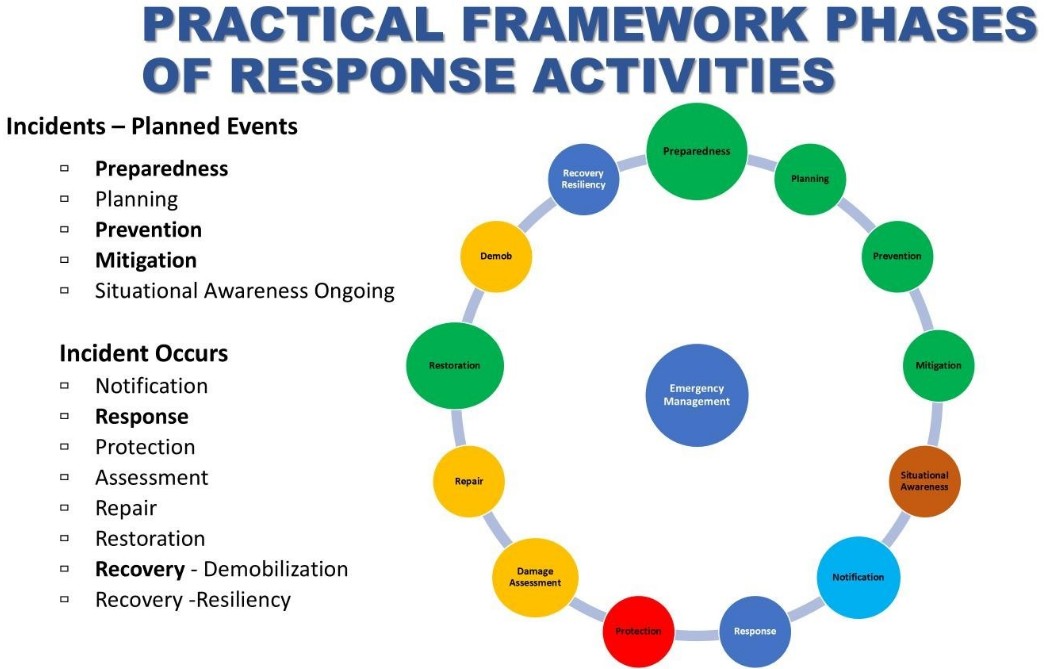
A Practical Framework Organized by the Five Emergency Management Phases
- Prevention
Utilities can move beyond reactive planning by applying proactive measures that prevent or limit system disruptions, including cybersecurity safeguards, physical security improvements, real-time monitoring, and interagency information sharing. Over time, these efforts help protect public safety, preserve economic stability, and reduce the cascading community impacts that follow major service disruptions. This phase directly supports the Critical Infrastructure Committee’s role in helping commissions identify evolving threats and encourage utilities to adopt practices that reduce the likelihood of catastrophic failures before they occur.
- Mitigation
Targeted risk-reduction investments can lessen disaster impacts, improve service continuity, and reduce the long-term burden on households, businesses, public agencies, and local economies. Examples include grid hardening, flood protection, substation fortification, vegetation management, wildfire mitigation, and improved system design. The discussion will also address tools such as RAMCAP/J100, which help quantify risks and resilience benefits, giving commissions a more objective basis for determining whether utilities are addressing known vulnerabilities in ways that strengthen community resilience over time.
- Preparedness
Preparedness is where regulatory oversight can have the greatest practical impact. Commissioners will gain a clearer understanding of what credible utility preparedness should include:
- Emergency plans aligned with NIMS and ICS
- Clear command structures and communication protocols
- Pre‑identified staffing strategies that anticipate personal impacts on employees
- Coordination with state emergency management, public safety agencies, and other lifeline sectors
- Messaging plans for customers, including medically vulnerable populations
- Exercises, training, and after‑action reviews that reveal whether plans are actionable
Winter Storm Fern showed that preparedness cannot stop at equipment, procedures, or mutual aid agreements. It must also account for utility staff who are expected to restore service while their own families and communities are affected. The session will help commissions evaluate whether utilities have realistic plans for workforce shortages, family-care needs, mental and physical fatigue, transportation disruptions, school closures, and other conditions that can limit response capacity during a major event. Strong preparedness supports long-term community stability by helping utilities maintain essential services, reduce recovery delays, and protect the workers who sustain lifeline infrastructure.
- Response
Integrated emergency management principles, especially ICS, can make utility response faster, safer, and more coordinated. These principles support unified command, clearer resource allocation, stronger cross-sector interoperability, and better situational awareness. They also help limit the duration and severity of community disruption by improving how utilities coordinate with public safety, emergency management, and other lifeline sectors during crises. This phase reinforces a critical operational reality: utility personnel must restore service while often managing personal disaster impacts of their own. Commissioners will gain insight into how to assess utility protocols for crew safety, mutual assistance, resource staging, decision-making, and employee support.
- Recovery
Recovery is more than restoring power; it is the phase that determines whether a disaster becomes a repeated vulnerability or a catalyst for stronger long-term community resilience. Commissioners will learn how effective recovery processes improve future planning, reduce recurring risks, and ensure that utilities capture lessons learned in a disciplined way. Recovery also requires coordinated documentation, reimbursement alignment, and transparent communication with commissions and communities. Regulators will see how after-action analyses can inform future rate cases, reliability plans, and resilience filings so that each event leads to stronger systems, better customer protection, and more durable community outcomes.
Key Takeaways
- A regulator-focused understanding of how the five emergency management phases create a complete, proactive resilience strategy that protects essential services and supports long-term community stability.
- Tools to evaluate utility plans- including risk assessments, staffing models, emergency exercises, communication strategies, and ICS/NIMS integration-with a focus on reducing service disruptions and improving outcomes for customers and communities.
- Recognition that utility staff serve both as responders and as community members affected by disasters, making workforce preparedness and continuity planning essential to safe, reliable restoration.
- A clearer approach to assessing prevention and mitigation investments, including standardized risk-assessment tools such as RAMCAP/J100, to help reduce recurring vulnerabilities and strengthen community resilience over time.
- Guidance for reviewing preparedness filings and after-action reports to determine whether utilities are applying lessons learned from events such as the January 2026 winter storm to improve future planning, recovery, and customer protection.
- A stronger regulatory lens for communication, equity, and customer protection, especially for medically vulnerable populations, rural communities, critical facilities, and others most affected by prolonged disruptions.
- Alignment with the NARUC Critical Infrastructure Committee’s mission to help state commissions evaluate threats, share solutions, and advance infrastructure security and resilience in ways that deliver lasting benefits for the communities utilities serve.
- Recognition that existing plans, standards, and compliance filings are only a starting point; regulators should require evidence that utilities can protect critical infrastructure under combined cyber, physical, weather-driven, and cascading lifeline-sector incidents.
Why This Information Matters to All
As hazards intensify and interdependencies deepen, state commissions must be able to evaluate whether utilities are not just reactive but proactively prepared across all five emergency management phases. Understanding these phases helps regulators assess whether utilities:
- Prevent what they can
- Mitigate what they cannot prevent
- Prepare for what they cannot mitigate
- Respond effectively under real‑world staffing constraints
- Recover in ways that strengthen future resilience
Each season has brought a new reminder that the nation’s lifeline infrastructure is operating under increasing pressure. The challenge before the utility sector is no longer recognizing the risk.
It is determining whether our planning, partnerships, workforce, security controls, and systems can keep pace with it. Resilience is no longer a future objective. It is a present-day operational necessity and a public safety requirement. By adopting an emergency-management-centered and security-focused approach, commissions can advance the Whole Community concept by ensuring utilities plan, train, exercise, and invest for everyone affected by disasters—customers, critical staff, public agencies, businesses, vulnerable populations, critical facility operators, and communities that depend on lifeline services. The Whole Community concept and critical infrastructure security are inseparable: communities cannot be resilient if lifeline infrastructure fails, and infrastructure cannot be truly secure if plans do not account for the people, services, and dependencies it supports. Standardized, NIMS-compliant preparedness should therefore be paired with stronger critical infrastructure protection, cyber and physical security coordination, dependency planning, and validated continuity capabilities so utilities can protect the full community they serve during and after major disasters.
2026 Update Addendum: Extreme Heat, Planned Shutoffs, and Regulatory Considerations
Winter Storm Fern and the summer heat emergencies of 2026 demonstrate that utility resilience must address both cold-weather and extreme-heat risks. During summer 2026, prolonged heat events drove record electricity demand, prompted emergency actions by grid operators and the U.S. Department of Energy, and required extensive coordination among utilities, emergency managers, public health agencies, and emergency operations centers.
Public Safety Power Shutoffs and other planned de-energization strategies should be incorporated into utility emergency management programs. While intended to reduce catastrophic wildfire and infrastructure risks, these actions can affect communications, healthcare, water, transportation, and other lifeline systems. Regulators should evaluate utility coordination, notification, and support plans for vulnerable populations and critical facilities.
Extreme heat response requires many of the same emergency management functions used during storms, including EOC activation, public information, mutual aid coordination, continuity of operations, cooling center support, and protection of medically vulnerable populations.
For regulators, recent FERC and NERC actions establish a stronger expectation for extreme-weather planning. FERC Order No. 896 directed development of new reliability requirements addressing extreme heat and cold weather planning. NERC standard TPL-008-1 requires transmission planners to assess system performance under benchmark extreme temperature scenarios and develop corrective actions where vulnerabilities are identified.