

The FBI’s Internet Crime Complaint Center (IC3) released its 2025 Internet Crime Report and accompanying state reports. The latest report includes information from more than 1 million complaints of cyber-enabled crimes that cost Americans nearly $21 billion in 2025 – a 26% increase in losses from 2024. Complaints that involved cryptocurrency and artificial intelligence were identified as the most damaging.
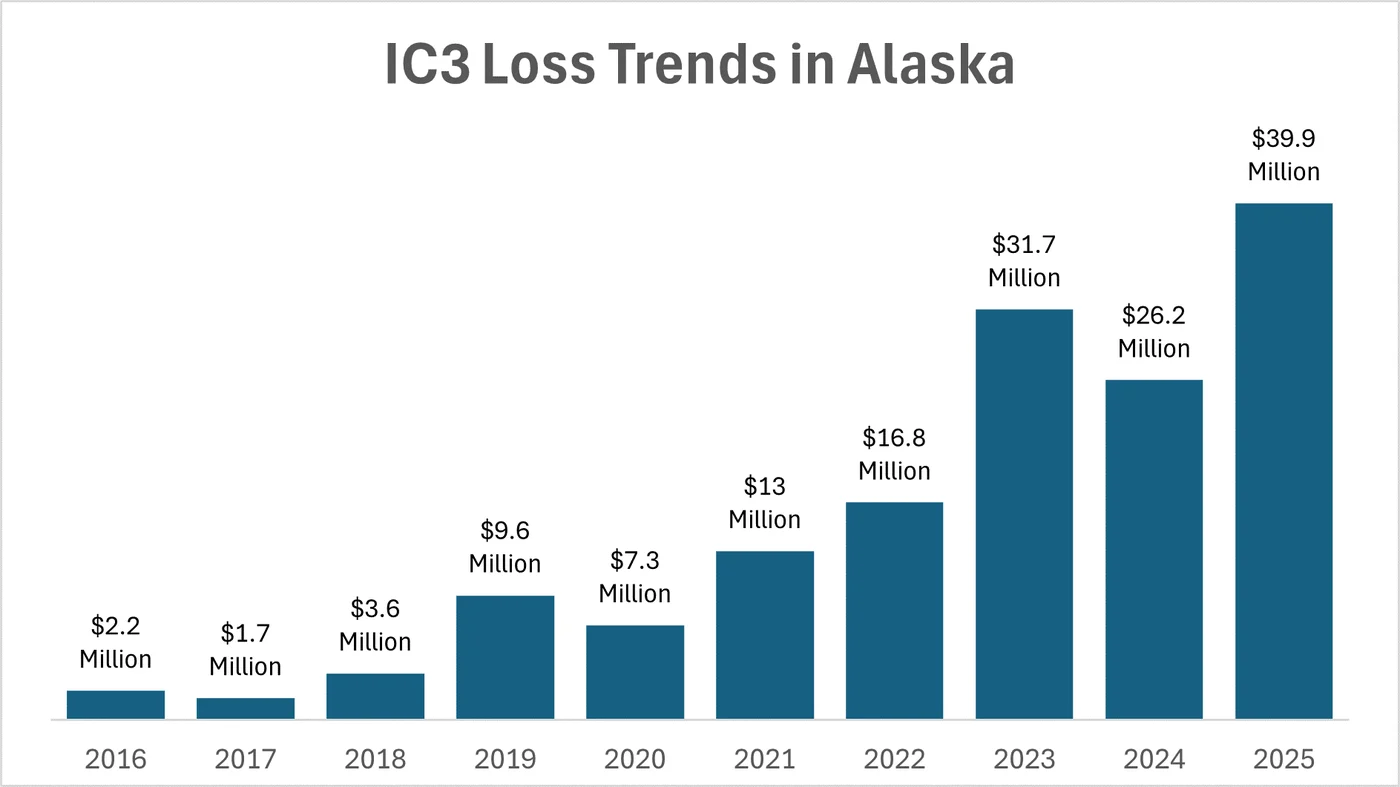
According to the 2025 report, Alaskans filed 3,202 complaints to IC3 with reported losses of nearly $40 million – a 52% (over $13.6 million) increase in losses from 2024. In Alaska, approximately 46% (over $18.6 million) of reported losses were cryptocurrency related.
“Following a more than 50 percent increase from the prior year, these numbers represent the highest financial losses ever reported in Alaska involving cyber-enabled crimes,” said Special Agent in Charge Matthew Schlegel of the FBI Anchorage Field Office. “Behind these numbers are real people – Alaskan families who lost hard-earned savings, retirement funds, and financial security. To combat this ever-evolving threat, it has never been more important for residents and businesses to be diligent with cybersecurity, electronic interactions, and safeguarding personal and financial information.”
Alaskans reported a variety of cyber-enabled crimes; however, the costliest schemes were reported as investment fraud ($13.2 million), confidence/romance fraud ($7.1 million), and business email compromise ($7 million). These crimes are described as:
- Investment Fraud: Deceptive practice that induces investors to make purchases based on false information. These scams usually offer the victims large returns with minimal risk. (Retirement, 401K, Ponzi, Pyramid, etc.)
- Confidence/Romance Fraud: An individual believes they are in a relationship (family, friendly, romantic) and are tricked into sending money, personal and financial information, or items of value to the perpetrator or to launder money or items to assist the perpetrator. This includes any scheme in which the perpetrator preys on the targeted individual’s “heartstrings.”
- Business Email Compromise (BEC): BEC is a scam targeting businesses or individuals working with suppliers and/or businesses regularly performing wire transfer payments. These sophisticated scams are carried out by fraudsters by compromising email accounts and other forms of communication, such as phone numbers and virtual meeting applications, through social engineering or computer intrusion techniques to conduct unauthorized transfer of funds.
In Alaska, all age groups were impacted by cyber-enabled crimes; however, those over the age of 60 accounted for the highest reported losses ($16.2 million), including the highest reported losses involving cryptocurrency transactions. The top crime types that were reported by those over the age of 60 in Alaska were investment fraud ($6 million), confidence/romance fraud ($4 million), and tech support fraud ($2.1 million).
For the past quarter-century, the IC3 has been the primary connection between the FBI and the public for information related to cyber-enabled criminal activity. The IC3 produces annual reports based on information received by the public, publishes public awareness campaigns, and provides consumer and industry alerts to the public and private sector.
The original announcement can be found here.