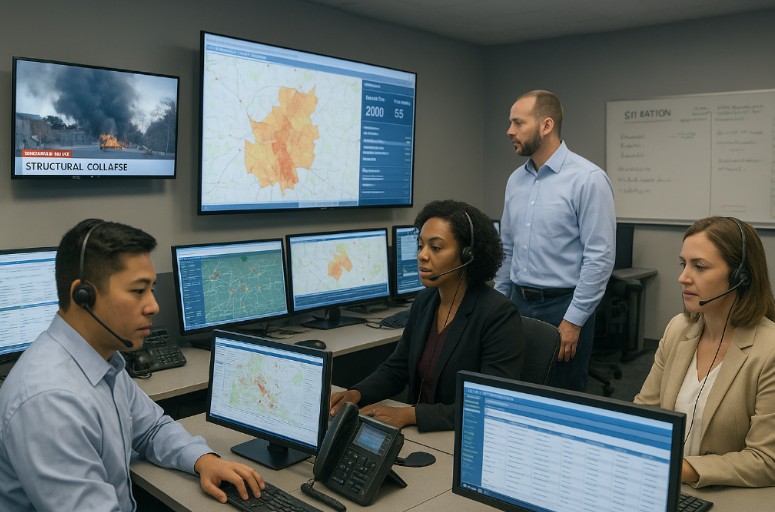
Not everyone who works in emergency management has spent time inside an Emergency Operations Center. Yet the EOC is where wide ranging impacts are coordinated into unified action, and where the everyday resilience of a community is tested under pressure.
I chose to tell this story in a narrative format because emergency management needs more storytelling. Facts and data are vital, but they do not always capture the human experience or the teamwork that drives successful outcomes. Stories can reveal the professionalism, sacrifices, and quiet heroism that rarely make it into after action reports.
Of course, this account is condensed for narrative clarity. One shift inside a real EOC could fill an entire novel, because the decisions never stop and the impacts continue to evolve long after one team hands off to the next. My goal here is simply to offer a glimpse into that world and to honor those who make communities safer when it matters most.
08:20
The walls hummed with activity that never truly began or ended. Morning sunlight filtered through the tinted windows of the Emergency Operations Center, though few noticed the outside world once they walked through the secured doors. The day shift was already well into their rhythm, caffeine, focus, and quiet urgency carrying the room.
Chief Daniel Okoye stood near the large incident board as he reviewed the latest reports. The power grid had failed across major portions of the region after an equipment fault had cascaded unpredictably. The sudden loss of electricity had strained everything that depended on it. Water pressure was dropping citywide. Two hospitals were running on backup generators that might not last through the night. Traffic signals had gone dark along major routes. Cell service flickered unevenly.
Daniel took a breath that he hoped no one saw. This would certainly test their training.
Across the room, posters for the Incident Command System lined the walls. Screens displayed maps with blinking alerts and scrolling impacts. The soft tap of keyboards and the murmur of professionals calling jurisdictional partners mixed with the static of radios working through backup repeaters.
This place had its own pulse.
At the Situational Awareness Desk, Ben Stevens scanned data streams. He leaned forward each time a new alert flashed red. “Water pressure is down to thirty percent at two treatment facilities. Operators say it keeps falling without pumps.”
Daniel raised his voice just enough. “Which neighborhoods are affected first”
Ben pointed to clusters of blue outlines pulsing on the map. “Southside first. Then West Ridge.”
Daniel nodded. “Sarah and Maria, come with me.”
Maria Hernandez, Planning Section Chief, held a binder thick with contingency procedures. “Hospitals are priority for water, but we have to track sanitation risks in homes.”
Sarah Lindstrom, Logistics Section Chief, tapped quickly on her tablet. “Water district needs manual readings. No SCADA [Supervisory Control and Data Acquisition], no remote visibility.”
“We can help them,” Daniel said. “Deploy mutual aid to support.”
Purpose filled the room, not panic.
10:05
Rumors had already arrived faster than verified facts.
Aisha Patel, Public Information Officer, walked briskly between workstations. She checked data points twice before releasing information. People without power were anxious and needed clarity more than comfort.
She approached Daniel. “Reporters are pushing the cyberattack angle.”
He crossed his arms. “Any evidence of that?”
“Not at this time,” she said. “I will stay disciplined in verifying before messaging.”
“One truth at a time,” Daniel replied. “No speculation.”
She nodded and sent the update.
EM was the art of solving problems calmly when calm was not the default.
12:00
The first wave of cascading impacts hit harder.
Ben’s tone sharpened. “Dialysis clinic is losing generator capacity.”
Sarah responded without pause. “We need to coordinate with the power company to make sure we are in synch on the order and priorities for restoration to the hospitals and treatment facilities. Everything else waits.”
Maria scribbled notes while turning binder pages. “We need patient transport contingencies too.”
Even at high speed, they documented every choice. Every decision needed a traceable path because accountability did not sleep in emergencies.
The collective goal remained constant. Protect the systems that keep people alive.
14:30
Heat climbed outside. Inside, the pace intensified.
Cooling centers normally opened during heat emergencies lacked sufficient generator power. Assisted living facilities reported failing medical devices. Refrigerated medicines in homes were warming. Battery powered lifelines were draining.
Response efforts synchronized. Resource lists updated. Volunteer groups contacted. Field teams deployed.
Maria stood near the planning board for a mid-operational period update. “We see partial stabilization in the western grid. Hospitals remain high priority. Water district has two repair teams in the field. They need safety escorts because intersections are volatile.”
Daniel nodded. “Every cleared intersection is potentially a life saved.”
“We project some neighborhoods getting power back within six hours,” Maria said. “Others could take twelve or more. We need overnight shelter plans for residents with medical needs.”
They did not flinch. They adapted.
Nobody here pretended this would be resolved by sunset.
16:15
Ben leaned forward. “Cell networks improving in the north. More connectivity for check ins.”
A brief wave of relief. Not celebration. Just breath.
“Water pressure is stabilizing at one treatment facility,” he added.
Maria let out a quiet exhale. “That is the break we needed.”
The news did not feel like resolution, but it was progress. A sign that discipline and stubborn attention to detail were turning momentum.
Daniel gathered the leads. “We controlled the critical points today. We have not won this fight, but we kept it from getting worse. Finalize documentation for handoff.”
They answered with simple acknowledgments.
The absence of cheering did not diminish what they had accomplished.
18:45
The overhead lights seemed softer as the shift winded down. Phones still buzzed. Radios still called. Outside, darkness grew and thousands still needed resources and reassurance. Yet inside these walls, there was measured order.
Sarah closed her tablet. Maria saved her final situation report. Ben stretched out stiff fingers. They had earned a few hours of rest before tomorrow arrived.
Aisha finished one last message before packing up her tablet. As she walked toward the exit, her phone buzzed. Another reporter calling. She would take that call in the car on her way home. The work does not necessarily end when you leave the EOC.
Daniel lingered a moment, scanning chairs left slightly askew, cold coffee, whiteboards filled with key decisions. This was success in its most humble form. Stability restored one adjustment at a time.
He stepped into the hall as the secured door closed behind him. The night shift would take the baton. They would push the progress further.
The sunlight was long gone. That did not matter.
Duty did not require daylight.
Inside the EOC, the mission continued.
Author’s Note
Emergency Operations Centers rarely make headlines, but when disaster strikes, they are the nerve center of the response. Emergency managers bring collaboration, calm judgment, and relentless coordination to protect communities. This story is fictional, yet every decision, every moment of stress, and every quiet victory honors real professionals who ensure others can endure the worst days of their lives. Their work is steady, disciplined, and deeply human.
Dan Stoneking is the Owner and Principal of Stoneking Strategic Communications, the Author of Cultivate Your Garden: Crisis Communications from 30,000 Feet to Three Feet, the Founder and Vice President of the Emergency Management External Affairs Association, and an Adjunct Professor in the Communications Department at West Chester University.