


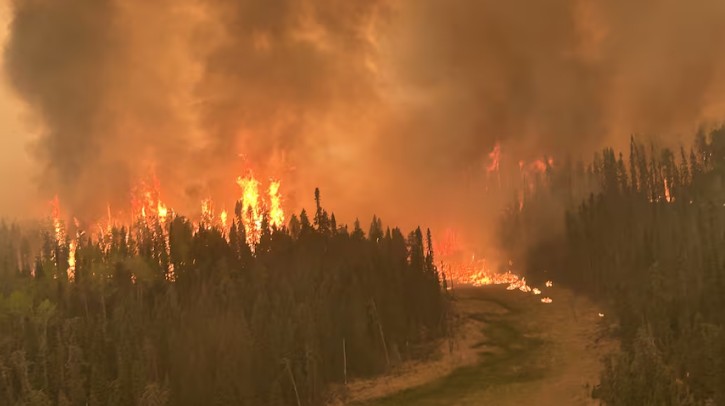
The Honourable Eleanor Olszewski, Minister of Emergency Management and Community Resilience and Minister responsible for Prairies Economic Development Canada, joined by Corey Hogan, Parliamentary Secretary to the Minister of Energy and Natural Resources, and Ginette Lavack, Parliamentary Secretary to the Minister of Indigenous Services, have provided an update on the worsening wildfire situation in Canada.
As of July 9, there were 796 active wildfires nationally including 60 with full response, that are out of control. In total this season, there have been 3,137 fires and 1.4 million hectares burned. Last year we saw fewer fires at this time, 2,913, but a more significant area burned, 4,614,713 hectares.
Canadian Prime Minister, Mark Carney provided the following update on July 16:
— Prime Minister of Canada (@CanadianPM) July 16, 2026
Looking ahead, Environment and Climate Change Canada’s weather forecasts point to above-average temperatures across much of Canada from July through August, with dry conditions expected for some regions like Manitoba and Northwestern Ontario.
Modelling indicates that in July, fire danger is expected to remain the highest across the Northwest Territories, Nunavut and northern Manitoba and areas surrounding the Hudson Bay, with elevated potential for fires in northern Ontario and Quebec. Given recent widespread and sustained precipitation, most of western Canada is forecast to experience low to moderate fire danger, with localized pockets of higher danger in interior British Columbia. In August, fire danger is expected to follow the same regional trends as July, except southern interior British Columbia is also expected to experience higher-than-normal fire danger.
Natural Resources Canada also announced a total investment of $1.25 million for six projects that will strengthen wildfire preparedness and response capacity across the country. This includes projects with the Métis Nation British Columbia, Métis Nation of Alberta, Métis Nation–Saskatchewan, and the Métis Nation of Ontario to strengthen wildfire preparedness and response through risk mapping, emergency planning, evacuation coordination and integrating Indigenous knowledge into wildfire management. It also includes investments for the Délı̨nę Got’ı̨nę Government and Chipewyan Prairie First Nation to train up to 38 Indigenous wildland firefighters and build local skills, certifications, and response capacity.
Please see my statement on Canada-US collaboration in wildfires and recent investments in forest sustainability and fire prevention: pic.twitter.com/nfkJs1OVO3
— Eleanor Olszewski (Ol-SHEV-skee) 🇨🇦 (@EleanorO_MP) July 18, 2026
The federal government is working closely with provinces, territories, and First Nations communities and partners to support response and recovery efforts.
At the same time, numerous regions are also struggling with flooding due to recent intense storms and rainfall. Manitoba has been hit particularly hard, especially in the Parkland Region. On Friday, July 3, Minister Olszewski approved Manitoba’s Request for Federal Assistance to support the flooding response and recovery in the province. This followed collaboration between federal and provincial officials as well as discussions with the Honourable Wab Kinew Premier of Manitoba and the Honourable Lisa Naylor, Manitoba Minister of Transportation and infrastructure, and Minister responsible for the Emergency Management Organization to determine how to best support the evolving response and recovery needs on the ground. The federal government also stands ready to support Manitoba if a request is made to access the Disaster Financial Assistance Arrangements, which provides cost-shared funding for eligible provincial response and recovery expenses following major natural disasters.
The original announcement can be found here.