


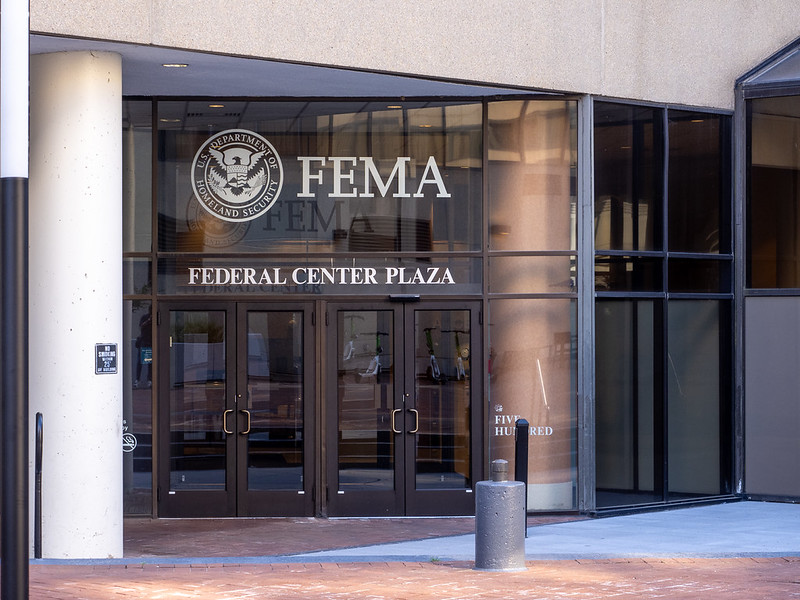
The House Transportation and Infrastructure Committee renewed its push for sweeping reform of the Federal Emergency Management Agency (FEMA) this week, with lawmakers and emergency management leaders examining proposals they say would fundamentally reshape how the federal government prepares for, responds to, and recovers from disasters.
The hearing brought together former FEMA Administrator Craig Fugate, local government officials, utility and insurance industry leaders, and business representatives to discuss long-term changes to the nation’s disaster response framework.
In his opening remarks, Committee Chairman Sam Graves (R-Mo.) argued that years of incremental reforms have failed to address systemic problems within the agency.
“What everyone seems to agree on is that FEMA is broken and has been for a long time,” Graves said.
Graves pointed to a series of congressional reforms—including the Post-Katrina Emergency Management Reform Act of 2006, the Sandy Recovery Improvement Act of 2013, and the Disaster Recovery Reform Act of 2018—that sought to improve FEMA’s operations but, he argued, have not resolved persistent challenges.
“We have passed reform after reform since FEMA was put into DHS and what was the result?” Graves said. “We have thousands of open disaster projects dating back to Hurricane Katrina, ballooning disaster costs, a bureaucracy that feels like you need a Ph.D. to navigate, and little common sense.”
According to Graves, the agency’s complex reimbursement process and administrative burden continue to slow recovery efforts for communities across the country.
FEMA Act at the Center of Reform Debate
Much of the hearing focused on the Fixing Emergency Management for Americans (FEMA) Act, bipartisan legislation developed by Chairman Graves and Ranking Member Rick Larsen (D-Wash.).
The proposal follows more than a year of stakeholder engagement, with committee staff consulting over 150 organizations representing state and local governments, emergency managers, nonprofits, industry, disaster survivors, and other experts.
Graves said the legislation shares many of the same objectives as recommendations recently issued by President Trump’s FEMA Review Council, suggesting growing consensus around the need for structural reform.
Among the reforms highlighted during the hearing are:
- A disaster response model that is state-led, locally executed, and federally supported
- Replacing FEMA’s reimbursement-heavy recovery model with upfront grants to accelerate rebuilding
- Streamlining mitigation funding to reduce future disaster losses
- Modernizing individual disaster assistance programs to simplify aid for survivors
- Reducing bureaucratic requirements that delay recovery projects
“We all agree FEMA’s reimbursement process for rebuilding is inherently flawed,” Graves said. “Moving to upfront grants will not only speed things up but reduce costs.”
Witnesses Highlight Diverse Perspectives
The committee heard testimony from a panel representing federal, state, local, and private-sector stakeholders:
- Craig Fugate, former FEMA Administrator
- Cynthia Lee Sheng, President of Jefferson Parish, Louisiana, testifying on behalf of the National Association of Counties
- Jim Matheson, CEO of the National Rural Electric Cooperative Association
- Brian Waller, Vice President of External Relations at Shelter Mutual Insurance Company, representing the National Association of Mutual Insurance Companies
- Chuck Chaitovitz, Vice President of Environmental Affairs and Sustainability at the U.S. Chamber of Commerce
The witnesses discussed disaster recovery challenges facing local governments, critical infrastructure operators, insurers, and businesses, underscoring the broad impact of FEMA policies across the emergency management community.
Momentum Builds for Legislative Action
The hearing comes as Congress considers the future of federal disaster policy amid increasingly frequent and costly natural disasters.
Graves said he hopes the release of the FEMA Review Council’s recommendations will provide additional momentum for passage of the FEMA Act.
“Now that the FEMA Review Council’s recommendations have been released, we hope we can move forward with passing the FEMA Act,” he said.
If enacted, the legislation would represent one of the most significant overhauls of the nation’s emergency management system since FEMA became part of the Department of Homeland Security, shifting the agency toward a model intended to give states and local communities greater flexibility while simplifying federal disaster assistance.