
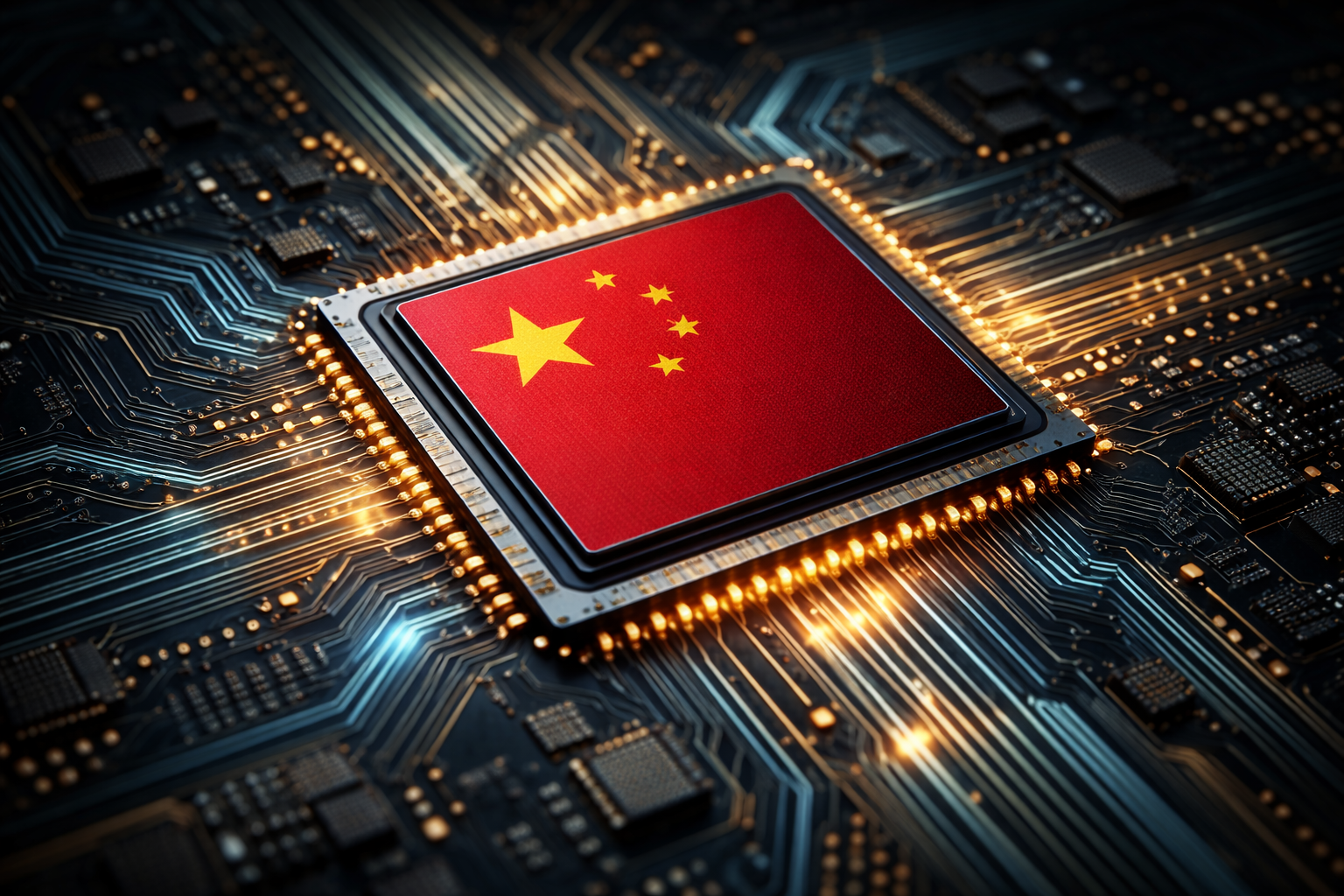
The race for semiconductors is the new arms race. Whoever controls the most advanced chips controls the future of artificial intelligence, economic growth, and national security. In 2022, the U.S. sought to freeze China out of this competition by imposing sweeping export controls on advanced processors and manufacturing equipment. But two years later, the very restrictions designed to hinder Beijing’s may instead be accelerating China’s progress.
Why the U.S. Turned to Export Controls
U.S. policymakers established semiconductor export controls in response to concerns regarding national security related to Chinese companies such as Huawei, issues identified in global chip supply chains during the COVID-19 pandemic, and efforts to support continued U.S. leadership in semiconductor chip technology development.
Huawei’s expanding role in 5G networks and U.S. reliance on China’s technology raised concerns about Chinese influence in critical infrastructure. The pandemic-era shortages underscored how dependent the U.S. economy had become on Taiwan’s Taiwan Semiconductor Manufacturing Company (TSMC), located just across the Taiwan Strait from China. Both the U.S. and China understand that advanced chips will shape the future balance of power, enabling breakthroughs in artificial intelligence (AI), advanced weapons, and high-performance computing such as quantum.
On October 7, 2022, the U.S. Bureau of Industry and Security (BIS) announced the most sweeping restrictions in decades. The rules targeted four areas: advanced AI processors, semiconductor design, fabrication capabilities, and access to manufacturing equipment.i NVIDIA’s flagship A100 and H100 graphics processing units (GPUs) were banned to export to China, while other U.S. companies, such as Applied Materials, Lam Research, and KLA Corporation, could also no longer export their most sophisticated tools to Chinese firms.ii GPUs accelerate graphics rendering by complex mathematical calculations needed in visual output.
The immediate aftermath of this BIS announcement was disruptive. Projects across the globe were delayed causing costs to rise and leading industry firms to scramble and adapt. However, as matters progressed, it became evident that loopholes, alternative approaches, and unforeseen outcomes could diminish the long-term efficacy of the strategy.
Loopholes and Workarounds
Despite their sweeping scope, the U.S. controls put in place by BIS contained technical, legal, and enforcement gaps. Regulators initially focused on chip specifications, such as interconnect speeds and performance thresholds, which left space for firms to design around restrictions while still delivering near-advanced capabilities.iii
Legal maneuvering also eroded the BIS’ restrictions impact. Some foreign companies stockpiled chips before the restrictions took effect, thus creating buffers of supply so they could adapt more strategically. Other foreign companies structured deals narrowly within compliance, exploiting ambiguities in the restrictive languageiv while other companies benefitted from unauthorized channels which was particularly concerning. For example, smuggling networks and third-party intermediaries facilitated the flow of restricted GPUs into China. Reports documented that NVIDIA’s A100 and H100 GPUs, supposedly cut off by U.S. policy, were still available for purchase on Chinese e-commerce platforms months after the ban.v
These gaps underscored the enduring challenge of technology denial in a globalized economy. Past attempts, from Cold War restrictions on supercomputers to sanctions on Russia, suggest that export controls can slow but rarely halt determined rivals. China’s scale, resources, and state coordination made it particularly adept at adapting to and circumventing U.S. export restrictions.
China’s Countermove: A National Drive for Self-Sufficiency
Rather than crippling Chinese innovation, U.S. export controls seemed to stimulate and motivate China’s push for technological independence. The effects were visible across multiple dimensions:
- Artificial intelligence adaptation. Chinese firms began building models optimized for locally available processors. DeepSeek, a rising AI company, released a large language model designed to run without NVIDIA’s cutting-edge GPUs. While U.S. firms like OpenAI rely on frontier hardware, DeepSeek’s work showed that software optimization could compensate for hardware constraints.vi
- Breakthroughs in chipmaking. In 2023, Huawei released the Mate 60 Pro smartphone, powered by an advanced 7-nanometer (nm) chip manufactured domestically by Semiconductor Manufacturing International Corporation (SMIC). The device shocked observers and caught the attention of U.S. officials, who had assumed China was years away from producing such advanced chips at that scale.vii
- Talent investment. Recognizing the need for human capital, China’s Ministry of Education made semiconductor sciences a priority discipline within their education system. Peking University launched its School of Integrated Circuits to train engineers, addressing estimates that the country would need up to 600,000 specialists in semiconductor sciences.viii Universities across China expanded programs, signaling a long-term commitment to developing expertise.
- Manufacturing equipment development. Chinese companies also turned to building domestic fabrication tools. Shanghai Micro Electronics Equipment (SMEE) announced plans for its first 28nm lithography machine by 2024, still far behind Dutch leader Advanced Semiconductor Materials Lithography (ASML) in the Netherlands, but a notable step toward independence from foreign suppliers.ix
- Massive government funding. Perhaps most striking was China’s infusion of state capital. In May 2024, Beijing launched a $47.5 billion semiconductor investment fund, more than double its previous record initiative in 2014.x The fund reinforced Xi Jinping’s broader ambition for China to achieve technological self-reliance and global leadership.
Overall, these developments resulted in measures intended to restrict China’s access to advanced technology coinciding with an increase in its domestic technological mobilization.
The Global Stakes
China’s accelerated progress carries serious consequences for the U.S. and its allies. Economically, the rise of a credible alternative supplier could diminish U.S. dominance in semiconductor markets. Countries across Asia, Africa, and parts of Europe may choose to diversify away from U.S. technology if Chinese chips become more competitive.xi
Geopolitically, adversaries such as Russia stand to gain from China’s ascension. Already constrained by Western sanctions, Russia could turn to China for advanced processors, boosting its military modernization. Iran, North Korea, and other countries may similarly benefit from Chinese willingness to supply restricted technology.xii
U.S. allies face difficult choices as well. Japan, South Korea, and the European Union members remain economically tied to China but strategically aligned with the U.S. Coordinating export control regimes across these actors has proven challenging, and fragmentation risks undermining the collective effort. TSMC in Taiwan, is an important part of global supply chains and plays a significant role in relations between the U.S. and China.
An additional consideration is the development of alternative next-generation technologies. The U.S. and its allies may dominate one ecosystem, while China and its partners build another. Such divergence could slow innovation, raise costs, and fragment markets, but it may also clarify strategic alignments in a world increasingly defined by technology competition.
Policy Options and Dilemmas
The U.S. continues to face a difficult balancing act. Export controls remain one of the few non-military tools available to slow competitors’ access to critical technologies. Yet the effectiveness of export control is limited, and the potential for unintended consequences is significant.
Several options exist for U.S. policymakers:
- Tighten enforcement. Regulators can close technical loopholes, increase monitoring of third-party transfers, and strengthen penalties for violations.
- Deepen allied coordination. Export controls are most effective when applied multilaterally. Aligning strategy with partners in Europe and Asia proactively will be critical to reducing leakage.
- Accelerate domestic innovation. Initiatives such as the CHIPS and Science Act is a government program to encourage investment in domestic U.S. semiconductor research, development, and manufacturing, represents important steps. However, sustaining U.S. leadership will require long-term investment to include technical workforce development.
Ultimately, U.S. export controls should be viewed not as an end in themselves but as part of a broader strategy. Export control value lies in buying time for the U.S. to slow and possibly prevent intellectual knowledge loss, innovate faster, and build more resilient supply chains.
Conclusion
The semiconductor export controls implemented in 2022 represented a deliberate effort to influence the direction of global technological competition. In the immediate aftermath, these measures disrupted Chinese enterprises and reinforced U.S. leadership in the sector. However, over the long term, such controls may inadvertently contribute to the development of a more autonomous and resilient semiconductor industry in China, potentially fostering the changes they were intended to preclude.
This represents a situation where actions intended to limit China’s progress may have contributed to its advancement. The U.S. government faces the task of reviewing its policies, addressing enforcement issues, and supporting domestic innovation. In the semiconductor industry, maintaining status quo is not considered viable.
The author is responsible for the content of this article. The views expressed do not reflect the official policy or position of the National Intelligence University, the Office of the Director of National Intelligence, the U.S. Intelligence Community, or the U.S. Government.
Endnotes
i Bureau of Industry and Security, “Commerce Implements New Export Controls on Advanced Computing and Semiconductor Manufacturing Items to the People’s Republic of China (PRC),” September 7, 2022, https://www.bis.doc.gov.
ii Karen Freifeld and David Shepardson, “Latest US Clampdown on China’s Chips Hits Semiconductor Toolmakers,” Reuters, December 3, 2024, https://www.reuters.com/technology/latest-us-strike-chinas-chips-hits-semiconductor-toolmakers-2024-12-02/.
iii U.S. Government Accountability Office, Export Controls: Commerce Implemented Advanced Semiconductor Rules and Took Steps to Address Compliance Challenges, GAO-25-107386 (Washington, DC: GAO, 2024).
iv Anthony Rapa, “The Silicon Curtain: Sweeping US Export Controls Complicate Compliance across the Semiconductor Value Chain,” Corporate Compliance Insights, November 19, 2024, https://www.corporatecomplianceinsights.com/sweeping-export-controls-semiconductor-value-chain/.
v Eduardo Baptista, “China’s Military and Government Acquire Nvidia Chips despite US Ban,” Reuters, January 15, 2024, https://www.reuters.com/technology/chinas-military-government-acquire-nvidia-chips-despite-us-ban-2024-01-14/.
vi Stephen Ezell, “How Innovative Is China in Semiconductors?” Information Technology & Innovation Foundation, November 25, 2024, https://itif.org/publications/2024/08/19/how-innovative-is-china-in-semiconductors/.
vii Samantha Murphy Kelly, “The US Government Is Investigating China’s Breakthrough Smartphone,” CNN, September 7, 2023, https://www.cnn.com/2023/09/06/tech/huawei-mate-60-pro-phone/index.html.
viii “Asian Universities Step up Semiconductor Programmes,” University World News, October 21, 2021, https://www.universityworldnews.com/post.php?story=20211021144726611.
ix ASML, “Statement Regarding Dutch Government’s Export Control Regulations Announcement,” April 25, 2024, https://www.asml.com/en/news/press-releases/2023/statement-regarding-export-control-regulations-dutch-government.
x Laura He, “China Is Pumping Another $47.5 Billion into Its Chip Industry,” CNN, May 28, 2024, https://www.cnn.com/2024/05/27/tech/china-semiconductor-investment-fund-intl-hnk/index.html.
xi Matteo Crosignani et al., Geopolitical Risk and Decoupling: Evidence from U.S. Export Controls, Federal Reserve Bank of New York Staff Reports, April 2024, https://www.newyorkfed.org/medialibrary/media/research/staff_reports/sr1096.pdf.
xii Diana Roy, “The CHIPS Act: How U.S. Microchip Factories Could Reshape the Economy,” Council on Foreign Relations, October 8, 2024, https://www.cfr.org/in-brief/chips-act-how-us-microchip-factories-could-reshape-economy