


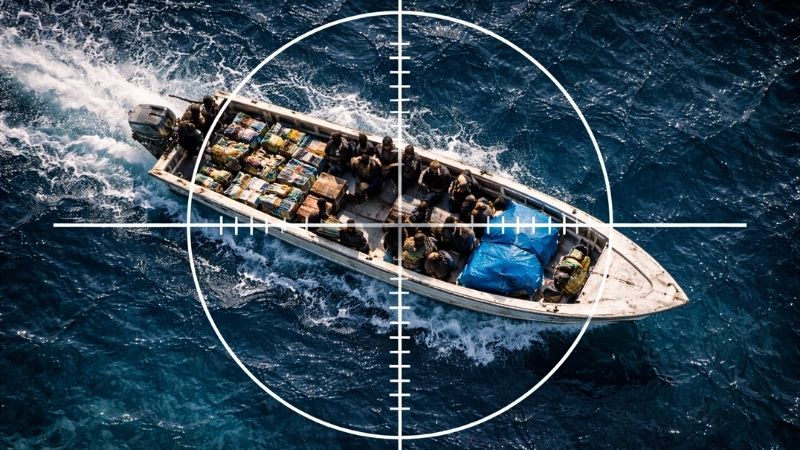
The Christmas holiday police action against the President of Venezuela took many inside the Beltway by surprise, even United States Senators. Questions now circulate about whether the South American police action will expand into an occupation, with or without a declaration of war by Congress. But one should be mindful: the intent has been there all along, from the beginning of the “Caribbean Boat Strike” matter.
This Trump Administration foreign policy moment started with classifying drug runners as “combatants” rather than “pirates.” Media and Congressional interest was focused on the targets, be they “victims” or “fatalities” (pick your paradigm). Few took note of the obvious question: if the targets were combatants, with whom was the United States at war? The language at the beginning was aligned with the Administration’s statements over this past weekend: you can only run a nation-state if you conquer the same. The awkward question of international law is whether there was a basis for action. That will require a determination—by all Americans—of whether international drug production and trafficking is the equivalent of war. That also means the sale of drugs could be the same, which will bring a whole new meaning to the “War on Drugs” in both urban and rural America.
Discourse regarding recent U.S. boat strikes in the Caribbean missed the point. Discussion of “war crimes” and “murder” blew past the initial step required before determining the lawfulness of these boat strikes. This is understandable, given the larger confusion. President Trump’s speaking in terms of “war” further confused matters. We are not at war, which subjects ourselves and enemies of the State to both international humanitarian law and U.S. wartime policy and regulations. But “war” in the metaphorical sense is far from novel in American jurisprudence. We wage war on poverty, war on inflation, war on drugs, war on cancer, even war on terror—all of this sloppy use of language muddies our thinking to the point where we are now accused of murder. Yes, the President acts in all our names. That is the downside of living in a Republic. You own what we collectively elect.
Determining the Legality of an Administration’s Actions
“Legal sufficiency” is the act by which Government attorneys advise decision-makers, based on input from subject matter experts (SMEs), on the legality of Government actions. It happens at every level of Federal, State and local governance. The prudent decision-maker “gets legal sufficiency” to reduce their liabilities. Think of the later rescinded 2002 Torture Memos providing for enhanced interrogation during the, yes, “War on Terror.” The process of issuing legal sufficiency can lead to protracted and intense battles between SMEs and offices of general counsel. In the lead up to the Caribbean Boat Strikes, this process ought to have produced three options, which have unfortunately become intertwined in the federal press relations and coverage during the fall of 2025.
Maritime interdiction may fall into one of three categories based not on some empirical analysis for a dissertation or a novella, but rather on the forum the decision-maker decides to pursue. In choosing the forum, one chooses the law, and the obligations under the law chosen. This same analysis needs to be conducted for actions against foreign Heads of State who step down from their thrones to conduct actions as everyday individuals. To the extent a Head of State deigns to act like a merchant of narcotics death, she or he may be stepping out from behind the aegis of international law.
There are three legal paradigms to consider:
- The Law of War. This places critique of the action in the category of ‘war crimes’ which will be alleged and adjudicated by the victor. Accordingly, it is good to be the victor. The International Criminal Court (ICC) can hear these cases; so can the victor’s court, or in the case of “victors,” a special tribunal, like the Nuremberg tribunals. If you do not want to take this path, do not declare war, and if declared, do not lose a war. In the United States, Congress declares war through a declaration of war, or, we can now accept, a use of force declaration. Rhetorical wars on poverty, inflation, drugs, terror, etc. are not ‘wars.’ They are political campaigns leading to policy initiatives.
- Prosecution of Maritime Crimes. The rhetorical “war on drugs” by the Reagan Administration led to passage of the Maritime Drug Law Enforcement Act (MDLEA). This federal statute criminalizes drug trafficking on the high seas and grants the United States broad powers to board, search, seize, and prosecute vessels and persons beyond the nation’s territorial waters. It is a tool, primarily for the United States Coast Guard (USCG), to move drug trafficking cases into federal District courts and empower American jurists in executing U.S. Law. The MDLEA’s extraterritorial jurisdiction has generated legal controversy over how far Congress may extend United States law regarding criminal liability. The MDLEA does not cover the same policy goals as The Law of War. It basically answers the question, controversially, of what the Coast Guard does when it has the drug trafficker in hand? The answer is: they send the criminal to a federal District Court. It does not obligate the President to take one path over another.
- The Law of Piracy. As is detailed below, when the statutory, convention, or treaty law does not apply because jurisdiction does not exist, or the United States has not assented to the law in question, the international customary law of piracy does apply. It does not create or empower lex talonis, or the Law of the Talon, but it does note when people—such as drug runners—have placed themselves outside the protection of the law and can be accordingly terminated. There are some due process concerns, primarily based in the need to prevent legal ‘mistake’ whereby the innocent ship master is mistaken for a pirate.
For the White House, this is not a scientific, empirical effort: collect the facts, decide in which category the Caribbean-transiting boats fall, and then apply the law. No, this decision-making is a choice from the outset: do we want war, prosecution, or lawful, extra-judicial termination. Once we choose the category, knowing the limits in place (e.g., Congress has declared no war, extra-territoriality is or is not an issue, etc.), we then act according to the rules regarding war, maritime crimes, or piracy.
When it comes to the lawfulness of using lethal force against pirates, the Trump Administration steers between Scylla and Charybdis. A pair of distinct legal frameworks—with their procedures, rights, justifications, obligations, consequences—stand on either side. Tacking to port takes the President to the wartime military paradigm with its potential violations of both U.S. military procedures and international humanitarian laws. Tacking instead to starboard brings us to the Maritime Law Enforcement (MLE) paradigm, where lack of due process and extrajudicial killings could bring murder charges.
A narrow yet historically well-traveled strait may offer passage between the two: the piracy paradigm.
Much Needed Clarity for Categorical Confusion
The nickname granted Secretary Hegseth in some internet corners, Pete “Hagueseth,” makes a categorical error. Separate from the question of whether these strikes are justified—an important one, certainly—is the question: were these strikes lawful according to those laws under which the United States has agreed to operate? An unlawful strike carried out by military means does not indicate a war crime. The distinction is far from pedantic. It determines the proper course of justice.
We can only discuss the laws, rights and potential violations thereof after answering this question: whom did we strike? This involves answering two interrelated questions:
- Given our policy choice regarding narcotics, under which category did these boat operators fall;
—and, thereby—
2. What legal model applies to them?
Are we at war? Are these lawful enemy combatants? If yes, we are in a military paradigm, and Wartime laws and international humanitarian protections apply. Or are these criminals subject to United States law—either by virtue of U.S. citizenship, being within U.S. territory, or being under U.S. jurisdiction—entitled to U.S. Constitutional protections? Or are these non-U.S. citizen criminals outside U.S. territory, protected by the flag of another nation? All might suit a maritime law enforcement (MLE) paradigm.
As talk of “war crimes” and the Geneva Conventions has crowded the airwaves, the more astute commentator observes that we are not at war. Congress has not declared war against Venezuela, nor authorized use of force against some other Latin or South American republic. So, these are not lawful enemy combatants. No war, no war crimes. It would be a disservice to the President to include the war paradigm among the options without explaining that he cannot declare war, and if he succeeds in doing so, he commits himself to rules regarding combatants to which he may not want to be held.
Are these “narco-terrorists,” as Secretary of Defense Hegseth calls them, civilian criminals, with no State allegiance or backing of an enemy of the State? Did a rights violation occur, legally speaking, with their destruction? Are we liable to another State that claims them? These outlaws flew no flag, and they operated on the high seas beyond any sovereign territory. Maritime law enforcement (MLE) policy and procedures do not apply, especially if we had no intent to bring them to U.S. jurisdiction through the federal District courts.
In determining the rightful course of justice, that leaves us with that narrow rhumb line between Scylla and Charybdis. Not military conflict, not maritime law enforcement. Piracy. This third paradigm has leagues worth of precedent behind it, even as it poses something of a legal quandary.
The Problem with Pirates
Piracy presents a unique challenge to global constitutional rights by virtue of being extraterritorial in nature, i.e. on the high seas. Pirates may be citizens of any country, or even stateless, and a single crew may consist of any number of citizenships. Piracy itself does not fit tidily into the category of either crime or war; response to piracy has historically blended both wartime and law enforcement measures. This in turn determines what rights these pirates have. If an enemy combatant, the pirates are protected under international military law like the Geneva convention. If criminals, the pirates may be entitled to due process.
Piracy, like terrorism, is something of a hybrid in-between case. It involves war-like force and war-like destruction, but it is not executed by a foreign state. Unlike terrorism, piracy takes place on the high seas, beyond the territorial jurisdiction of any singular nation. Motive is another differentiating factor. Terrorists are ideologically motivated, usually seeking some political impact. Pirates, on the other hand, are motivated by profit and personal gain.
The cartels targeted in these Caribbean boat strikes may share select tactics with some terror organizations, but they are not terror organizations. They are pirates of the Caribbean.
Military Paradigm: Are these war crimes?
Counterintuitive as it may seem to some, the fact is these pirates would have enjoyed more legal protections if the U.S. had declared war against them.
The International Criminal Court (ICC), located in the Hague for which Secretary Hegseth’s occasional nickname derives, defines war crimes as an egregious violation of international humanitarian law in a wartime context. Denying quarter to enemy combatants—issuing an order to “kill them all” and taking no prisoners, for instance—may constitute a war crime under the Geneva Conventions. Elements of Crimes (Article 8(2)(b)(xii)) codifies the “war” half of the war crime equation. War crimes take place in a wartime context: during and pursuant to an international armed conflict.
Secretary Hegseth’s alleged order to “kill them all,” followed by a secondary strike upon unarmed people who were ‘dead in the water,’ so to speak, would qualify as a war crime—if the U.S. were at war. It is not. The Trump Administration has, at times, been careful to use the phraseology “non-international armed conflict.” This is likely an effort to align their actions in the Caribbean less with acts of war restricted by wartime and international human rights law, and more with defense-oriented strikes against terrorist groups. This is not unlike the quandary faced by U-Boat commanders and their crews at the beginning of the First World War; if you do not abide by international conventions in your use of force, you may suffer the penalty under the law to which you have assented.
The “terrorist” designation is highly significant and carries with it a ripple effect, impacting anyone associated with the group(s) in question. But the pirates’ motivations and modus operandi prevent this from providing a compelling answer to the question: what category of actors did we target in these strikes?
Maritime Law Enforcement (MLE) Paradigm: Was This Murder?
These boat strikes fall outside the scope of the war paradigm. Wartime-specific, international humanitarian law is not applicable. Let us consider another framework, then: the Maritime Law Enforcement (MLE) paradigm. International law has recognized the policing role of navies for centuries. The United Nations Convention on the Law of the Sea (UNCLOS) not only permits but demands its signatories participate in the repression of piracy where appropriate. The forces used to execute that obligation are primarily military (often, navies). MLE is routine for many militaries, not only ours: particularly when it comes to intercepting and thwarting terrorism, drug trafficking, human trafficking, and other illicit and destructive activity.
Maritime law enforcement, both in U.S. waters and the high seas, is a core function of the U.S. Coast Guard (14 U.S. Code § 522). The USCG undertakes great pains to ensure the legality of its interdiction efforts. Vessels registered to foreign nations may complicate this process, but even flagless vessels are afforded due process. USCG’s jurisdiction often comes from the nexus of interdicted vessels to the U.S.: they are either in or headed to U.S. territory, or trafficking goods headed to or from the U.S. market. Such operations are crucial to U.S. security.
Flagless vessels—those not associated with any nation—are seized and prosecuted according to U.S. maritime law. Even then, USCG Interdiction is scrupulously carried out. Missteps may result in charges being dismissed and interdiction efforts wasted. Under this framework, if a USCG unit opened fire upon an alleged pirate boat without warning and/or killed survivors in the water, making no efforts to preserve life at sea, they could face murder charges under MLE law, rules and regulations. An MLE paradigm mandates that any use of force be proportional, reasonable, and the minimum degree necessary to stop the illicit activity—piracy, in this case. Destroying the ship and all the considerable evidence onboard is not USCG SOP.
UNCLOS too demands the preservation of life at sea in MLE. The U.S. is not a signatory to UNCLOS and not legally bound by it. Even so, these flagless and stateless vessels engaged in narcotics smuggling on the high seas are pirate vessels under (customary) law of nations. This is the same standard used to define piracy under U.S. law: “by the law of nations.” If Washington Post’s reporting is to be believed, U.S. forces on the scene had neither the personnel nor the equipment required to rescue the shipwrecked. This is a far cry from USCG procedure. The USCG, who operate under a MLE paradigm, are fully trained and prepared to switch from interdiction to search and rescue at a moment’s notice. These terms are interwoven with their jurisdiction.
The Administration’s efforts to characterize these operations as military actions are misguided. Perhaps this is an effort to avoid violations under MLE-informed laws and procedures. The military paradigm is not a step toward solid ground, but thin ice. From what we know this moment, allegations of a war crime would be most salient in the reported second strike on unarmed people clinging to flotsam in the ocean. President Trump’s best defense is the fact that we are not engaged in war.
The law enforcement model demands that only the minimum degree of force necessary be used to stop the piracy. Actions undertaken to stop piracy are held to the tripartite standard of: proportional, reasonable, and the minimum necessary to stop the criminal activity. Hence the potential unlawfulness of these boat strikes under a MLE paradigm. However, the forces involved in the boat strikes in question were not engaged in MLE. U.S. laws and procedures regarding MLE do not apply.
But under the international customary law of nations, the U.S. does not require jurisdiction to defend the freedom of the high seas from pirates.
Do Pirates Have Rights to Violate?
Not all but many rights derive from 1) the nation that claims you as a citizen, 2) the fact that any nation claims you as citizen, and 3) the flag flying over the territory you are currently in. In the eyes of the Supreme Court, U.S. citizens carry their Constitutional rights around the world. However, the U.S. Constitution does not protect noncitizens extraterritorially. Only U.S. citizens are protected by the U.S. Constitution outside U.S. borders. Challenges to the lawfulness of these boat strikes based in the Constitution—e.g., due process and habeas corpus—do not hold water.
Because the U.S. Constitution does not apply, any legal limitations on U.S. government actions would be a matter for international law or diplomacy. This is narrowed even further by the fact that pirates operate on the high seas: marine waters not governed by the sovereignty of any individual state(s): two hundred (200) nautical miles off the coastline, according to the United Nations Convention on the Law of the Sea (UNCLOS). UNCLOS prohibits member states from exerting their sovereignty over the high seas, and obligates signatories to repress piracy while restricting the degree of force permitted.
But the U.S. is not an UNCLOS signatory. Because the U.S. has not ratified UNCLOS, UNCLOS is effectively customary international law at best. It does not bear the legal weight of codified international law. The limitations UNCLOS places on the exercise of force in controlling piracy do not apply.
Pirates—operating under no flag, in the high seas, engaged in hostile activity—have very little in the way of legal protections from the U.S. government. Without having all the facts, let us assume there was no proof that the boats targeted in these strikes were targeting the U.S. We would lack jurisdiction for these strikes under codified international law like UNCLOS. But even then, there would still be precedent for the lawfulness of these strikes in U.S. jurisprudence and the international customary law of nations.
What Does It Mean to Be at War with Pirates? U.S. Precedent
As other commentators have pointed out, President Trump’s choice to speak of these boat strikes in wartime terms could open him up to allegations of violating international humanitarian law like the Geneva Conventions. However, our Constitution places the power to formally declare war solely with Congress. Congress has not declared war. Nor has Congress passed an Authorization for Use of Military Force (AUMF).
More fundamentally, pirates are stateless by definition. Congress cannot declare war when there is no nation to declare war against. In Brown v. United States, 12 U.S. 110 (1814), a landmark case regarding the capture of a British ship during the War of 1812, Justice Marshall briefly addressed the scope of presidential authority to declare war. He wrote in his opinion that “[t]he declaration of war has only the effect of placing the two nations in a state of hostility, of giving those rights which war confers.” Thus, it is categorically impossible to declare lawful war against pirates.
Nor does U.S. law demand that presidents, as commanders-in-chief, lack any authority to utilize military force without consent of Congress. This is a matter of some debate and has been since this Republic’s inception. But in the 21st century, deploying military forces in a peacekeeping capacity rather than an offensive, combat-oriented offensive has not qualified as “war,” and thus has not required Congressional authorization. Examples are myriad. President Obama used this rationale to launch an air campaign against Libya without approval from Congress in 2011. His justifications hinged upon the limited and directed scope of military force: no ground troops deployed, and a mission with a focused goal of protecting civilians in Libya. In President Obama’s words, the multilateral campaign in Libya was executed by nations “bear[ing] both the responsibility and the cost of enforcing international law.”
That, however, was a use of military force as international peacekeepers within the territory of another state. The boat strikes in the Caribbean targeted flagless pirate vessels on the high seas: individuals without state affiliation, outside of any sovereign territory. The question of presidential authority to deploy military force ought to be far less contentious in the case of pirates.
Piracy Policy Precedent
Our history abounds with pirates. The U.S. Departments of the Navy and Marine Corps were seasoned by early American conflict with Mediterranean pirates. It is little wonder then that piracy was such a matter of debate. Historically, the judiciary branch has been reluctant to engage the question of presidential war powers. Debates often come down to a president taking offensive action versus defensive action. Offensive action requires Congress’s blessing. Defensive action, which implies far more exigency than a House floor debate can accommodate, does not require consent from Congress.
Complicating matters is the fact that this dichotomy between defensive and offensive military action has been bleeding relevance for a century. What one nation views as a defensive act to protect itself, another will perceive as an offensive act violating its sovereignty. The changing nature of war—the scale, the weaponry, speed of travel—have made the defensive/offensive line harder to draw. Is it a defensive move or an offensive one to go into another nation’s territory and destroy their capability to manufacture nuclear weapons? Then, combine this increasingly nebulous distinction with the hybrid-nature of piracy itself, and the inherent difficulties of delegating a wartime military or MLE approach.
Piracy has not enjoyed the same degree of internationally cooperative definition as “war crimes.” Neither this century nor the preceding one has seen a Nuremberg of pirates to provide piracy with its own class of international crime. The frequent deployment of “piracy” in a pejorative context hardly clarifies matters. “Piracy” has classically functioned as a specific means of distinguishing something from wartime and emphasizing the inapplicability of the laws of war.
In 1861, U.S. District Court Judge Sprague defined pirates thus:
“Pirates are highwaymen of the sea, and all civilized nations have a common interest, and are under a moral obligation, to arrest and suppress them; and the constitution… enables the United States to perform this duty, as one of the family of nations. Pirates are called and recognized as enemies. They carry on war, but it is not natural war; and they are not entitled to the benefit of the usages of modern civilized international war. There being no government with which a treaty can be made, or which can be recognized as responsible for the acts of individuals, the individuals themselves are held amenable to criminal justice, and liable to be put to death for the suppression of their hostilities.”i
The U.S. is not at war. Nor are these strikes maritime law enforcement operations. The U.S. is not a signatory to UNCLOS and not legally bound by it. The boats targeted are flagless and stateless vessels engaged in narcotics smuggling on the high seas, and thus pirate vessels under the customary law of nations. This is the standard used to define piracy under U.S. law: “by the law of nations” (18 U.S. Code § 1651).
Pirates are hostis humani generis—an enemy of mankind—and thus beyond legal protection. The U.S. does not require jurisdiction when it comes to defending the freedom of the high seas from pirates. The Trump Administration’s actions, if not words, reflect this principle of admiralty law and the customary international law of nations.
Conclusion: Were These Strikes Lawful?
Many have been demanding the legal rationale for these boat strikes—some so they can label the “crime” accordingly: war crimes or murder. The piracy paradigm is a viable third option. Destroying pirate vessels on the high seas when they are attempting to evade capture is lawful. The Trump Administration’s way forward through the narrow strait between the Scylla of wartime and the Charybdis of MLE is clear. But our first question has not gone away.
Under what category do the operators of these vessels fall?
“Pirates” may well be the answer, and the boat strikes may be lawful. What remains to be determined is this: How did the Secretary of Defense make that determination? International customary law of nations permits the destruction of pirates. But the full might of the U.S. military cannot be lawfully unleashed by waving one’s hand and declaring a given target “pirate” in order to place them beyond the protections of law. There is more to be examined here. What was the secretary of defense’s process in identifying these people as pirates? Does this process meet the standards of international customary law of nations for due process?
Our maritime affairs are tangled by our present and potential treaty obligations, international customary law of nations, U.S. law and regulations concerning maritime law enforcement, and our security concerns. Three overlapping paradigms for dealing with bad actors are available to us: wartime military force, maritime law enforcement, and the piracy model. President Trump’s actions, if not his words, have hitched his administration’s star to the International Customary Law of Nations and the piracy paradigm.
This course was plotted before President Trump, by the failure to commit to international legal agreements like UNCLOS, and Congress’s refusal to declare war while still appropriating funds to its waging it in all but name. Should Congress wish to grant flagless pirates in the high seas protections, declaring war is their surest way. They are empowered to do so.
Understanding the present can be difficult without the aid of the future. An argument could be made by a veteran civil servant of the Johnson Administration that they won the Vietnam War. China’s role in Vietnam is check; Vietnam is integrated into a globalized Southeast Asia. If one understands the outcome from Lyndon Johnson’s fears in 1965, it could be called a victory—a nastily brutal victory, but victory nonetheless. With respect to South America, now Secretary Marco Rubio and the Trump Administration can show its competence where other Administrations failed dramatically: Melvin Laird’s Vietnamization of the early 1970s; George W. Bush’s Iraq and Afghanistan civil society initiatives of the early Naughts; and the Biden withdrawal from Afghanistan in 2021. These Silent Generation and Baby Boom personal presidents and their teams spoke the rhetoric of the Greatest Generation but could not deliver in the same manner as the Marshall Plan.
What was different about Grenada and Panama, the “not-so-much-as-wars” executed by President Ronald Reagan? It may have been the Powell Doctrine. One only uses our Armed Forces to secure national interests with clear goals, overwhelming force, strong public/international support, and a clear exit strategy. The General learned these from our Southeast Asian foreign policy failures, 1954-1974. The Powell Doctrine requires military action be a last resort after exhausting diplomatic options, using decisive power to avoid prolonged conflicts and minimize casualties, a concept contrasting with later interventions. Good guidance to avoid Lebanon, 1983.
i Quoted by Alfred P. Rubin, “The Law of Piracy,” U.S. Naval War College: International Law Studies, 63 (1987): 178-79).
Dan thanks Elijah W. Byrnes, Business Development Writer at Tully Rinckey, PLLC, for his assistance with research and editing on this article.