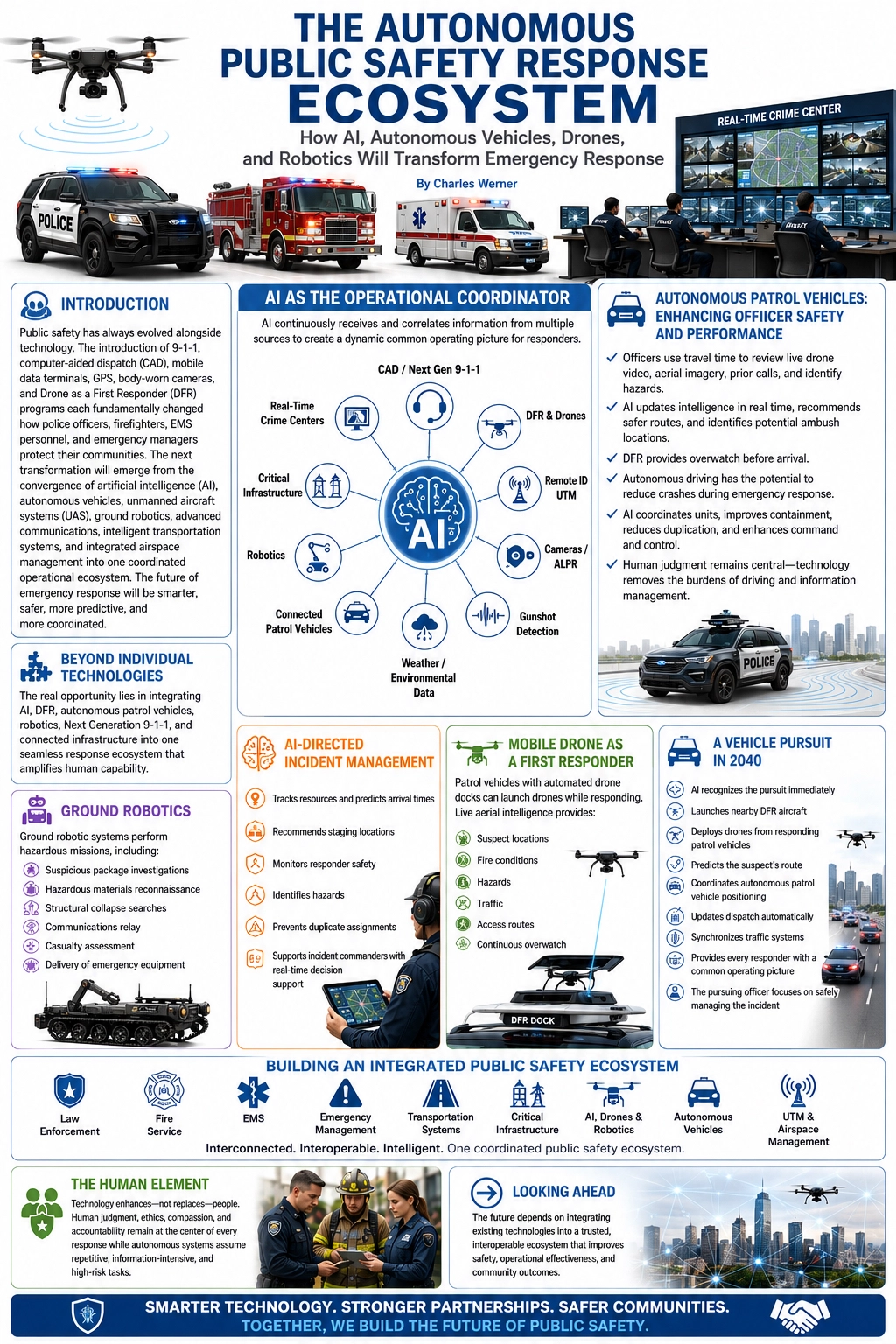
Public safety has always evolved alongside technology. The introduction of 9-1-1, computer-aided dispatch (CAD), mobile data terminals, GPS, body-worn cameras, and Drone as a First Responder (DFR) programs each fundamentally changed how police officers, firefighters, EMS personnel, and emergency managers protect their communities. The next transformation will emerge from the convergence of artificial intelligence (AI), autonomous vehicles, unmanned aircraft systems (UAS), ground robotics, advanced communications, intelligent transportation systems, and integrated airspace management into one coordinated operational ecosystem. The future of emergency response will be smarter, safer, more predictive, and more coordinated.
Beyond Individual Technologies
Today’s conversations often focus on individual innovations. The real opportunity lies in integrating AI, DFR, autonomous patrol vehicles, robotics, Next Generation 9-1-1, and connected infrastructure into one seamless response ecosystem that amplifies human capability rather than replacing it.
AI as the Operational Coordinator
AI continuously receives and correlates information from CAD, Next Generation 9-1-1, Real-Time Crime Centers, DFR, Remote ID, UTM, cameras, ALPR, gunshot detection, weather, connected patrol vehicles, robotics, and critical infrastructure to create a dynamic common operating picture for responders.
Autonomous Patrol Vehicles: Enhancing Officer Safety and Performance
Autonomous patrol vehicles fundamentally change how officers prepare for incidents. Instead of focusing on driving, navigation, and radio traffic, officers use travel time to review live drone video, study aerial imagery, examine prior calls, identify hazards, and coordinate with responding units. AI continuously updates developing intelligence, recommends safer approach routes, identifies potential ambush locations, and assists tactical planning. DFR aircraft provide overwatch before arrival, while autonomous driving technology has the potential to reduce crashes during emergency response. AI also coordinates responding patrol units, improves containment, reduces duplication, and enhances command and control. Human judgment remains central while technology removes the burdens of driving and information management.
Mobile Drone as a First Responder Patrol vehicles equipped with automated drone docks can launch drones while responding. Live
aerial intelligence provides suspect locations, fire conditions, hazards, traffic, access routes, and continuous overwatch before personnel arrive.
Ground Robotics
Ground robotic systems perform hazardous missions including suspicious package investigations, hazardous materials reconnaissance, structural collapse searches, communications relay, casualty assessment, and delivery of emergency equipment.
AI-Directed Incident Management
AI tracks resources, predicts arrival times, recommends staging locations, monitors responder safety, identifies hazards, prevents duplicate assignments, and supports incident commanders with real-time decision support.
A Vehicle Pursuit in 2040
AI recognizes the pursuit immediately, launches nearby DFR aircraft, deploys drones from responding patrol vehicles, predicts the suspect’s route, coordinates autonomous patrol vehicle positioning, updates dispatch automatically, synchronizes traffic systems, and provides every
responder with a common operating picture while the pursuing officer focuses on safely managing the incident.
Building an Integrated Public Safety Ecosystem
Law enforcement, fire, EMS, emergency management, transportation, critical infrastructure, AI, drones, robotics, autonomous vehicles, and UTM become interconnected components of one coordinated public safety ecosystem.
The Human Element
Technology enhances—not replaces—people. Human judgment, ethics, compassion, and accountability remain at the center of every response while autonomous systems assume repetitive, information-intensive, and high-risk tasks.
Looking Ahead
The future depends on integrating existing technologies into a trusted, interoperable ecosystem that improves safety, operational effectiveness, and community outcomes