
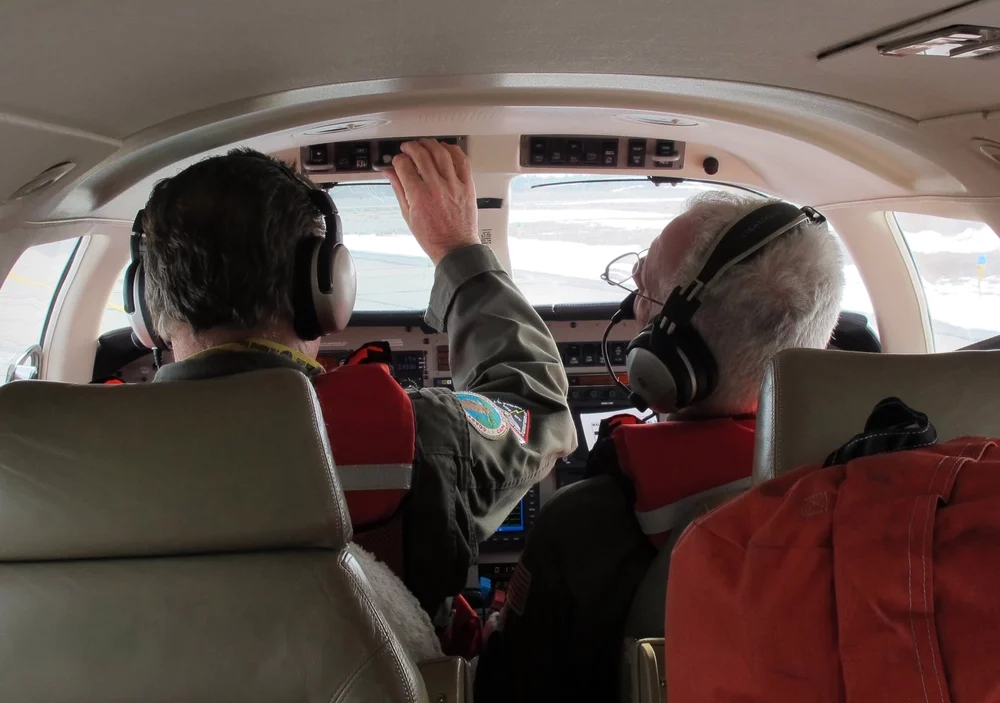
The Coast Guard Auxiliary’s aviation program expands aerial reach, enhances situational awareness, and delivers cost-effective capacity for port security, search and rescue, and maritime operations
In homeland security, the ability to see early, communicate clearly, and respond quickly can determine whether a situation is controlled or allowed to escalate. That is why air power has always played a critical role in maritime security, search and rescue, pollution response, and port protection. Within that broader mission set, the U.S. Coast Guard Auxiliary’s aviation program, AUXAIR, remains one of the most underappreciated force multipliers available to the Coast Guard.
AUXAIR is not simply a volunteer flying program. It is a structured operational capability that expands the Coast Guard’s reach at relatively low cost while connecting skilled civilian aviators and aviation enthusiasts to missions of real national importance. For a service charged with protecting ports, waterways, coastal infrastructure, and the maritime approaches to the homeland, that matters.
Extending the Coast Guard’s Reach
The Coast Guard’s mission portfolio is large, but its aviation and surface resources are finite. Auxiliary aviation helps bridge that gap by adding trained volunteer crews who can support a wide range of missions, including search and rescue, aids-to-navigation verification, marine safety patrols, pollution monitoring, and homeland security overflights. In practical terms, AUXAIR gives the Coast Guard more eyes in the sky, more communications support, and more mission coverage without requiring the service to build every capability from within.
That makes AUXAIR valuable not only in routine operations but also in contingency planning. A trained Auxiliary aircraft can help identify anomalies, monitor traffic patterns, document hazards, and support situational awareness during heightened security conditions. In an era when maritime threats include smuggling, illicit trafficking, infrastructure vulnerabilities, and disaster-related instability, airborne observation remains a meaningful operational advantage.
Cost-Effective Capability
One of the enduring strengths of the Auxiliary is efficiency. AUXAIR leverages volunteer expertise, privately owned or authorized aircraft, and mission-ready training to deliver value at a fraction of the cost of comparable full-time capability. That does not make the program secondary. It makes it smart.
Every hour flown by a trained Auxiliary air crew represents added capacity for the Coast Guard. That capacity is especially important in regions where long coastlines, busy ports, inland waterways, and tourism traffic create constant demand for observation and response. When a mission requires a timely aerial assessment, an auxiliary aircraft can help fill the gap between need and availability.
This is the essence of force multiplication: using a small investment in trained personnel and organizational structure to generate a greater operational effect. AUXAIR does exactly that.
Civilian Expertise with Operational Value
AUXAIR also draws strength from the people it attracts. Pilots, retired aircrew, flight instructors, aviation mechanics, and dedicated enthusiasts bring useful experience and discipline to the program. Many of them already understand cockpit communications, navigation, scan patterns, crew coordination, and the importance of procedure under pressure.
The Air Observer role is particularly important in this regard. Observers do not need to be pilots to contribute meaningfully. They help manage communications, maintain mission records, and serve as active searchers during operations. That makes AUXAIR accessible to a wider pool of volunteers while still preserving high standards of performance and accountability.
From a strategic perspective, this matters because the Coast Guard benefits when it can recruit from a broader base of motivated citizens with relevant skills. AUXAIR is not simply about aviation enthusiasm. It is about converting that enthusiasm into operational readiness.
Supporting Homeland Security
The homeland security environment is dynamic, and maritime threats rarely present themselves in neat or predictable ways. Ports, marinas, bridges, refineries, shipping lanes, and critical coastal infrastructure all require awareness and surveillance. AUXAIR contributes by adding an aerial perspective that can quickly identify irregular activity, verify conditions, and improve the Coast Guard’s understanding of the operating picture.
That airborne perspective becomes even more valuable during major events, storms, evacuations, and port disruptions. Auxiliary aircrews can support damage assessment, monitor waterways, and help inform decision-makers who need timely information to protect life, property, and critical systems. In this way, AUXAIR is not just a training program for volunteers. It is a practical homeland security asset.
The ability to support official missions while maintaining a flexible volunteer structure gives AUXAIR a distinct advantage. It can surge when needed, integrate with Coast Guard operations, and deliver value in ways that directly align with mission demand.
A Strategic Investment in Readiness
If homeland security is about resilience, then AUXAIR deserves attention as a readiness investment. The program strengthens the Coast Guard’s ability to observe, assess, and respond while building a cadre of trained citizens who understand service, discipline, and mission support.
For policymakers, Coast Guard leaders, and potential volunteers alike, the takeaway is simple: AUXAIR expands capacity without creating unnecessary burden. It brings aviation capability, public service, and national security together into a single model. That is a rare combination, and one worth strengthening.
In a time when the nation depends on adaptable and cost-conscious solutions, AUXAIR stands out as a quiet but effective force multiplier. It deserves more recognition, more support, and more volunteers ready to answer the call.
The views expressed in this article are solely those of the author and do not represent the official views of the United States Coast Guard, the United States Coast Guard Auxiliary, the Department of Homeland Security, or any government agency.
Sources
U.S. Coast Guard Auxiliary. (n.d.). Missions: Aviation. https://join.cgaux.org/missions
U.S. Coast Guard Auxiliary District 7. (n.d.). Aviation. https://uscga-district-7.org/av.php
U.S. Coast Guard Auxiliary. (n.d.). Aviation training: Air Observer steps to achievement. https://wow.uscgaux.info/content.php?unit=053&category=training-observer
U.S. Coast Guard Auxiliary East District Northern Region. (n.d.). Auxiliary Air Program. https://5nr.org/auxiliary-air-program/