
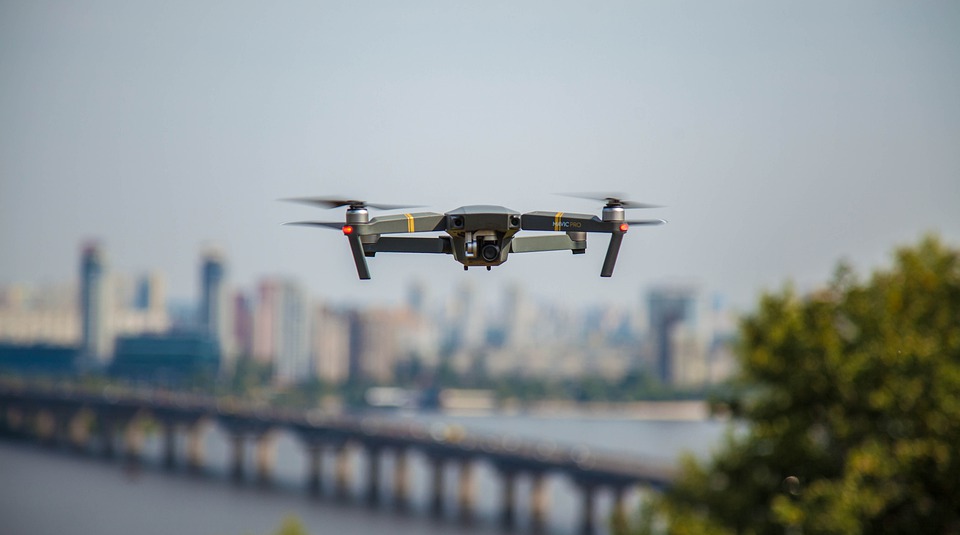
The Science and Technology Directorate (S&T) continues to collaborate with government, industry, and academic partners to study the effects of kinetic Counter-Unmanned Aircraft Systems (C-UAS) mitigation methods. A test team was deployed to North Dakota over the summer to evaluate the capabilities of several systems that can deny and defeat the UAS threat.
To advance the study of kinetic Counter-Unmanned Aircraft Systems (C-UAS) technologies, S&T recently completed a series of demonstrations to evaluate multiple kinetic mitigation technologies that are appropriate for use against malicious UAS and currently on the market.
The demonstration took place over three weeks in late July and early August and is the latest in a series of technology assessments. Partners included the University of North Dakota (UND) Research Institute for Autonomous Systems, UND Aerospace, the FAA-designated Northern Plains UAS Test Site, accessND, and the North Dakota National Guard. Key DHS Component partners from the U.S Customs and Border Protection and U.S. Secret Service also attended.
During the event, 10 companies demonstrated capabilities across four categories: Global Navigation Satellite System jamming, handheld weapon-fired munitions, directed energy weapons, and drone-on-drone counter systems, including keynote demonstration of the Epirus High Power Microwave system.
Testing the potential for domestic usage is critical because, “Keeping the public safe many times means that the systems and methodologies used by the military in a war zone are not going to be appropriate for us to use domestically or in a law enforcement situation,” said S&T Project Manager Andy Myers.
By bringing government agencies, academia, and industry together to test and evaluate different mitigation capabilities, the event enabled participants to document best practices and informed the evolution of future generations of C-UAS technologies.
As legitimate UAS usage continues to grow beyond just drone enthusiasts and hobbyists to include professionals performing power line inspections, crop dusting, and other work-related tasks, the incidence of questionable or even malevolent use also continues to proliferate. “There have been numerous widely reported incidents of drones flying into restricted airspace. These incursions include UAS flying over everything from major sports arenas (one even caused a game delay) to military installations where the ramifications could be far more serious. Occurrences such as these, as well as bad actors using drones for criminal purposes, illustrate why there is a continued and growing concern regarding inappropriate drone operations,” said Myers.
In addition to the directed energy solutions, other less futuristic systems were also deployed across different testing scenarios. These systems included suicide drones that would ram into the incoming UAS, drones that would drop or deploy materials meant to foul enemy UAS mechanisms, and even specific types of ammunition were used by sharpshooters to take down incoming threats.
Over the course of the testing, multiple systems were used against different sized drones in differing scenarios. These scenarios were based upon the size of the aggressor drone, distance, altitude, and other factors.
The testing at Camp Grafton is another example of how S&T is meeting the challenge to secure the homeland and defend against the growing UAS threat. Mitigation capabilities are evolving rapidly; by working with partners across industry, academia, and government on this critical mission testing, S&T is providing DHS Components with the means to engage and defeat nefarious drones—while minimizing unintended collateral damage.
The outcomes of the events provide invaluable data for S&T to assist DHS Components with field mitigation systems that are compatible with different mission areas.
“Our analysis from these events is informing planning for future kinetic mitigation events that are focused on operational use cases and red-teaming,” said Myers. “The event was a true success and showcased the continued collaboration between S&T, the University of North Dakota, and our other partners.”
The original article can be found here.