If you have ever watched Breaking Bad, you know the moment that Walter White realizes he’s no longer operating on the margins. What began as a desperate, contained decision has expanded into something much more industrial, an enterprise with supply chains, distribution networks, and consequences far beyond his control.
For many American parents, that same realization is happening now.
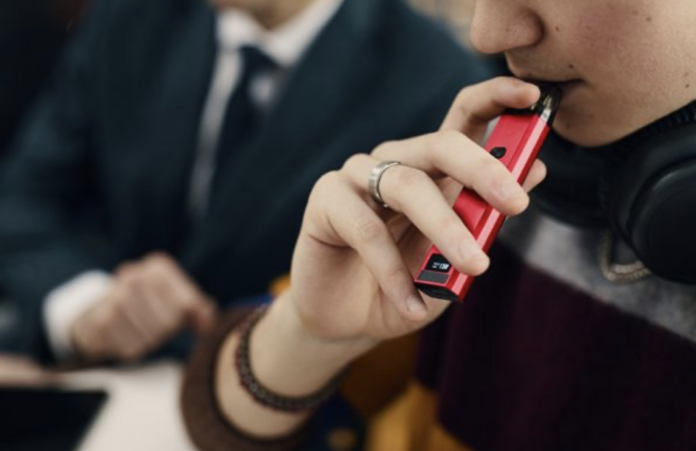
In 2024, it was reported that more than 1.6 million U.S. youth vaped.[1] What was once dismissed as a “school hallway problem,” a few kids sneaking into bathrooms between classes to vape, has widened into something far more complex.
Behind the lockers and disciplinary reports sits a multi-billion-dollar global system, one that produces, distributes, and markets addictive products with remarkable efficiency.
This is no longer just about teenage risk-taking. It is about infrastructure.
The shift becomes undeniable in moments that feel almost surreal. In one widely reported case from Wisconsin, a special-needs five-year-old in a dinosaur T-shirt was forced by older students to inhale from a vape device.[2] It is the kind of moment that reframes everything. A sudden recognition that what seemed isolated is anything but.
The Global Engine Behind the Devices
At the center of this system is a manufacturing hub thousands of miles away in Shenzhen, China, often referred to as “Vape Valley.”[3] The vast majority of the world’s illicit disposable vaping devices originate here, produced at extraordinary speed and scale.
What makes this dynamic striking is the contrast in domestic versus export policy. Within China, flavored and high nicotine vape products face strict limits. Yet those same categories are produced for export in massive quantities, flowing into markets like the United States through a mix of legal gray areas and outright illicit channels.
The result is a steady stream of devices entering the U.S., often mislabeled, rerouted through intermediaries, and distributed through networks that are difficult to track and even harder to shut down. Enforcement agencies seize millions of units each year, but the volume continues to grow.
Designed for Efficiency and Dependence
While tape technology was intended as an offramp for those addicted to cigarette smoking it has evolved far beyond its early iterations. One of the most significant developments is nicotine salt formulation, which allows high concentrations of nicotine to be delivered rapidly and smoothly.
Unlike traditional cigarettes, which produce a harsh throat sensation that can act as a natural limiter, these newer devices reduce that friction. The experience becomes easier, faster, and, for inexperienced youth users, deceptively manageable.
But the numbers tell a different story.
Vape devices contain nicotine levels comparable to multiple packs of cigarettes. However, the larger, illicit high-capacity devices can deliver dramatically more. For adolescents, whose brains are still developing and are particularly sensitive to dopamine stimulation, this creates a powerful feedback loop. The product is no longer just an alternative to smoking; it has become an illicit optimized delivery system to kids.
Disguised in Plain Sight
While the chemistry has advanced, so has the secretive designs. Today’s illicit vape devices are often engineered to evade detection as much as they are to deliver nicotine. They are built to resemble everyday objects that kids possess, such as highlighters, USB drives, hoodie drawstrings, even smartwatch accessories. Some incorporate screens, games, and Bluetooth connectivity, blending seamlessly into the digital environments young users already inhabit.
Parents have to recognize; this is not accidental. It is strategic on behalf of those that benefit from kids being addicted to illicit vapes.
By transforming a nicotine device into something that looks and feels like a toy or gadget, and even mirrors sweet shop imagery, the barrier between experimentation and regular use is lowered. What might once have been hidden behavior becomes drastically normalized, even gamified.
In this environment, parent and teacher supervision becomes harder, and early exposure becomes easier.
Real-World Consequences
The risks are no longer theoretical. Across the country, cases continue to emerge that highlight the physical toll of these illicit products born from unregulated markets. Some involve long-term respiratory damage linked to chemical exposure. Others involve device malfunctions, including battery explosions that cause severe injuries.
These incidents underscore a critical distinction: while vaping itself carries risks, the most severe outcomes are frequently associated with products that exist outside regulatory oversight. In other words, the danger is not just the habit, it is the system supplying it.
The Final Link: Organized Distribution
At the far end of the pipeline, distribution networks take over. Law enforcement agencies have documented connections between illicit vape trafficking and broader criminal operations. In some cases, the same routes used to move narcotics are also used to transport large quantities of unauthorized vaping devices.
A recent seizure along the southern U.S. border revealed shipments containing both drugs and millions of vape units, stacked together and moved through sophisticated smuggling infrastructure. [4]
What begins as a consumer product ends as part of a larger ecosystem, one that blurs the line between public health issues and criminal enterprise. The numbers reflect the scale of the shift. While the Federal Drug Administration has only authorized 41 vaping products in the United States for legal sale,[5] the overwhelming majority of vape devices being sold on shelves fall outside that legal framework.[6]
This is no longer a fringe issue. It is the dominant market.
And yet, much of the conversation remains focused on individual behavior, why kids are vaping, how schools can respond, what parents should watch for. Those questions matter. But they are incomplete. Because behind every device is a supply chain, and behind that supply chain is a system designed to persist.
What We Choose to Confront
What began as an off-ramp tool for adult smokers — thanks to China and criminal cartels — has now evolved into something far more complicated, and, in many ways, more concerning.[7]
A global manufacturing base. A resilient illicit distribution network. Products engineered for ease, concealment, and appeal. And a user base that increasingly includes those a regulated system was never meant to serve.
The question now is not simply how to respond at the margins. It is whether to continue treating the visible symptoms, or to confront the structure that produces them. The pipeline is no longer hidden. The only question is what we do now to ensure that parents and teachers can see it. ❦
RESOURCES
1] Park-Lee, E., Jamal, A., Cowan, H., et al. (2024). Notes from the Field: E-Cigarette and nicotine pouch use among middle and high school students — United States, 2024. Morbidity and Mortality Weekly Report, 73, 774–778. https://doi.org/10.15585/mmwr.mm7335a3
[2] TMJ4 News. (2025) A video taken earlier this month showing a K5 student being forced to vape in a school bathroom has been circling throughout Wisconsin…Facebook, https://www.facebook.com/watch/?v=676105871552066.goog
[3] Ng, Michelle (2026) ‘Vape valley’: Double standards in China’s powering of world’s e-cigarette boom, The Straits Times. https://www.straitstimes.com/asia/east-asia/vape-valley-double-standards-in-chinas-powering-of-worlds-e-cigarette-boom.
[4] Mack, Jason. (2025) DEA operations target Laredo vape shops; drugs and deep tunnel found on site, LMT Online. https://www.straitstimes.com/asia/east-asia/vape-valley-double-standards-in-chinas-powering-of-worlds-e-cigarette-boom.
[5] U.S. Food & Drug Administration (2025). E-Cigarettes, “Vapes” and Other Electronic Nicotine Delivery Systems (ENDS) Authorized by the FDA. https://www.fda.gov/tobacco-products/market-and-distribute-tobacco-product/e-cigarettes-vapes-and-other-electronic-nicotine-delivery-systems-ends-authorized-fda
[6] Truth Initiative (2024) U.S. Retail sales data show 86% of e-cigarette sales are for illegal products. https://truthinitiative.org/research-resources/tobacco-industry-marketing/us-retail-sales-data-show-86-e-cigarette-sales-are?utm_source=chatgpt.com
[7] Rumney, E., Kang, K., and Polansek, T. (2025) How middlemen funnel illegal Chinese vapes into the Unites States, Reuters. https://www.reuters.com/business/healthcare-pharmaceuticals/how-middlemen-funnel-illegal-chinese-vapes-into-united-states-2025-06-23