





The homeland security landscape entering 2026 looks markedly different than it did a year ago. To make sense of these shifts, Homeland Security Today turned to our Editorial Board, columnists, and community of subject-matter experts for their assessment of the threats facing the nation in 2026. Our contributors bring decades of practical experience defending and protecting America, and their insights reflect both enduring concerns and emerging challenges.
This year’s forecasts are delivered amidst significant transition: changes in leadership with Department of Homeland Security agencies, evolving federal priorities, and a threat landscape that continues to grow in complexity. Our experts examine familiar adversaries alongside newer risks, from the persistent threat of terrorism to the rapid advancement of technologies that both enable and challenge our security efforts.
Several themes emerge across these assessments: the enduring and evolving nature of terrorist threats, both foreign and domestic; the accelerating role of artificial intelligence, unmanned systems, and other emerging technologies in the hands of both defenders and adversaries; and the multidimensional challenges that cut across traditional categories—from infrastructure vulnerabilities to gaps in strategic foresight.
This year’s forecasts address three interconnected areas of concern.
- Terrorism – examining threats from ISIS and its affiliates, lone actors and small cells, soft-target vulnerabilities, and the convergence of extremist movements
- Emerging Technology – addressing necessary policy frameworks for advanced air mobility, cybersecurity, and AI; unmanned aerial systems in law enforcement; identity and credential security; and the exploitation of AI by criminal organizations
- Systemic Risks – exploring infrastructure security, lifeline resilience, facilities protection, foresight gaps, and the intersection of major events with evolving threat streams
Some assessments appear here as excerpts; full versions are available via the links provided. We encourage you to read the comprehensive analyses our contributors have shared, and to share these articles alongside your own perspectives with us via LinkedIn (tag @GTSC’s Homeland Security Today). The homeland security mission depends on practitioners in the field, and we want to ensure this conversation reflects the full scope of our community’s knowledge and concerns.
Whether confronting a resurgent adversary or anticipating the next disruptive technology, these assessments offer a clear-eyed look at the challenges ahead and a foundation for the strategies we’ll need to meet them.
Part I, Terrorism
Hybrid Extremism and Persistent Violence: Key Terrorism Risks Ahead
Mahmut Cengiz, PhD, Associate Professor and Research Faculty with the Terrorism, Transnational Crime and Corruption Center (TraCCC) and the Schar School of Policy and Government at George Mason University; Editorial Board Member and Columnist, Homeland Security Today
[Excerpt]
Heightened Lone-Actor and Small-Cell Violence Driven by Ideological Hybridity
A defining counterterrorism risk in 2026 is the continued prevalence of lone-actor and small-cell attacks fueled by overlapping ideological, religious, political, and personal grievance motivations. Patterns observed in 2025 demonstrate that individuals increasingly draw selectively from Salafi-jihadist propaganda, domestic extremist narratives, and contemporary geopolitical grievances without formal organizational direction. This ideological hybridity complicates detection and prevention, as perpetrators often fall outside traditional counterterrorism profiles and may radicalize rapidly through online ecosystems. As a result, violence is likely to remain frequent, low-level, and unpredictable, sustaining a persistent baseline of threat rather than discrete waves of coordinated attacks.
Intensification of Localized Insurgency and Mass-Casualty Violence
The 2025 pattern of high-fatality attacks against military bases, security forces, and civilian populations suggests that localized insurgent violence will remain a central feature of the threat landscape in 2026. Jihadist groups are likely to continue prioritizing territorial influence, state erosion, and population control over externally directed mass-casualty operations. In regions such as the Sahel, the Lake Chad Basin, Somalia, Pakistan’s border areas, and parts of the Middle East, these actors will exploit overstretched security forces, declining international military engagement, and unresolved political grievances. Sustained or escalating violence risks deepening humanitarian crises, accelerating displacement, and further undermining already fragile state legitimacy.
Expansion of Permissive Environments and Transnational Spillover
A major counterterrorism risk entering 2026 is the persistence—and potential expansion—of permissive environments that allow jihadist groups to train, regroup, and project influence beyond national borders. Afghanistan, parts of Syria and Iraq, and large areas of the Sahel and Central Africa continue to be characterized by weak governance, limited counterterrorism capacity, and ambiguous political commitments to suppress extremist actors. These conditions enable groups such as Islamic State–Khorasan Province (ISIS-K), ISIS–Sahel, ISIS–Democratic Republic of Congo (ISIS–DRC), and al-Qaeda–affiliated Jama’at Nusrat al-Islam wal-Muslimin (JNIM) to sustain training infrastructures, facilitate cross-border mobility, and inspire or indirectly support attacks abroad. The continued existence of these safe havens increases the likelihood of regional spillover, the circulation of foreign fighters, and the diffusion of tactics and ideology across Asia, Africa, and the Middle East.
Analysis of Rising Attacks by Radical Extremists (ISIS): Trends and Implications for the U.S. Homeland in 2026
John Halinski, CEO, SRI Group, LLC; Editorial Board Member, Homeland Security Today; former Deputy Administrator/Deputy Assistant Secretary, Transportation Security Administration
In recent years, the world has witnessed a notable increase in attacks perpetrated by radical extremists across various regions. These incidents have generated widespread concern due to their frequency, scale, and the challenges they pose to security and the ability to mitigate these threats. This analysis explores the trends in rising extremist attacks, particularly ISIS and how they pose a renewed, growing threat to the United States homeland in 2026.
Global Trends in Extremist Attacks
Data from international monitoring agencies and independent research institutions indicate a significant uptick in extremist attacks over the past decade. These incidents span diverse geographical areas, including but not limited to the Middle East, Africa, South Asia, Europe, and North America. The methods employed have also evolved, ranging from large-scale coordinated assaults and bombings to lone-actor attacks using simple techniques such as vehicles, knives, and guns.
Recent global changes and military actions have significantly reduced the capability and support from traditional extremist strongholds in the Middle East, resulting in a significant blow to traditional terrorist groups and their operations in locations such as Iran, Yemen, Lebanon and other locations. While these actions have mitigated terrorist capabilities, it has resulted in extremists using media, internet recruiting and any means necessary, to include small-scale attacks, to keep their causes and ideologies relevant. Recently, western nations have seen an increase in attacks motivated by religious, political, and ideological extremism, particularly ISIS. ISIS is an extremist Islamic group which had been limited by U.S. and Western forces in the previous decade, but has recently regained momentum and is actively recruiting, particularly in the West.
Recent attacks, such as those in Bondi Beach, New Orleans and a potential attack thwarted by the Federal Bureau of Investigation (FBI) in North Carolina on New Year’s Eve 2025, highlight the resurgence of ISIS and its sympathizers. ISIS has successfully been able to maintain a degree of influence with disenfranchised extremists through manipulation by using the internet as a recruiting tool. ISIS-inspired attacks are very hard to identify because the extremists involved are disjointed, operate in isolation, and use a varying degree of violent techniques some as simple as knives and tools. Their objective is to create chaos through violent attacks and gain as much publicity as possible for their extremist cause.
Contributing Factors to the Resurgence of ISIS
- Political Instability:State fragility, civil conflict, and military action in the Middle East have significantly reduced the financial and logistical support traditionally available to terrorist and extremist groups. However, ISIS operates Rather than relying on these conventional support mechanisms, it has developed independent funding streams and simple but highly effective recruiting methods that resonate with disenfranchised individuals. This operational independence – developed in part as Western counterterrorism efforts disrupted traditional extremist networks – has enabled ISIS to directly target the U.S. and the West.
- Ideological Propagation: The proliferation of extremist ideologies through online platforms, like social media and gaming platforms, has made radicalization more accessible and transnational in nature.
- Globalization and Migration: The movement of people across borders can sometimesfacilitate the spread of extremist networks, while also creating social tensions that may be exploited by radical groups. Disenfranchised, extremist individuals thrive in these environments. The U.S. and Western Europe have experienced significant movement of migration from all regions.
- Technological Advances: Extremist groups, particularly ISIS, increasinglyleverage technology for recruitment, communication, and the execution of attacks, making their activities harder to track and prevent. Use of secure media apps and tools make the job of identifying the threat more difficult for law enforcement and the intelligence community.
Impacts and Implications for the U.S. Homeland in 2026
The United States’ recent military and political actions have greatly changed the terrorist threat streams throughout the globe. The U.S. actions in the Middle East, Africa and other regions have changed the traditional threat picture and replaced it with a shifting landscape. As large-scale terrorist or extremist activities have been mitigated somewhat, it allows for groups like ISIS to call for actions against the United States.
I believe recruiting and promoting extremist attacks against the U.S. by ISIS will significantly increase over the coming year. Due to their use of successful recruiting tactics, reliance on lone-actor or small-group attacks, and objective of creating chaos for exposure, the resurging ISIS threat will prove difficult to mitigate.
Upcoming events, such as the FIFA World Cup, the 250th Birthday of the United States, U.S. midterm elections, Mardi Gras, and the Super Bowl, are all potential targets for ISIS extremist actions in 2026. While the U.S. intelligence and law enforcement community have had prevention success, the risk factors for these types of extremist actions, particularly by ISIS, continue to pose a serious threat to the U.S homeland during 2026.
The Evolution of Domestic Terrorism Is Outpacing Our Defenses
Dexter Ingram, IN Network: The National Security Academy; Editorial Board Member, Homeland Security Today; former Director, Office of Countering Violent Extremism, Department of State
For 2026, domestic terrorism is my biggest concern—the way young men are being radicalized online should worry all of us.
A decade ago, it took over a year for someone to go from curious browser to violent actor. Now it can happen in months. The pipeline has gotten shorter and harder to spot. Young men who feel like failures – guys who can’t find work, can’t find relationships, can’t find purpose – are finding communities online that tell them who to blame. The manosphere is a big part of this. What starts as dating advice or fitness content pulls them toward increasingly extreme ideas about women, minorities, and society. Mix in easy access to weapons and a desire to matter, and you have a recipe for violence that doesn’t fit our old profiles.
These guys aren’t ideological purists anymore. Someone can start in the manosphere, pick up white supremacist ideas, add accelerationist content about collapsing society, and end up with a personal belief system that doesn’t match any single movement. That makes them harder to track. The incel-to-violence pipeline is real—Isla Vista, Toronto, Plymouth. We have a body count. But we still treat misogynist extremism as less serious than other forms. That’s a gap.
Here’s another one. What we used to call REMVE – racially or ethnically motivated violent extremism – doesn’t even have a name in today’s national security priorities. The threat didn’t disappear. The label did. Same with misinformation and disinformation. They’re no longer priorities either, even though they feed the grievances that drive radicalization. False narratives about elections, immigrants, and “replacement” don’t just pollute public discourse—they give disenfranchised young men a target list. Threats we can’t name are threats we can’t fight.
The 2026 World Cup raises the stakes. So does the calendar. The 25th anniversary of September 11th will draw global attention—and anyone looking to make a statement knows it. We’re hosting most of the matches here at home, with millions of visitors spread across 11 cities over 40 days. That’s a lot of soft targets outside the stadiums – fan zones, hotels, transit hubs – that we can’t lock down the way we secure a venue. Lone actors see events like this as their shot at the world stage.
And ISIS is still in the game. Just since November, we’ve seen arrests in North Carolina, Texas, Virginia, Massachusetts, and Michigan. An 18-year-old with knives and hammers. A guy passing bomb materials. An Afghan refugee tied to ISIS-K. These aren’t old cases. They’re last month. The system we built after 9/11 is catching them. What scares me is the violence coming from directions we’re barely watching.
The hard truth is the political environment has made prevention work radioactive in certain circles. Programs got defunded or repurposed that set us back. State and local professionals are the ones who can build the relationships and the threat assessment teams that catch these cases early. Federal agencies can’t do that alone. If you’re early in your career and wondering where you can actually make a difference, this is it. The work isn’t glamorous. It’s school resource officers, behavioral threat assessment teams, fusion center analysts, community liaison positions. It’s the kind of ground-level prevention that doesn’t make headlines but stops the next headline from happening.
The next mass casualty attack on American soil probably won’t come from a name we’re watching. It’ll come from someone we never saw coming—because we weren’t looking in the right places.
The Exponential Threat to Jews in America
Naveen Khan, Nonresident Research Fellow, Michael J. Morell Center for Intelligence and Security Studies, University of Akron (Ohio); Columnist, Homeland Security Today
Besides several other security challenges, the Islamist terrorist industry that is not only alive and operating worldwide but also enjoying executive authority in Afghanistan poses a very real threat to the U.S. homeland. This multitude of threats has been summarized perfectly by Michael Glasheen, Operations Director of the Federal Bureau of Investigation (FBI), in a December 11, 2025, sentence quoted below:
“Our nation continues to face a multitude of serious and evolving threats ranging from international terrorists to hostile foreign intelligence services and operatives, from sophisticated cyber-based attacks to internet-facilitated sexual exploitation of children, from violent gangs and criminal organizations to public corruption and corporate fraud.”
As acknowledged by Director Glasheen in the beginning, the threat from foreign terrorist organizations (FTOs) – particularly from FTO-inspired homegrown violent extremists (HVEs) – is a persistent concern. These organizations in 2026 will continually attempt to radicalize individuals and inspire them online into carrying out lone attacks on U.S. soil, particularly as a fallout of the Israel-Hamas war.
Given these FTOs’ aims of launching attacks on American soil, their agenda converges with the Iranian mullah regime’s, which aims to avenge the assassination of the Islamic Revolutionary Guard Corps-Qods Force (IRGC-QF) Commander Qassem Soleimani by targeting U.S. officials and Iranians in the United States who it deems a threat.
Nevertheless, the most prominent homeland security threat in 2026 will be to Jewish community members regardless of their citizenship and location, and to those working in Israel-linked facilities. A repeat of the Bondi Beach-style massacre, particularly on Jewish holy days, will be a “prized achievement” for any Islamist terrorist organization that both seeks revenge from the Israeli government for the killings in Gaza and aims to eliminate Jews from the planet in their own right.
All Jewish and Israeli facilities must therefore be provided with appropriate security all over the U.S., and any intelligence report of a threat dealt with proactively to avert impending human tragedy. The situation in Afghanistan wherefrom several dangerous FTOs are operating globally online and aspiring to mount terrorist attacks against Jewish and Western targets must also be constantly monitored.
The Bondi Beach Attack: A Case Study on the Terrorism Confluence Effect for 2026
Moshe Nelson, Partner, Defense and Security Practice, Guidehouse; former Legislative Fellow, U.S. House Subcommittee for the Middle East
Less than one month after the release of the 2025 Terrorism Threat Retrospective, another attack exemplifying the Terrorism Confluence Effect (TCE) occurred—this time nearly 10,000 miles away in Australia. The incident followed a familiar pattern observed in recent attacks across the United States and Europe: lone actors, radicalized online by ISIS, operating within an environment of antisemitism amplified by hostile state influence, converged on a soft target—a Hanukkah celebration on Bondi Beach.
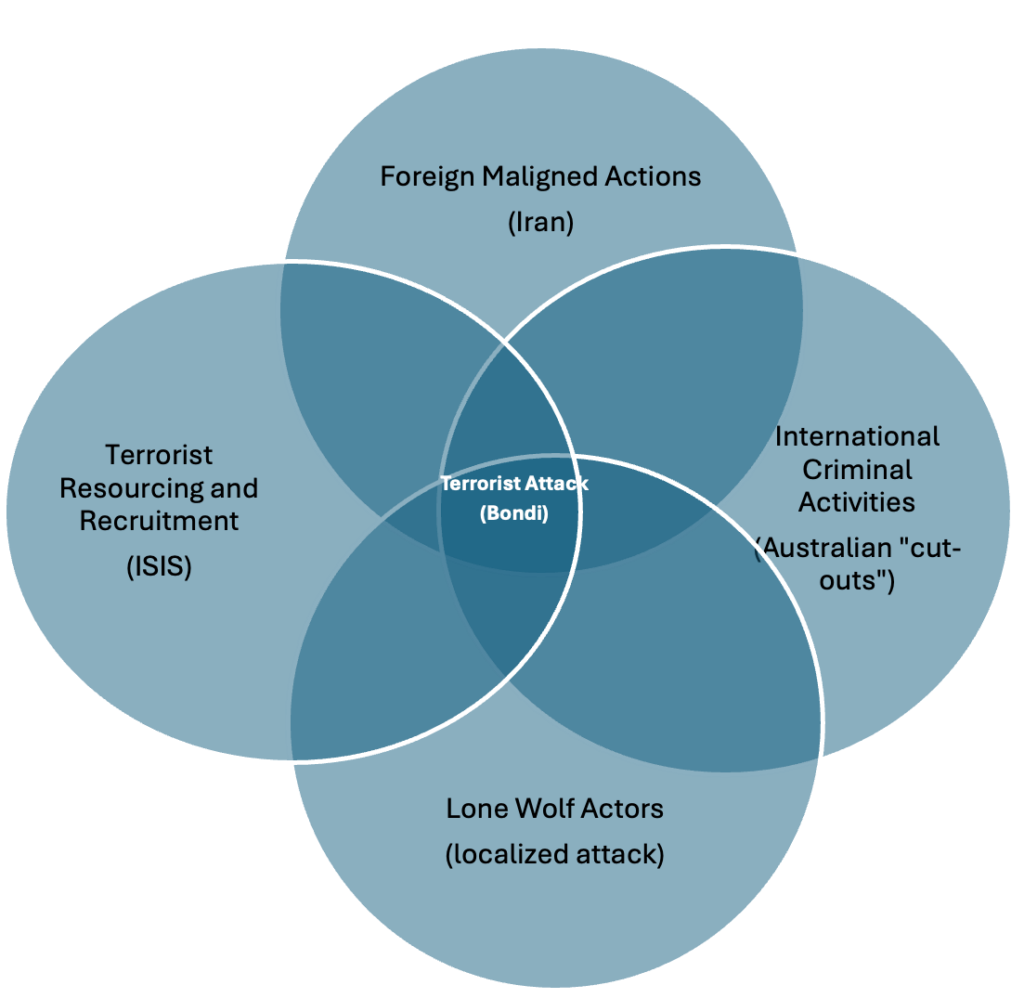
- Technology investments in infrastructure and advanced skill development.
- Influence operations leveraging social media, bot networks, and propaganda.
- Radicalization platforms that catalyze lone actors (the Bondi attackers were flagged years earlier for participation in extremist forums but cleared by authorities).
- Exploitation of fringe causes to mobilize individuals susceptible to ideological manipulation.
This strategy is effective because it offers plausible deniability, builds on prior investments by other malign actors (e.g., bot campaigns, terrorist networks, influence operations), and produces outcomes that incentivize further attacks and cross-group support.
To counter this multidimensional threat, the United States must continue applying lessons learned from TCE-related attacks both domestically and internationally throughout 2026. Specifically, this requires leveraging open-source intelligence (OSINT) to identify and disrupt cyber influence campaigns; targeting and prosecuting malign actors and transnational criminal organizations (TCOs) that enable domestic terrorism; educating the public on influence operations and pathways to radicalization; and strengthening interagency collaboration to detect and mitigate lone-actor threats. We cannot allow history to remain prologue.
Soft Targets: America’s 2026 Security Blind Spot
Kristyn Shapiro, Director, Defense and Security Practice, Guidehouse; former Senior Executive Service (SES) Section Chief, Counterterrorism Division, FBI
Last year, I warned that America’s terrorism prevention strategy needed recalibration—away from assumptions and toward practical hardening of soft targets. That warning feels even more urgent today.
In 2026, the United States will host some of the most significant events in its history: the Semiquincentennial (America250), the Route 66 Centennial, and FIFA World Cup. These celebrations will draw millions, and the security footprint around headline venues—stadiums and major parade routes—will be formidable. But the greatest risk isn’t where the cameras point. It’s in the places that define everyday American life—community festivals, houses of worship, museum forecourts, and small-town commemorations. These gatherings are symbolic, densely packed, and largely unprotected—the soft targets adversaries seek when hardened venues become impenetrable.
Soft Targets Remain Vulnerable
Federal threat assessments warn that violent extremists—foreign-inspired and domestic—prioritize mass gatherings, often using vehicle rammings, incendiaries, and simple improvised explosive devices (IEDs) with little warning. The Department of Homeland Security’s 2025 Homeland Threat Assessment judged the terrorism threat high, with lone offenders and small cells most likely to strike amid global conflicts that fuel antisemitic and anti-Israel violence. On January 1, 2025, a driver flying an ISIS flag rammed crowds in New Orleans, killing 14 and injuring dozens. In June, a gunman shot a young couple outside the Capital Jewish Museum in D.C., and another attacker hurled Molotov cocktails at a pro-Israel gathering in Boulder, burning an elderly Holocaust survivor. The day before Thanksgiving, two National Guard soldiers from West Virginia were ambushed in Farragut Square in D.C. These were not stadium attacks; they struck targets in public spaces.
Resources are Constrained and the Burden Shifts Local
Federal manpower has surged toward immigration enforcement and removals, absorbing attention that would otherwise bolster pre-attack detection. At the same time, the designation of major cartels as Foreign Terrorist Organizations, coupled with Office of Foreign Assets Control (OFAC) sanctions, has expanded investigative workload across sanctions and financial flows—stretching intelligence and operational capacity just as soft-target defense needs sustained attention. Finally, workforce-reshaping tools and voluntary exit programs accelerated the departure of federal personnel with the knowledge and skills central to terrorism prevention. The combined effect pushes more of the protective burden to state and local partners, who often lack equivalent intelligence feeds, training pipelines, or surge funding.
Why Vigilance Matters
September 11th wasn’t chosen because it symbolized anything to us; it was the day an adversary’s plan matured while “the system was blinking red.” The lesson for 2026 is simple: signals precede attacks. We must detect and act on them—especially in places that feel safe until they aren’t.
Challenges Ahead
- Scale and timing:America250, Route 66, and World Cup festivities will create hundreds of decentralized gatherings—parades, faith services, museum forecourts—where crowds are predictable, but screening is rare.
- Hybrid motivations and copycat risk: Attackers increasingly blend personal grievance with ideology. Low-techtactics—vehicles, incendiaries, simple IEDs—remain portable and widely promoted online.
- Local capacity gaps:State and local agencies become primary guardians for soft targets—often without equivalent intelligence, specialized training, or surge funds.
Mitigations We Need Now
- Soft-target playbooks: Push 30-day/7-day/72-hour checklists for traffic hardening, ingress/egress control, and volunteer steward training.
- Fusion huddles: Short, recurring touchpoints between fusion centers, local chiefs, and event organizers to share pre-incident indicators and deconflict tips.
- Rapid perimeter layering: Deploy vehicle barriers and visible guardianship at choke points like museum steps and parade bottlenecks.
- Faith-community posture: Offer no-cost site assessments, greeter training, and egress checks for houses of worship hosting commemorations.
- Public empowerment: Micro-campaigns like “See Something, Say Something” or “Run, Hide, Fight” and “Know Your Exit” to boost vigilance and evacuation readiness.
- Mutual-aid surge agreements: Formalize arrangements so neighboring jurisdictions can augment local capacity.
In a year of celebration, our vigilance must match our scale. The cameras will be on the big stages, but the fabric of American life is the most at risk. Let’s honor 2026 by acting on today’s signals before it’s too late.