
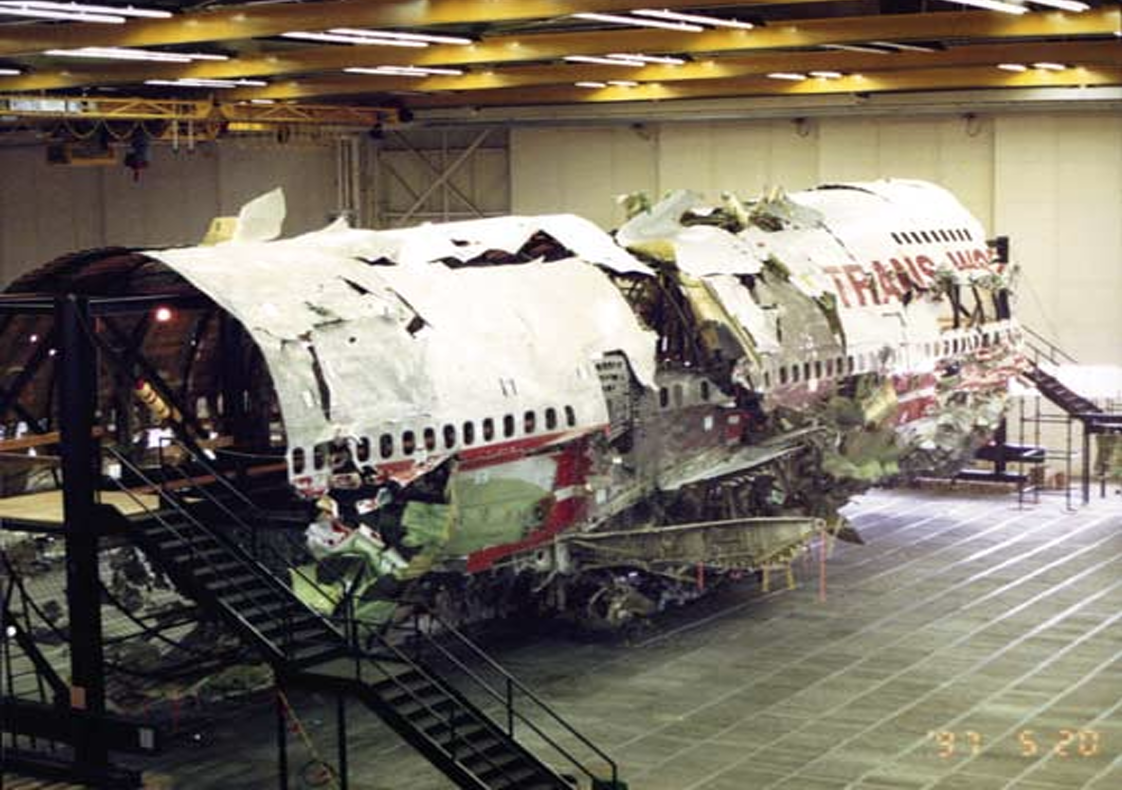
Thirty years ago, tonight, TWA Flight 800 exploded and fell into the Atlantic off Long Island, twelve minutes after leaving JFK for Paris. All 230 people aboard — 212 passengers and 18 crew — were lost. Every anniversary belongs first to them: to the families who have carried this for three decades, and to everyone who loved someone on that airplane.
It also belongs to the thousands of responders, investigators, and volunteers who spent the next ten months turning a scene of unimaginable loss into one of the most complex maritime search, recovery, and interagency coordination operations in U.S. history — conducted before the Department of Homeland Security or the National Incident Management System existed. What they built, largely from scratch, became part of the foundation on which the emergency management system stands today.
I was a young Coast Guard lieutenant that night, fortunate to serve in a role shaped by an emerging Coast Guard effort to bridge what had often been separate disciplines—search and rescue, Captain of the Port and Federal On-Scene Coordinator authorities, and early Incident Command System practice. Long before overlayed Groups and Marine Safety Offices were consolidated into single geographic commands of Sectors with unified command centers, which helped connect distinct missions, plans, and people. I was equally shaped by mentors with a vision of a better way to achieve multi-agency collaboration alongside leveraging technology. I was exposed to innovative digital tools—which together broadened my understanding of coordination, information sharing, and response. Now, thirty years later, leaders are in an environment that enables emergency managers to use sensors, autonomous devices, and artificial intelligence – bridging the gap in real-time information sharing and assessment between entities.
TWA 800 was the first national disaster response of my career. I’d been through large-scale military operations like Desert Storm, but this was different — what practitioners would later refer to as a “black swan event”, one that outstripped the multi-agency’s existing capacity and unified planning. A month before the crash, we provided ICS training on Long Island’s South Shore with local fire departments, as part of our Area Contingency Plan spill-response training — training that existed because of lessons learned from Exxon Valdez. None of us knew it at the time, but those sessions built the personal relationships we leaned on weeks later, bridging federal, state, and local responders under real pressure. It’s a lesson I carried on for the rest of my career: the relationships that matter most in a crisis are usually built before it starts.
What follows is the broader institutional history of that response — how it worked, what it exposed, and what it helped build.
THE COAST GUARD’S CENTRAL ACHIEVEMENT
Because there were no survivors, the Coast Guard’s mission shifted from search and rescue to search and recovery, scene control, family support, and preservation of what had become both a large-scale incident and a potential crime scene. Coast Guard Group Moriches took part in the initial search, and the cutter USCGC Harriet Lane served as on-scene commander for much of the early operation, while Coast Guard aircraft, cutters, and boats converged on the debris field alongside local fishing boats, police craft, and volunteers arriving from every direction.
The Coast Guard’s achievement wasn’t the rescues we prepared and trained for — there wasn’t one to make. It was creating a controlled maritime operation under extraordinary uncertainty, when responders did not yet know whether they were dealing with mechanical failure, a bomb, a missile, or a continuing threat. That meant organizing search patterns, deconflicting military, law-enforcement, commercial, and volunteer vessels, controlling access to the search area, recovering victims with dignity and debris as evidence respectfully, protecting responders from hazards, and maintaining a defensible chain of custody — all while transitioning from rescue to a prolonged underwater salvage investigation. Moriches became an operational hub, hosting daily interagency logistics meetings and handling the unglamorous essentials: shore access, transportation between vessels and land, telephone and electrical service, hazardous-material handling.
The lesson is one the Coast Guard still teaches: command of a maritime disaster isn’t only about operating boats and aircraft. It’s about building the coordination structure that enables scientific, investigative, military, medical, law-enforcement, and commercial capabilities to operate safely in the same space.
A MISSION DIVIDED AMONG SPECIALIZED LEAD AGENCIES
There was no single incident commander overseeing all functions. Authority was distributed by statute. The Coast Guard directed the maritime search-and-rescue operation and the offshore coordination, access control, and shore infrastructure on which the recovery depended. The National Transportation Safety Board was responsible for determining the cause and issuing safety recommendations. The FBI simultaneously investigated whether terrorism had caused the explosion, treating recovered material as potential evidence and placing agents aboard recovery vessels to maintain custody of man-made objects. The Navy’s Supervisor of Salvage and Diving — SUPSALV — managed the underwater search, diving, ROV, and salvage effort; on July 28, 1996, the Navy stood up Joint Task Force 40.50 to organize its recovery resources, which grew to include the salvage ships Grasp and Grapple, the dock landing ship Oak Hill, and more than 750 Navy and contractor personnel by the end of that month. NOAA supplied hydrographic surveying and scientific mapping. New York State, Suffolk County, and local governments handled victim identification, security, transportation, and shoreline operations through the Suffolk County Medical Examiner, New York State Police, local police departments, the New York Army National Guard, and the New York Naval Militia. Private industry supplied salvage expertise, ROVs, rigging, vessels, and technical personnel that the government didn’t maintain in sufficient quantity on its own.
Many of these organizations had little history of working together. The response needed an arrangement simple enough to stand up quickly, powerful enough to direct real resources, and acceptable to agencies with different legal authorities and institutional cultures.
NAVY SUPSALV AND THE UNDERWATER RECOVERY
A pre-existing memorandum of agreement between the NTSB and the Navy had already designated SUPSALV as the Department of Defense’s point of contact for underwater aircraft search and salvage. That single agreement saved enormous time on authorities and reimbursement — a good example of why emergency-management relationships are best negotiated before a catastrophe, not during one.
The at-sea salvage operation ran until May 18, 1997: roughly 4,344 manned dives, more than 1,700 diver bottom-hours, about 2,700 ROV bottom-hours, extensive sonar mapping, and months of trawling. When diving and ROV recoveries produced diminishing returns, SUPSALV contracted commercial scallop trawlers to systematically sweep the bottom, using differential GPS to hold tight search tracks while FBI agents aboard the trawlers controlled the evidence as it came up. Navy divers, ROV operators, FBI, New York State Police, New York City Police, and Suffolk County divers worked under one coordinated diving structure. All 230 victims and more than 95 percent of the aircraft were recovered.
NOAA: TURNING THE OCEAN FLOOR INTO AN INVESTIGATIVE MAP
NOAA Ship Rude offered assistance and was on scene the morning after the crash. Its side-scan sonar surveys, alongside the contractor vessel Pirouette, documented underwater targets and helped define the debris fields within days — allowing investigators to direct divers and ROVs to specific contacts rather than search blind. A laser line-scan system aboard the vessel Diane G. could resolve individual rivets on the fuselage from a moving platform, genuinely advanced technology for 1996.
NOAA’s role is a reminder that emergency management isn’t only command, communications, and logistics — it also requires scientific intelligence: hydrography, currents, geographic data, environmental modeling, technical interpretation. The recovery data eventually linked each object’s seafloor location to its position on a model of the aircraft, allowing investigators to study the breakup sequence and how different sections reached the bottom. NOAA later drew its own lesson from TWA 800 and other major incidents, developing more formal internal coordination so that multiple NOAA capabilities could deploy as a single team in a single response.
THE NTSB-FBI DUAL INVESTIGATION
Running the NTSB’s safety investigation and the FBI’s criminal investigation simultaneously created an unusual governance problem. The NTSB needed to reconstruct the aircraft and determine how it failed; the FBI needed to determine whether a crime occurred and protect evidence that might end up in court. Neither mission could be subordinated to the other while terrorism remained a plausible explanation, so every recovered component potentially had two meanings — evidence of an engineering failure or evidence of a deliberate attack. The two agencies built a working relationship in which the NTSB remained responsible for the safety investigation and the FBI led the parallel criminal investigation.
That dual-authority problem is closely addressed by modern doctrine through Unified Command: agencies retain their own legal authority but agree on shared objectives, priorities, and information-sharing. TWA 800 didn’t invent Unified Command and didn’t directly create NIMS. It did demonstrate why large incidents require a structure that reconciles agencies with different missions without pretending that one of them legally controls the others.
NEW YORK STATE AND LOCAL GOVERNMENT
The response wasn’t only federal. The Suffolk County Medical Examiner led victim identification. State and local police provided divers, transportation, and security. The New York Army National Guard moved wreckage from Coast Guard Station Shinnecock to the reconstruction hangar at Calverton, while the New York Naval Militia supplied maritime support. New York’s emergency-management structure at the time didn’t resemble today’s model — coordination was organized around specific agencies performing each mission rather than a single state emergency operations center directing everything. That didn’t mean emergency management was absent; it meant TWA 800 had many of today’s emergency support functions operating, just without the standardized national structure NIMS would later provide.
EMERGENCY MANAGEMENT BEFORE NIMS
1996 wasn’t unstructured. The Federal Response Plan, published in 1992, already used an Emergency Support Function approach to coordinate federal assistance. The Incident Command System was well established in the fire service and in hazardous materials and oil spill response. The National Contingency Plan, first created in 1968 and substantially expanded after the Exxon Valdez spill, governed oil and hazardous-substance incidents. Agencies at every level maintained disaster plans, mutual aid, and emergency operations centers.
What was missing was a single national doctrine requiring every discipline and level of government to speak the same incident-management language. The Federal Response Plan mostly described federal support; fire departments, police, the military, transportation investigators, and private companies often arrived with different command cultures. TWA 800 is a pre-NIMS prototype: an effective, partly improvised whole-of-government response, built from statutory authority, personal relationships, memoranda of agreement, daily coordination meetings, and the practical need to get the job done.
THE 1996 TECHNOLOGY ENVIRONMENT
The response happened in a world that now looks distant. Only about a quarter of American adults were online in 1996. The first iPhone wouldn’t arrive for another eleven years. Responders had no smartphones, no cloud drives, no live digital common operating picture. The Navy’s tracking data moved between Quattro Pro, Microsoft Access, and AutoCAD to build a digital map of where each recovered piece belonged on the aircraft — cumbersome by today’s standards, genuinely advanced by 1996’s standards. The operation ran on VHF and UHF radios, landlines, early cellphones that could be intercepted, expensive satellite calls, paper charts, printed sonar images, and face-to-face morning and afternoon coordination meetings.
TWA 800 was simultaneously analog and, in places, technologically ahead of its time — NOAA side-scan sonar, ROVs, precision GPS, computer-assisted reconstruction. Its limitation wasn’t a lack of technology. It was the absence of a seamless information architecture connecting everyone who needed the same data.
EXXON VALDEZ AND THE NATIONAL CONTINGENCY PLAN
The National Contingency Plan predates Exxon Valdez by two decades. Exxon Valdez led to the passage of the Oil Pollution Act of 1990, which strengthened prevention and response requirements, expanded federal funding and authority, and required vessel, facility, and Area Contingency Plans — reinforcing a Coast Guard-EPA system of federal on-scene coordinators, Regional Response Teams, and the National Response Team. That structure mattered for TWA 800 because it proved the country already knew how to build multiagency incident organizations for specific categories of emergencies. The remaining challenge was extending common principles across aviation disasters, terrorism, natural disasters, and everything else.
FROM TWA 800 TO SEPTEMBER 11 AND NIMS
September 11 exposed harsher versions of the same problems — incompatible communications, competing command posts, fragmented information — compounded in New York by the destruction of the city’s Office of Emergency Management headquarters in 7 World Trade Center at the moment coordination mattered most. Afterward, the federal government created the Department of Homeland Security and, in 2004, issued the National Incident Management System: a common doctrine for incident command, unified command, resource management, communications, and coordination across government, nonprofits, and the private sector. The National Response Plan and, later, the National Response Framework connected NIMS to national-level federal support, carrying forward the Emergency Support Function concept introduced by the 1992 Federal Response Plan.
As a timeline: 1992 saw the grouping of federal agencies into support functions. 1996-97, TWA 800 built an effective incident-specific organization through agreements, task forces, and daily coordination, without a national standard to lean on. 2001 revealed the cost of not having one. In 2004, incident command and coordination became a nationwide standard across all disciplines. Just eighteen months later, Hurricane Katrina in August 2005 showed how far implementation still had to go, exposing serious gaps in multi-state coordination, resource typing, and unified command at a scale nothing before it had tested, and driving the next round of refinement to the National Response Framework. Since then, the frameworks have widened that standard to include the private sector and whole-community response.
DEEPWATER HORIZON, THE LATER COMPARISON
The 2010 Deepwater Horizon response, five years after Katrina’s lessons were absorbed into national doctrine, shows how far national incident management had come. It ran through the National Contingency Plan, Coast Guard federal on-scene coordinator authority, Unified Command, a National Incident Commander, and Spill of National Significance procedures, pulling in federal agencies, Gulf states, local governments, BP, contractors, and scientific organizations under a structure meant to connect tactical operations to national policy. Coast Guard testimony credited that structure directly to lessons from earlier incidents and exercises.
It also showed that doctrine alone doesn’t eliminate friction — the scale of that spill exposed real limits in industry preparedness and source-control capability. The comparison is instructive: TWA 800 asked the government to integrate the industry mainly for salvage and technical support. Deepwater Horizon asked the government to direct and oversee a responsible party that held most of the equipment and technical knowledge needed to stop and clean up the release. Both proved that private-sector capability must be built into public incident management without ever displacing government responsibility or independent technical judgment.
LASTING LESSONS
- Plans and agreements matter. The pre-existing NTSB-SUPSALV agreement saved critical time when it counted most.
- The first lead agency doesn’t have to stay the lead. The Coast Guard directed initial rescue operations; the NTSB, FBI, and Navy took on larger roles as the incident became an investigation and recovery.
- Shared objectives matter more than organizational ownership. Every agency kept its own authority but had to share priorities, resources, and information.
- Science belongs inside command, not outside it. NOAA’s mapping turned raw search data into investigative intelligence.
- Logistics must be part of command from day one, not added after the fact — the Navy’s own after-action review found logistics succeeded largely through ad hoc effort and recommended embedding a dedicated logistics function in the command center for future operations.
- Public information is operational, not an afterthought. Investigators concluded that delayed, incomplete information fed public speculation, including the missile theory, and recommended faster, more accurate public communication going forward.
- Industry is an operational partner. Specialized vessels, trawlers, ROVs, and technical services aren’t things the government can always keep in its own inventory.
- Data interoperability is a command capability, not an IT detail. Even advanced-for-its-time systems still required manual translation between formats.
- Responder safety must be deliberately managed. Diving, wreckage handling, fuel, sharp metal, weather, vessel traffic, and the psychological weight of the work all created risks well beyond the original accident.
LOOKING AHEAD: DATA, AUTONOMY, AND ARTIFICIAL INTELLIGENCE
In 1996, this response came more than a decade before smartphones became commonplace, and it used whatever data tools were available at the time to link the recovered wreckage to a digital model of the aircraft. That gap between the technology available and the technology later taken for granted is worth remembering because emergency management is entering a similar gap right now with artificial intelligence and autonomous systems.
The next generation of maritime and disaster response will lean heavily on remote and autonomous platforms in exactly the kind of austere, sensor-sparse environments that defined TWA 800: open ocean, damaged infrastructure, and disaster sites without the camera and sensor density that dense urban environments now take for granted. Autonomous underwater vehicles, unmanned aircraft, and AI-assisted sonar and imagery analysis are already doing work that towed side-scan sonar and human interpretation did in 1996, faster and over a wider area. AI-assisted planning tools will continue to build on what SAROPS started, fusing environmental, sensor, and historical data to narrow a search area in near real time rather than overnight. The harder problem won’t be the technology itself; it will be building the interagency data-sharing agreements, training, and trust needed to let federal, state, local, and private-sector responders act on a shared, AI-informed picture the same way response agencies learned, gradually and under pressure, to act on a shared incident command structure.
The lesson from 1996 holds either way: capability without a coordination structure around it isn’t readiness. The people and agencies that invest now in the skills, relationships, and data-governance agreements needed to use these tools responsibly will be the ones ready for whatever the next black swan event turns out to be.
IN MEMORY
TWA Flight 800 didn’t create modern emergency management — the National Contingency Plan, the Incident Command System, and the Federal Response Plan already existed before 1996. What it did was prove, under enormous pressure and without a national playbook, that agencies with different missions, cultures, and legal authorities could build a functioning whole-of-government and industry response using radio calls, landlines, paper charts, stand-alone databases, personal relationships, and daily face-to-face meetings. The Coast Guard supplied the initial command structure. NOAA made the seafloor searchable. The Navy turned search into industrial-scale salvage. The NTSB reconstructed the accident. The FBI protected the investigation. New York and Suffolk County carried the essential local response. Private companies and volunteers — including the fishermen and boat owners who knew those waters better than anyone — filled in what no single agency could provide alone.
Modern emergency management, with NIMS, Unified Command, interoperable communications, and digital common operating pictures, didn’t replace what they built. It institutionalized it so that the next complex incident wouldn’t have to invent its own coordination system while the emergency was already underway.
Thirty years later, 230 people are still remembered by name by the families who loved them, and by a country whose ability to respond to the next disaster is measurably better because of what was learned from theirs. That is the legacy worth marking today — not only the loss, but everything it taught us about showing up for each other when it matters most.
A note on sources: this piece draws on the author’s original Coast Guard ICS after-action training materials from 1996-2001, the U.S. Navy’s official salvage report, NOAA and Coast Guard historical records, and contemporaneous and retrospective news coverage. Research, fact-checking, and drafting were done with the assistance of several AI tools.