
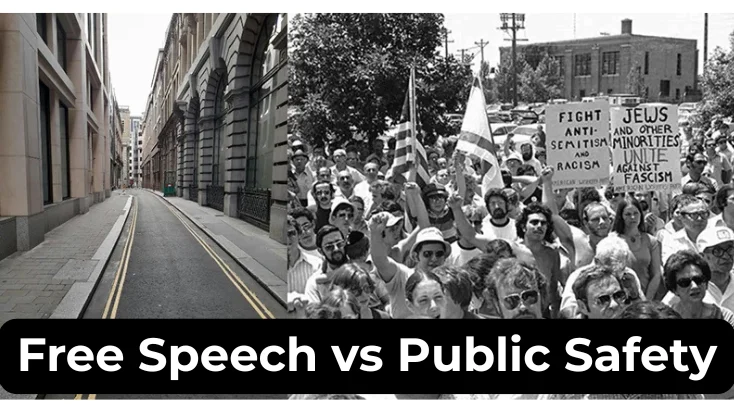
The Metropolitan Police’s recent decision to ban a United Kingdom Independence Party (UKIP) protest in Tower Hamlets offers a striking illustration of how the United Kingdom and United States take fundamentally different approaches to managing contentious demonstrations. These approaches are rooted in distinct constitutional frameworks and philosophies about when government should intervene in public expression.
The Whitechapel Decision: Preventive Policing in Action
On October 21, 2025, the Metropolitan Police (the Met) invoked Section 14(3) of the Public Order Act 1986 to prohibit the UKIP’s planned “mass deportations tour” event from occurring anywhere in Tower Hamlets. Met Commander Nick John justified the unprecedented borough-wide ban on two grounds: the realistic prospect of serious disorder and the potential for significant disruption to a major arterial route.

The calculus was straightforward. Tower Hamlets has the UK’s largest percentage of Muslim residents. UKIP organizers described their event as a “crusade” to “reclaim Whitechapel from the Islamists.” A substantial counter-protest was also expected. The Met assessed these factors and concluded that preventing the assembly entirely was both lawful and necessary.
This represents preventive intervention: stopping speech before disorder occurs based on assessment of risk.
The American Answer to the Same Question
The United States, of course, has a history of contentious protests. Recently, these include the 2017 “Unite the Right” rally in Charlottesville, the anti-Israel protests and demonstrations following the October 7, 2023, Hamas attack on Israel, and the “No Kings” protests that took place across the country on June 14, and October 18, 2025.
Perhaps one of the most striking comparisons between the UK and the U.S. approach to protest rights can be highlighted by an event almost 50 years ago. In 1977, the National Socialist Party of America (aka the American Nazi Party) sought to march through Skokie, Illinois, a suburb of Chicago, and “home to some 70,000 people, of whom 40,500 were Jews, and of those 5,000–7,000 were survivors of Nazi concentration camps.” The demonstrators planned to wear Nazi uniforms and display swastikas. The psychological trauma to survivors would be profound and intentional.
Skokie officials attempted to block the march through permit requirements, insurance bonds, and ordinances prohibiting hate speech and the display of symbols offensive to particular communities. The legal battle made its way through the Illinois Supreme Court and the U.S. Supreme Court, with the American Civil Liberties Union (ACLU) defending the Nazis’ right to march on First Amendment grounds.
The U.S Supreme Court agreed with the ACLU: the march could proceed. In National Socialist Party of America v. Village of Skokie (1977) and related cases, the courts held that the government could not suppress speech simply because it was deeply offensive to the community, even a community with unique historical trauma. The emotional harm, while real and severe, did not constitute a sufficient basis for “prior restraint” (preventing speech and its potential harm before the message is articulated).
The comparison is instructive. Both Skokie and Whitechapel involved:
- Deliberately provocative speech targeting a specific community;
- A marginalized group with historical trauma (Holocaust survivors; British Muslims post-7/7 and amid rising Islamophobia);
- Organized protesters choosing to demonstrate in areas where their message would cause maximum distress;
- Significant risk of counter-protest and potential violence; and
- Local authorities seeking to prevent the event to protect community peace.
The outcomes could not have been more different. Skokie’s attempts at prevention were struck down as unconstitutional. Tower Hamlets received a borough-wide protection order.
Constitutional Architectures and Philosophical Differences
The divergence between U.S. and UK approaches begins with constitutional structure.
The First Amendment in the U.S. provides that “Congress shall make no law…abridging the freedom of speech, or of the press; or the right of the people peaceably to assemble.” While courts have recognized narrow exceptions, the amendment’s language suggests an absolute prohibition on government interference with peaceful expression. The American legal system places the burden overwhelmingly on the government to justify any restriction, with “content-based” restrictions facing strict scrutiny.
By contrast, the UK’s Human Rights Act 1998, incorporating Article 10 of the European Convention on Human Rights, explicitly frames freedom of expression as a “qualified” right. Article 10(2) lists circumstances under which restrictions may be imposed: national security, public safety, prevention of disorder or crime, protection of others’ rights, and maintaining judicial authority. These restrictions must be prescribed by law, necessary in a democratic society, and proportionate, but the framework inherently requires governmental balancing of competing interests.
This reflects different philosophies. The UK framework emphasizes proportionality: are the restrictions proportionate to the legitimate aims pursued? The UK system trusts authorities to make preventive judgments about when speech poses unacceptable risks.
American courts have consistently held that the government cannot silence speakers simply because their message might provoke a hostile reaction from listeners. Otherwise, this gives what’s called a “heckler’s veto” to those who oppose the message. The U.S. system requires letting speech occur and addressing consequences afterward.
The burden on the U.S. government to justify preventing speech before it occurs is extraordinarily high; higher, arguably, than the Met could have met in U.S. courts even with detailed threat assessments.
The Cost of Consistency
The Skokie case revealed what absolute First Amendment protection requires of communities. Holocaust survivors – people who had experienced the ultimate consequences of Nazi ideology – were told that their trauma, while real and sympathetic, could not justify government suppression of Nazi symbolism. The government is not permitted to choose which viewpoints deserve protection based on their offensiveness or the pain they cause.
The American approach – unlike that of the UK – is meant to reflect a profound skepticism about government’s ability to distinguish good ideas from bad ones without political bias. It requires faith that communities can withstand hateful speech through counter-speech, solidarity, and resilience rather than government intervention.
Notably, the Nazis ultimately chose not to march in Skokie, holding a rally in Chicago instead. But the principle was established: American law would have required the village to allow it.
In contrast, the Tower Hamlets ban is not an isolated example of UK authorities preventing public gatherings based on security assessments. Birmingham authorities banned Maccabi Tel Aviv soccer fans from attending a November 6, 2025, Europa League match at Villa Park, citing “public safety concerns outside the stadium bowl and the ability to deal with any potential protests.” West Midlands Police deemed the fixture “high risk based on current intelligence and previous incidents, including violent clashes and hate crime offences” from a 2024 Ajax-Maccabi Tel Aviv match in Amsterdam.
The decision drew condemnation from politicians, sports organizations, and Jewish groups, revealing a troubling extension of UK preventive powers: authorities excluded not protesters expressing views, but Israeli fans whose presence might trigger protests. Under American constitutional doctrine, U.S. authorities would be constitutionally required to provide security and protect the fans rather than exclude them because others might target them.
The Maccabi Tel Aviv case also exposes an ambiguity in the UK framework: Does it protect vulnerable groups, or only select ones? Or does it manage them as security problems?
Tower Hamlets Muslims were shielded from a hostile demonstration. Maccabi Tel Aviv fans – also facing antisemitism – were excluded to avoid managing hostility toward them. The same preventive logic that protects one community can exclude another based on operational convenience.

When game day came on November 6, a police force of 700 was deployed at the Aston Villa v. Maccabi Tel Aviv game – seven times the size of a normal European night at Villa Park – to control hundreds of pro-Palestine campaigners. Meanwhile, counterprotests from pro-Israeli groups were corralled by British police in a fenced-in basketball court off of Villa Park grounds.
On Saturday, October 25, when a counter-protest organized by the group “Stand Up To Racism” occurred in Tower Hamlets – while the UKIP protest took place in Central London – and over 150 masked men were filmed chanting, “We will honour all our martyrs! From the river to the sea! Allahu akbar!”
Testing America’s Limits
Nearly 50 years after Skokie, the American system faced two simultaneous tests: could it protect vulnerable minorities from harassment while preserving First Amendment rights, and could it accommodate unprecedented mass mobilization against government authority?
The Campus Crisis: Following Hamas’s October 7, 2023, attacks and Israel’s military response in Gaza, campus protests erupted across the U.S. Not long after, Jewish university students reported severe harassment: being told “Go back to Poland” and “fuck you” while wearing kippahs or Stars of David; signs reading “Al-Qasam’s Next Targets” pointing at them; chants of “Burn Tel Aviv to the ground” and calls for October 7 to happen “10,000 times.”
Yet, protesters invoked First Amendment rights to demonstrate against Israel’s actions. Universities faced an impossible constitutional bind: they couldn’t ban protests based on anti-Israel content (that would be viewpoint discrimination), and they couldn’t prevent protests because Jewish students felt threatened (that would be heckler’s veto), but they faced Title VI liability if they failed to protect students from discriminatory harassment.
By March 2025, the Department of Education was investigating 60 universities for antisemitic harassment and had canceled $400 million in federal funding to Columbia University. President Trump posted: “All Federal Funding will STOP for any College, School, or University that allows illegal protests.” Secretary of Education Linda McMahon declared: “This is not a freedom of speech issue. This is a safety and civil rights issue.”
Mass Mobilization: Meanwhile, the “No Kings” protests on June 14, 2025, brought an estimated 5 million Americans out to demonstrate across 2,100 locations, and an additional 7 million Americans on October 18 across 2,700 locations in what may be the largest and most geographically widespread demonstration in U.S. history. Small towns in red states saw protests alongside major cities. The demonstrations explicitly challenged President Trump’s authority, with organizers invoking the constitutional principle that no person is above the law.

Despite the protests’ scale, they proceeded without federal suppression. Law enforcement across hundreds of jurisdictions facilitated these demonstrations, stating “in New York City and Washington, D.C., where rallies drew some of the day’s biggest crowds, … no protest-related arrests were made.”
The constitutional architecture here prevented the kind of governmental prohibition the Met exercised in Tower Hamlets. Under UK law, both situations likely would have been handled differently, just as the Maccabi Tel Aviv decision would be constitutionally unthinkable in the United States. Here, it is the government’s responsibility is to protect citizens from hostile audiences, not to exclude them from public spaces to avoid managing that hostility.
Practical Implications for Homeland Security
These contrasting frameworks create distinct operational realities for security officials:
Planning and Resource Allocation: UK authorities can redirect resources away from banned events. The Met eliminated a major policing operation with the Tower Hamlets ban. West Midlands Police avoided deploying resources to separate Maccabi Tel Aviv fans from protesters by simply excluding the Maccabi fans. U.S. law enforcement must prepare to facilitate and protect even the most contentious demonstrations, often at significant cost, even if that means accommodating millions of “No Kings” protestors across hundreds of jurisdictions. The Met aimed to eliminate that burden entirely with a ban.
Legal Liability and Risk: American law enforcement faces potential civil rights litigation if they restrict protests too aggressively, but also liability if they fail to protect adequately. The consequences of neglecting this liability were seen in the actions taken by the administration and Department of Education after Jewish students failed to receive adequate protection on university campuses amid anti-Israel protests. The legal safe harbor is narrow. UK police have broader discretion to intervene preventively under the Public Order Act, with the primary check being judicial review of the proportionality determination.
Community Relations: The UK approach allows authorities to appear responsive to vulnerable communities’ safety concerns, potentially building trust. The U.S. approach forces authorities to defend even repugnant speakers, potentially alienating communities who feel abandoned. After Skokie, many Holocaust survivors felt betrayed by institutions they expected to protect them. Jewish students in 2024-2025 experienced similar feelings when universities cited First Amendment constraints while harassment continued.
Federal Intervention: The Trump administration’s attempt to defund universities over “illegal protests” represented an effort to break through constitutional constraints but raised concerns about weaponizing civil rights language against political opponents.
Homeland Security Amid Democratic Commitments
The Tower Hamlets ban, the Maccabi Tel Aviv exclusion, Skokie, the campus protests, and the “No Kings” demonstrations illustrate two incompatible visions of democratic governance.
The British approach asks: what good is freedom of speech if vulnerable communities cannot safely participate in public life? It empowers authorities to make contextual judgments about when expression crosses the line into harassment, intimidation, or incitement to hatred. It treats freedom of expression as one right among many, to be balanced against community safety and human dignity.
The American approach asks: who decides what speech is too dangerous? It assumes that government, given power to suppress “bad” speech, will inevitably abuse that power against dissent. It treats freedom of speech as a foundational right that enables all others, requiring absolute protection except in the most extreme circumstances. It forces communities to develop resilience to hateful speech rather than depend on government protection.
For homeland security professionals, understanding these trade-offs is essential.
The British model is seemingly meant to offer tactical flexibility and, thus, proactive protection: the Met avoids a major security operation and potential violence by banning the UKIP event entirely in that target area. But the outcome depends on public acceptance of official judgments about acceptable speech and risks accusations of viewpoint discrimination. The demonstrations, enhanced police presence, chants of “death to the IDF,” and arrests outside the Villa Park stadium November 6 effectively negated the provided justification for the initial ban.
The American model constrains tactical options and lends itself to a reactionary stance. Police would have been required to facilitate and protect the Nazi Skokie march despite the trauma to Holocaust survivors. But it reflects deep skepticism about the government’s ability to make censorship decisions neutrally and places responsibility on civil society to counter hateful ideologies.
Neither approach is obviously superior. Both reflect legitimate democratic values and involve real trade-offs. The United Kingdom accepts greater government discretion for the stated goals of community protection and social cohesion. The United States chooses maximal speech protection, accepting greater risk and requiring communities to endure trauma in service of abstract principle.
What Skokie and Whitechapel together illuminate is the price each society pays for its choice. As both nations face unprecedented polarization and mobilization, the question is whether either system can maintain public trust while managing the collision between expression rights and community safety in increasingly fractured societies.