
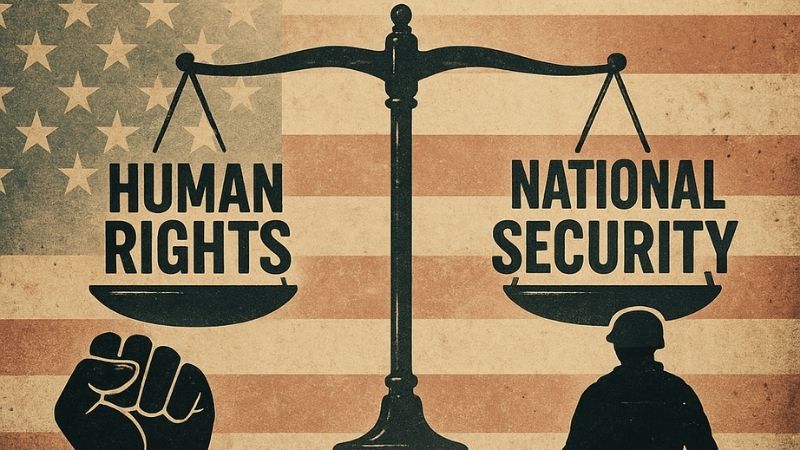
Imagine this: A sensationalized issue has grown beyond political discourse and spilled over into action. It is the standard stencil of measures taken when societal temperatures reach an uncomfortable degree in the interest of restoring order to brewing chaos. What that order is, and what apparent chaos threatens it have, historically, varied in answer and consequence—each landing on either end of the moral spectrum. Such is the nature of United States history, carved from the test and trials of human rights with each outcome shaping the image of our country in its laws, norms, and privileges. We could surmise that the positioning factor on this proposed spectrum ultimately comes down to a question of humanity: Where does the balance lie in maintaining security and upholding human rights, and at what point do we justify sacrificing our rights as citizens and as humans in the name of national security?
The very purpose of declared human rights is to remind governing powers and their legislature of our humanity. That is what the United Nations endeavored in 1948 through their “Universal Declaration of Human Rights”, which consists of thirty articles that define what constitutes “universally protected rights” regardless of race, religion, sex, country of origin, et cetera (un.org Universal Declaration of Human Rights). The power of these articles exists as universal boundaries intended to protect people from government overreach and to cultivate the optimal human experience in an equitable fashion across the globe. Ideally, this intersects with national security in the shared interest of ensuring the sanctity of humanity through established agencies, legislations, or governances. The U.S. Constitution is one such example of this synergy as a living document purposed to hold accountable the comprising powers of the United States to its constituents. In recent months, this dual support has been strained and faltered in the misuse of power displayed by one of our own national security agencies: Immigration Customs and Enforcement.
Immigrations and Customs Enforcement (ICE) are one of the many departments in the United States with the goal of safeguarding our nation’s security through a few avenues; Homeland Security Investigations (HSI) which involve human trafficking, smuggling, transnational threats, among other threats, and Enforcement and Removal Operations (ERO) which involves the identification and removal of undocumented immigrants (ice.gov/mission). Thus far, of the thirty articles mentioned in the “Universal Declaration of Human Rights”, there are at least three that, by their definition, have been violated in ICE’s recent ERO activities over the past few months: Articles 3, 9, and 20. The commonality that these three articles share is their explicit safeguard against direct and deliberate maltreatment towards a person by a governing entity. Article 3 addresses this with a declared right to “life, liberty, and security of person”—which, if the first two rights sound familiar, it is because they also exist in the Declaration of Independence (un.org Universal Declaration of Rights; Declaration of Independence: A Transcription). “Security of person” is a unique term when considering its wide-ranging definition that encompasses physical protection from bodily abuse, mental protection from psychological abuse, legal protection from abuse of law and legislative oppression, and material protection from undue or arbitrary seizure of property (liberty.org Security of Person). Article 3’s widespread nature overlaps several of the articles mentioned in the “Universal Declaration,” including those mentioned in this article.
Generally, ICE’s protocols regarding use of force and restraints follow a strict “in case of emergency” criteria, where the detainee presents a danger to themselves, others, or surrounding property (2025 National Detention Standards, 44). Even then, this is solely after all attempts at communication—approaching the detainee “in a language or manner that [they] understand”—have been attempted to no avail (2025 National Detention Standards, 44). These protocols have been mishandled or bypassed altogether in recent attempts at detainment with U.S. citizens becoming a target.
Against Article 9’s prohibition of “arbitrary arrest, detention or exile”, ICE’s endowed power to detain violators of immigration law has overextended to include citizens like Amanda Trebach, who was one of many to record masked ICE agents as they detained undocumented immigrants (un.org Universal Declaration of Human Rights; Tozeman and Wong, ‘There’s no due process’). Her actions were met with handcuffs and a seat in the back of a black van where she was detained without due process and released hours later (Tozeman and Wong, ‘There’s no due process’). Ms. Trebach is not alone in this situation, with one George Retes suffering the same issue after he was caught between a protest and an ICE raid (Tozeman and Wong, ‘There’s no due process’).
The Department of Homeland Security’s official website has issued an official statement to debunk this claim, implying that the Retes was obstructing the officers’ route and “refusing to move his vehicle” (DHS Debunks New York Times False Reporting: DHS Does NOT Deport U.S. Citizens). However, the visual timestamps of their interaction with Retes show a brief conversation happening shortly after the 50-minute mark before ICE advances. A gas cannister is deployed approximately twenty seconds after ICE begins advancing, requiring the car to reverse. At 51 minutes and 35 seconds, Mr. Retes’ car is entirely engulfed in gas with cars to the front and side of him, effectively blocking his vision and mobility (Fox 11, ICE agents, protesters clash during raid at Ventura County farm). In the span of four minutes since his arrival on the scene, Mr. Retes is encased in tear gas where, he recounts, being subjected to escalated violence, arrest, and detainment (Tozeman and Wong, ‘There’s no due process’).
True to history, the people have spoken out against these violations through assembling in peaceful protest. Article 20 of the United Declaration of Human Rights protects the right “peaceful assembly” which, also true to history, has been met with varying levels of forceful opposition (un.org). On October 24th, a video during one of the Chicago protests shows senior ICE officer Gregory Bovino throwing what is believed to be a tear gas cannister, despite the tactic being prohibited (NBC News, Border Patrol commander appears to throw tear gas at protestors, 0:16). Just over a month prior shows a pastor among other protestors in the same city briefly collapse after being “shot in the head with a pepper ball” by an ICE agent (Fox32, Video shows federal agent shoot Chicago pastor in head with pepper ball during Broadview ICE protest). Nevertheless, these violations have not been the dissuading force we can only imagine they were intended to be, but have only served to further embolden citizens to act upon their rights. In a distant way, the practice draws a certain parallel to past protests in the name of human rights—albeit trading freshly-pressed suits for inflatable frog costumes—where protesters collectively endeavored to set the narrative of presenting themselves as non-threatening, despite authoritative publications dictating otherwise (Best, Anti-ICE protester’s frog costume gains a reach well beyond the small Portland pond; DHS Debunks New York Times).
Even so, the effects of these violations can still reverberate through the best of intentions. Calling back to the definition of “security of person” including psychological factors, one apparent effect of these violations is fear. Fear, when left unchecked, can make a monster out of anyone—and a person strained with it may be encouraged take drastic measures. Joshua Jahn took his fears to the extreme when, on the 26th of September, he opened fire on ICE agents during a detainment process. His recorded intention was to instill the same fear that they brought to the Dallas community, yet his actions instead created a deeper anxiety of retribution against the immigrant communities at the hands of ICE authorities (Santucci et. al 2025).
The extremes that unfettered fear can bring out in a society are what spurred President Franklin Roosevelt to detail the “freedom from fear” in his 1941 State of the Union Address (President Franklin Roosevelt’s Annual Message (Four Freedoms) to Congress (1941)). The “Four Freedoms Speech”, which would later inspire the foundational rights in the “Universal Declaration of Human Rights”, were born during the time of great uncertainty: The Great Depression and the second World War. The post-war world he idealized was not one that required or used greater force to maintain power and stability. He looked toward a world where, among other freedoms, men and women were unbound by the weight of a looming threat—be it economical or physical. Most of all, he dreamed of the freedom born when human rights stand at the forefront of society. How that relates globally in today’s world is not the purpose of this article; how our government has allowed the current directive of ICE to abuse the people under the guise of national security is.
This article mentioned earlier the importance of human rights as a reminder to governing powers of our humanity. When our humanity is forgotten or abandoned, fear sets in. This blind attribution of power to one agency has generated a currency of fear that leaves those who deal in it broken. Human rights are not to be treated as inconsequential. Their existence sets a precedent for governments and their respective societies to build and improve upon, and fosters accountability in cases of abuse or negligence. That is why delegitimizing their authority through contradictory actions is dangerous. A rhetoric of violence does not create the trust and unity that a government desires in its constituents; instead, it breeds fear, discord, and collectively undoes the bonds that bring us together. The banner of national security should not be waved to permit the existence of this cruelty against humanity, but to ensure the safety and sanctity of it.
Works Cited
“Border Patrol Commander Appears to Throw Tear Gas at Protestors.” NBCNews.Com, NBCUniversal News Group, 24 Oct. 2025, www.nbcnews.com/video/border-patrol- commander-appears-to-throw-tear-gas-at-protestors-250592837799.
“DHS Debunks New York Times False Reporting: DHS Does Not Deport U.S. Citizens | Homeland Security.” Homeland Security, U.S. Department of Homeland Security, www.dhs.gov/news/2025/10/01/dhs-debunks-new-york-times-false-reporting-dhs-does- not-deport-us-citizens. Accessed 3 Nov. 2025.
Flosi, Nic. “Video Shows Federal Agent Shoot Chicago Pastor in Head with Pepper Ball during Broadview Ice Protest.” FOX 32 Chicago, FOX 32 Chicago, 8 Oct. 2025, www.fox32chicago.com/news/video-federal-agent-shoot-chicago-pastor-head-pepper-ball- broadview-ice-protest.
“ICE Agents, Protesters Clash during Raid at Ventura County Farm.” Fox11 Los Angeles, YouTube, www.youtube.com/watch?v=lO-2YVvYFDM&t=3121s. Accessed 3 Nov. 2025.
“Ice’s Mission | ICE.” U.S. Immigration and Customs Enforcement, U.S. Department of Homeland Security, www.ice.gov/mission. Accessed 3 Nov. 2025.
Roosevelt, Franklin Delano. “President Franklin Roosevelt’s Annual Message (Four Freedoms) to Congress (1941).” National Archives and Records Administration, National Archives and Records Administration, www.archives.gov/milestone-documents/president-franklin- roosevelts-annual-message-to-congress. Accessed 4 Nov. 2025.
Santucci, Jeanine, et al. “Suspect in Ice Shooting Targeted Agents, Officials Say; Advocates Call for Info on Victims.” USA Today, Gannett Satellite Information Network, 26 Sept. 2025, www.usatoday.com/story/news/nation/2025/09/25/ice-shooting-dallas- updates/86341252007/.
“STANDARD 2.8 USE OF FORCE AND RESTRAINTS.” 2025 National Detention Standards, U.S. Immigration and Customs Enforcement, pp. 44–44, https://www.ice.gov/detain/detention-management/2025. Accessed 3 Nov. 2025.
Tozman, Ariel, and Aloysius Wong. “‘There’s No Due Process’”: L.A. Nurse, Veteran among Citizens Forcefully Arrested by Ice amid Immigration Crackdown | CBC News.” CBCnews, CBC/Radio Canada, 1 Nov. 2025, www.cbc.ca/news/world/us-citizens-ice- arrests-detentions-9.6960504.
Santucci, Jeanine, et al. “Suspect in Ice Shooting Targeted Agents, Officials Say; Advocates Call for Info on Victims.” USA Today, Gannett Satellite Information Network, 26 Sept. 2025, www.usatoday.com/story/news/nation/2025/09/25/ice-shooting-dallas- updates/86341252007/.
United Nations. “Universal Declaration of Human Rights.” United Nations, 10 Dec. 1948, www.un.org/en/about-us/universal-declaration-of-human-rights.