
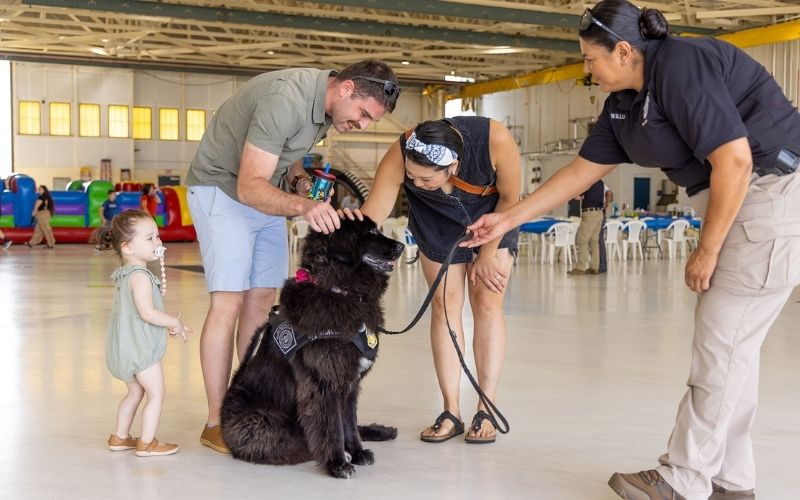
In October 2022, when U.S. Customs and Border Protection Supervisory CBP Officer Monica Williams and Izzy, the agency’s first emotional support therapy dog, were deployed to help employees in Florida cope with a colleague’s line of duty death, Williams received another cry for help. The wife of a CBP officer begged Williams to help her husband who was suffering from trauma and internalizing it. The officer was refusing help, but when he met Izzy, he immediately bonded with the canine. The gentle Newfoundland opened the door for Williams to start communicating with the officer. He let his guard down and shared what was troubling him, paving the way for Williams to safely help the officer get the therapy he needed.
CBP’s Critical Incident Response Canine Program, launched nationwide in 2022, as part of a mental wellness effort, was Williams’ brainchild and one of her long-held aspirations for law enforcement. A 29-year, second generation veteran of CBP and its legacy agency, the U.S. Customs Service, Williams has developed innovative concepts that have had a major impact on helping CBP, other law enforcement agencies, and the public at large. Additionally, Williams is the only CBP employee who is a crisis negotiator and crisis negotiation trainer for the FBI.
As a teenager, Williams went with her dad, a Vietnam veteran who was a U.S. Customs Service inspector, to the local Veterans Affairs hospital in El Paso, Texas, where she observed veterans interacting with emotional support dogs. Williams saw how the veterans’ demeanor changed when the dog was present. They seemed happier and healthier mentally.
Years passed and Williams, who by then was a CBP officer in San Diego, became a certified trainer for emotional support therapy dogs. She acquired a mastiff named Abby that she certified in therapy work. Together, they did voluntary visits at local hospitals, memory care facilities, colleges, veterans’ events, and other community activities. In 2016, Williams lost Abby to cancer, but by that time, Williams understood the profound healing effects of support dogs, especially with children. Somehow, she wanted to be able to help the law enforcement community because she knew the need was there.
“We’re called out to high stress crisis scenarios. It’s heavy on first responders,” said Williams. “I see the pain and hurt in our officers and how they suppress and hide it because we’re the helpers, and we are horrible at seeking and asking for help. We bury it. I knew that these dogs could help,” said Williams.
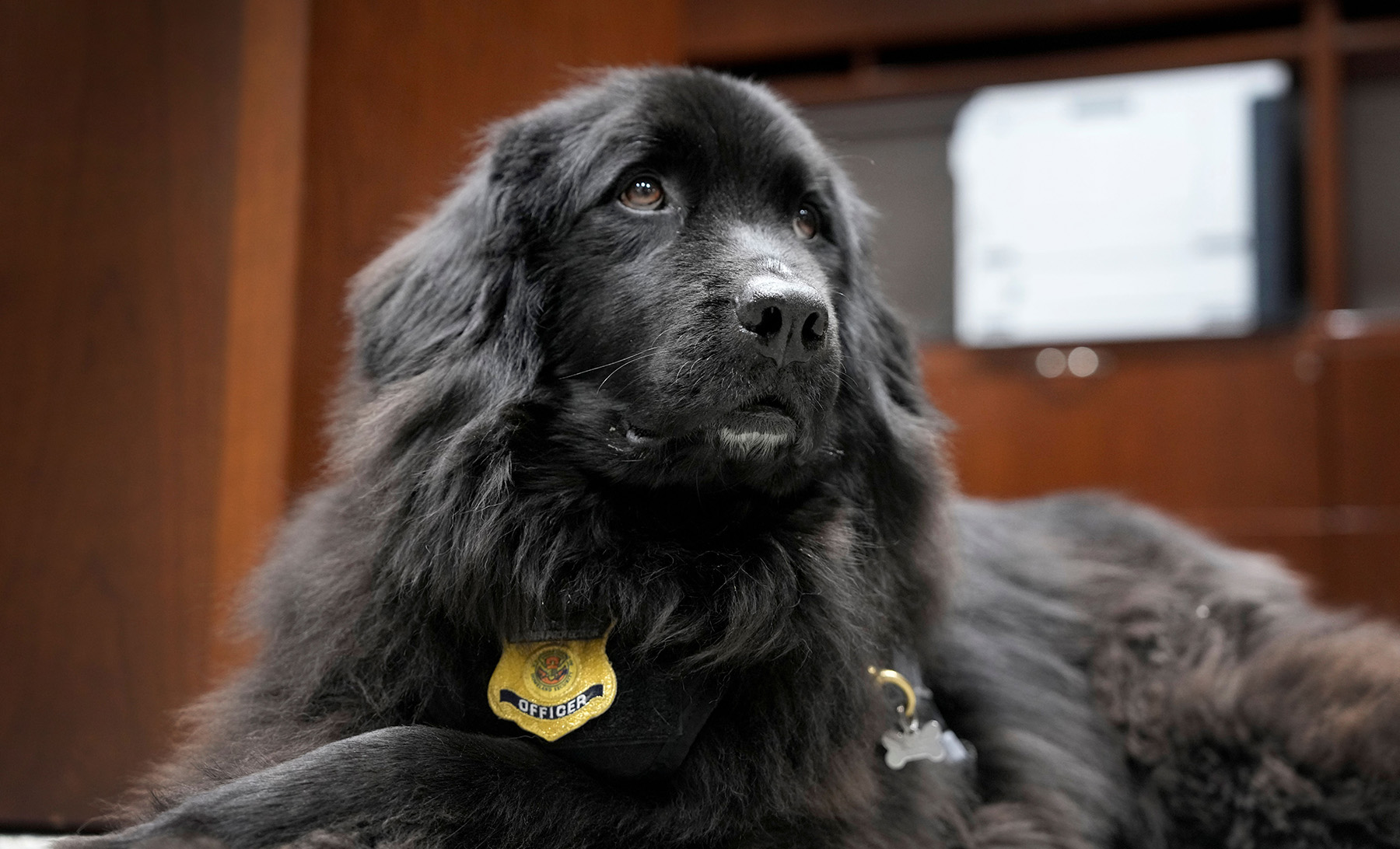
In 2017, Williams acquired another dog that she trained and certified as a support therapy canine. Izzy, a majestic, black Newfoundland, did similar volunteer work with Williams. At the time, Williams was assigned to work on the FBI’s Border Corruption Task Force that investigated corruption on the Southwest border. When the FBI learned about how Williams and Izzy were helping the local community, Williams was asked if she could bring Izzy to the San Diego FBI Field Office for wellness days to help employees. That went so well that Izzy was brought in to comfort traumatized children and adult victims of violent crimes and sex trafficking. “Therapy canines help victims manage the stress and anxiety of having to recount a difficult, traumatic event while we’re conducting our investigations,” said FBI Special Agent Edward Cabral who works in the Bureau’s San Diego Field Office.
The success at the FBI spurred Williams to see if she could help employees and their families at CBP. “I thought it would be therapeutic for CBP’s first responders who are dealing with very stressful, tragic, crisis situations,” said Williams. “The agency uses dogs to detect explosives, narcotics, humans, currency, and agriculture, but this would be the first time that CBP used dogs to help our employees.”
Williams’ idea was embraced. “My gut reaction was let’s do whatever we can to help our employees. If it helps relieve stress, if it helps open doors for communication, then let’s give it a shot and see how it goes,” said retired Acting CBP Commissioner Pete Flores, then director of field operations at the San Diego Field Office. “The San Diego Field Office is fast-paced. San Ysidro, Otay Mesa, Calexico are some of our busiest ports. There’s always something going on—assaults, shootings, deaths in custody, migrant caravans, congested traffic lanes. It takes a lot of man hours to keep the ports operational and a lot of sacrifice and vigilance to keep our borders safe.”
For a number of years, the San Ysidro Port of Entry also had been dealing with a large influx of illegal aliens from Central America and Haiti. “The intensity of the work and the amount of hours we were requiring of employees was demanding,” said Flores. “Seeing a canine could provide an avenue of relief.”
Pilot program
In 2018, a support canine pilot program was launched to help CBP’s workforce, their families, and the communities the agency serves. Williams and Izzy’s first assignment was to assist CBP during Operation Secure Line, a response to the arrival of thousands of illegal aliens traveling in caravan from Guatemala, Honduras, and El Salvador, seeking asylum in the U.S. “Hundreds of CBP officers were sent from across the nation to provide support to the Southwest border because we were getting overrun,” said Williams. “The officers were separated from their families and they missed home. It was mentally stressful for them. I would interact with officers on different shifts and some would just start crying. They would hug Izzy. She was a form of support.”
The officers took pictures with Izzy and sent messages to their field offices and the word spread. Before long, requests started coming in for Williams and Izzy to travel across the country to help employees directly affected by the loss of their coworkers and provide support at funerals, critical incidents, and other tragic events.
In one instance, Williams and Izzy were sent to Miami to help the family of a young CBP paralegal who had died suddenly. Gilda Gomez was the mother of two children, Arianna, a 14-year-old, and Matteo, who was 6. The children’s father was worried that his son was too young to handle the tragedy and thought it might be better to wait and tell him when he was older.
“He wanted to protect Matteo, but the psychologist told my son that it was better to tell him the truth that his mother had passed away,” said Ondina Carrion-Gomez, the children’s grandmother.
The family, however, was at a loss of how to tell the child. “We had no idea how we were going to tell him the painful news,” said Gomez. “And then my son told me that a CBP officer, Ms. Williams, was going to help us.”
Gomez and her son brought Matteo to a public park to meet Williams and Izzy. “They told my grandson and he cried, but Izzy and Ms. Williams were there to support him. Every time he broke down, Izzy was sitting by his side. He looked at Izzy and she had a look of peace and serenity that touched my grandson’s heart. Izzy absorbed his pain,” said Gomez. “Matteo ran with Izzy in the park and forgot his pain.”
Williams asked Matteo if he wanted to attend the funeral the next day to say goodbye to his mother. “I told him not to be afraid and that Izzy would be there,” said Williams. Matteo said, “Yes,” and the following day Williams drove the little boy and his grandmother to the service. At the funeral home, Gomez asked her grandson if he wanted to write a letter to his mom. “I explained that this was the last time he was going to see his mom physically,” said Gomez. “He wrote the letter and it said, ‘Mom, I love you forever and I am keeping you in my heart.’ Ms. Williams gave him stickers of Izzy. He put them on his letter and placed it in the casket with his mother.”
“Ms. Williams and Izzy are a wonderful team,” said Gomez. “They were a source of strength for my grandchildren in their time of grief, when we needed them the most.”
Sensing stress
Often while visiting a CBP Field Office, Williams would find others who needed help. Such was the case when she and Izzy were called to Miami, in October 2022, to provide emotional support after a CBP firearms instructor was accidentally shot and killed during a gun range training exercise.
While Williams spoke to a group of CBP officers at the seaport, Izzy walked the room until she approached one of the officers and sat next to him. “Dogs can detect if someone is experiencing stress, anxiety, or depression from smelling the cortisol levels on that person,” said Williams. “Izzy is trained to recognize cortisol, the main stress hormone, and she knew he was hurting.”
But, as Williams soon learned, the officer’s stress wasn’t caused by the death of his colleague. Omar Abu-Hantash was struggling with his own personal battle. His 2 1/2-year-old son, Adam, had been diagnosed with cancer.
Six months earlier, Abu-Hantash’s wife, Morgan, had taken Adam to the doctor for an ear infection. She and her husband noticed their son was bruising easily, too, and then, he couldn’t run. “It’s not like it happened within a month. It happened within days,” Morgan said. Adam was diagnosed with Acute Lymphoblastic Leukemia, a type of blood cancer that is more curable and treatable for children than other forms of leukemia. His chemo treatments started within 24 hours. “As a parent you just want to fix it. You just want your child to be healthy and happy and not go through any of these terrible things,” said Morgan.
One of the managers at the Miami seaport asked Abu-Hantash if he wanted Williams, a member of CBP’s peer support, to visit his family with Izzy. “I was a little hesitant at first,” said Abu-Hantash. “I’ve always been wary of dogs. I’m not a dog guy. But I realized my son needs this.”
When Izzy arrived at the Abu-Hantash home, she went straight to Adam and laid her head beside him. “Adam didn’t have a lot of strength,” said Morgan. “Izzy is giant, so Adam just curled up with her on the floor. She gave him peace, comfort, and grounding.”
Later, when he felt he could, Adam played with Izzy. “He threw a little tennis ball and Izzy would go get it, and he would just laugh,” said Morgan. “A 2-year-old smiling and laughing is one of those little joys that you don’t miss until you don’t have it. We were tearing up from seeing how happy he was and how much joy Monica and Izzy brought him.”
Although Williams and Izzy live on the West Coast, they visited Adam whenever they were in Miami. “Monica also kept in contact with us constantly, sending pictures and calling,” said Morgan. “At that age, Adam didn’t have any friends. He hadn’t started school and he was immunocompromised, so he couldn’t be around pretty much anyone. When they came, it was like his best friends were here. There were months where he didn’t smile, and as soon as Izzy would walk in, his little face would light up.”
Over the next two years, Adam had 19 lumbar punctures or spinal taps to make sure his chemotherapy and steroid treatments were working. “It’s a terrible process. They take fluid from his spine and then inject him with chemo,” said Morgan. Williams and Izzy made a surprise visit during one of the procedures and stayed the entire day. “When Adam woke up, he asked if Izzy could jump up on the hospital bed with him. She did and they had the best time.”
After 800 straight days of chemo, Adam was cancer free. Williams and Izzy surprised him again at his bell ringing ceremony, on July 13, 2024, when Adam had his last treatment and the hospital had a party for him. “We went through a terrible situation and would never wish that on anyone, but having Monica and Izzy come into our lives was such an amazing thing to come out of such a traumatic experience. We’re keeping them forever,” said Morgan. “We can’t let them go.”

Community impact
At times, Williams and Izzy helped entire communities. A profound example occurred after the mass shooting in Uvalde, Texas, in May 2022, at the Robb Elementary School, where 19 students and two teachers were killed, and 17 others were injured. A specialized Border Patrol team took down the gunman, a former student at the school. The small Texas town was reeling in pain and emotionally in shambles when CBP Officer Daniel Benavidez, the designated commander of CBP’s Traumatic Incidents and Events Response Team arrived in Uvalde hours after the shooting.
“The first responders were coping with the horrors of the tragedy,” said Benavidez. “They were very visibly impacted. Everybody at the Uvalde Border Patrol Station was in a somber, dark mood.” But when Benavidez suggested that the agents speak with a counselor, they rejected the idea. “The reaction was, ‘Oh, no. I don’t need it. I’m fine,’” said Benavidez.
As soon as Izzy arrived, everything changed. “It took a 180-degree turn,” said Benavidez. “Everyone was drawn to Izzy. ‘Can we touch her?’ Some of the agents who previously had rejected any support now were the ones most receptive. But the real magic wasn’t the instant therapeutic effects that Izzy provided. It was how she paved the way for the agents to receive a higher level of care from a professional clinician,” he said. “Our clinician worked hand in hand with Monica. Sometimes the agents didn’t even realize that they were talking to a clinician. But after they spoke with her, I could see the relief on their faces. They were smiling again and breathing.”
From there, the trio reached out to the community at large. “We helped families who lost children and families with surviving children,” said Williams. In one case, the family had experienced both. The surviving child lost her sister in the shooting. “The little girl was not talking to anyone. She was in shock, in a catatonic state,” said Benavidez. “Her family was very concerned. But again, because of Izzy, the child was able to break through the trauma she was going through and was revived.”
“The level of emotion and intensity was very high in Uvalde. The severity was at a completely different level than anything any of us had ever had to deal with,” said Cynthia Elledge, the behavioral health advisor and clinician who worked alongside Williams. “Monica and Izzy were a calming presence that made a terrible situation bearable. That comfort, that feeling of safety at that vital time made a huge impact medically in the recovery process, especially for the first responders.”
The Border Patrol recognized the value of having a support therapy canine in Uvalde and decided to create a similar program to the one CBP’s Office of Field Operations was piloting. “The Robb Elementary School shooting was the catalyst,” said Adrian Cruz, a Border Patrol agent and peer support member who assisted with CBP’s rescue efforts at the school. “I saw how effective Monica and Izzy were. Not only what they did for me and my peers, but also how they helped the people in the community of Uvalde. I told myself, ‘That’s what I want to do.’ She and Izzy put smiles on people’s faces. She puts people at ease and creates a calmness, a soothing feeling from within.”
In February 2024, Cruz became one of the Border Patrol’s Critical Incident Response canine handlers. His partner, Jackie, is a 4-year-old English Labrador. “Monica and Izzy’s work was the foundation for my current career,” said Cruz. “I was inspired by Monica. She was instrumental in creating the Border Patrol’s program, which helps build resiliency within our agency. It also promotes mental wellness, lifting people’s spirits and building morale.”
Working with a canine brought Cruz’s peer support work to a new level. “I’ve been able to help my peers feel good. So many people during my deployments have said, ‘Oh my God. Thank you for coming. Thank you for bringing Jackie. I was having such a horrible day and then I saw you.’”
Positive effects
In December 2024, Williams and Izzy were called to assist CBP’s Air and Marine Operations branch after an air interdiction agent died in a helicopter crash in San Diego County. The reason for the crash is still unknown, but the loss of Jeffrey Kanas, the pilot, was devastating for his family and colleagues.
Raymond Richards, the CBP chaplain who helped the Kanas family, met Williams and Izzy for the first time at Agent Kanas’ funeral service. “I was grateful Monica was there, but I didn’t understand why she brought a dog,” said Richards. “It wasn’t until she took Izzy around the grieving family that I knew I was looking at something significant. Izzy was able to do something that no human could do. She was able to go up to the family in the middle of the funeral and console them. For a moment, they didn’t grieve. They were able to focus on a loving dog that made them smile,” said Richards.
CBP’s Air and Marine Operations top executive also attended the service and observed how Izzy comforted the Kanas family. After seeing the positive effects of a support canine, he decided that CBP’s Air and Marine Operations should have a dog to help its employees and families too. Richards was tapped to run the program and be the handler for the component’s first dog, Raja, an English Labrador Retriever.
Over the past few months, Richards and Raja have been traveling to Air and Marine Operations’ units to introduce themselves. “I didn’t want the first time that people met us to be when a traumatic incident had occurred,” said Richards. It’s important to build relationships and establish trust, so that if something does happen, our employees know they have a resource.” Richards explained that his mental wellness visits with Raja aren’t always serious and intense. “Sometimes I walk in and someone just wants to throw a ball and chase Raja in the hallway. Support canines are not always about stress and trauma. Sometimes they just let our folks be a kid with a dog again and have some fun.”
In 2022, Williams’ canine support pilot was greenlighted by Flores and became a national program of record. “We were looking at how we could assist our employees’ well-being and make them more resilient personally and professionally,” said Flores, who at the time was CBP’s acting deputy commissioner. “A lot of times, employees talk about peer support and how meaningful it is to have someone there to support them, but with a support canine, there is a different emotional connection, another level of comfort to express themselves,” he said. Flores noted that the program adds a lot of value for CBP. “If we have employees who are feeling good about themselves mentally and physically, it makes them better people, which in turn, makes them better employees.”
Crisis negotiation
Williams had other ideas to help first responders. When she started serving on the FBI’s Border Corruption Task Force in 2011, she discovered that one of the case agents on her squad was a crisis negotiator for hostage and other traumatic situations. Williams was fascinated and thought it would be great to bring this skill set to CBP, so she asked if she could take the training. Both the FBI and CBP gave her the nod. “I thought what she would learn about deescalating and negotiating would fit well with what we do. Our officers and tactical teams interact with people daily. Sometimes it’s a volatile situation or it’s an emerging situation where someone, for example, is threatening to jump off a pedestrian bridge into traffic, said Flores. “Many times we are the first responders and until we can get a trained negotiator there, this would help bridge that gap.”
It took months to get everything authorized and there was a long wait list to take the highly intensive training, but Williams passed with flying colors. She became CBP’s first crisis negotiator, deploying with the agency’s elite tactical teams, and then, the FBI asked Williams to be a crisis negotiator for the Bureau locally. Again, CBP’s leadership approved the request and soon Williams was embedded with the FBI’s San Diego SWAT team and the San Diego Police Department on crisis intervention callouts. Since 2016, Williams has been a primary and secondary negotiator in situations involving hostages, barricaded subjects, individuals firing weapons, and suicide attempts. She has dissuaded bridge jumpers and negotiated with people holding a knife to their neck.
In one callout that lasted for approximately 12 hours, a suicidal young man was threatening to jump off a cliff in La Jolla, California, on a chilly February night. “He was a 21-year-old college student who had been sending text messages to his family and friends, telling them where he was and that he was going to end his life,” said Williams, the lead negotiator for most of the incident. “He had trauma in his life and was suffering from mental illness, but he was an attention getter too.”
Williams succeeded in getting the young man to walk toward her to a slightly safer spot. “He was at the edge of the cliff and I didn’t want him to accidentally slip or fall. It was late, it was cold, and I knew he was tired,” she said.
After several hours, the decision was made to switch over to another negotiator and FBI Special Agent Cabral was sent in to relieve Williams. “Ultimately, we were able to resolve the situation peacefully. We took the young man into custody and he was taken to a local hospital for a mental health evaluation,” said Cabral, who is also the current senior team leader of the San Diego FBI field office’s Crisis Negotiation Team. “Monica has the ability to connect with people who are at their lowest point and build rapport. She kept the young man engaged in conversation and deescalated the situation, allowing him to vent a lot of the emotions he was struggling with. She maintained that for an extended period of time and kept him from jumping. This is precisely what this job is all about.”
In 2019, Williams was approved to take advanced training at the FBI’s Academy in Quantico, Virginia. “Quantico is the premiere hostage negotiation school in the world. The fact that Monica was able to go there is a great reflection on her abilities and what we think of her,” said retired FBI Special Agent Jeffrey Horner, who was the senior team leader of the FBI’s San Diego Crisis Negotiation Team prior to Cabral. “I can’t think of anyone else who is a member of an FBI negotiation team from an outside agency and attended the school. She’s the only one.”
“People can wait years to get into this course, even from the FBI,” said FBI Supervisory Special Agent Angela Pennington, who is part of the FBI’s Crisis Negotiation Unit in Quantico and a full-time negotiator for the Bureau. “Just because you are nominated for the course doesn’t mean that you’ll be selected to go. Monica was nominated, selected, and then completed the course in September 2020.”
Pennington nominated Williams for the advanced training while she led the FBI’s San Diego Crisis Negotiation Team. “I nominated her because she is an integral part of our team,” said Pennington. “She is a great negotiator. She exudes empathy and caring. As negotiators, one of the most common things we hear from the person in crisis is ‘You’re only here because you have to be here. It’s your job.’ Monica genuinely cares about people. Because of that, she has a lot of successful negotiations.”
After completing the course, Williams became a certified crisis negotiator for the FBI nationwide and a crisis negotiation trainer for the Bureau. She is the first and only CBP employee who has these credentials, and as she had hoped, she brought the skills back to the agency. “Monica has been that bridge of allowing folks from her agency to come and attend our training. As one of our instructors, she has helped CBP have its own negotiators,” said Cabral.
“Our best ideas come from those willing to do the work and value the importance of what it does for our agency,” said Flores, who has supported Williams throughout her career. “All of the opportunities I’ve had, he’s blessed,” said Williams. “He said, ‘Yes,’ when it would have been easier to say, ‘No.’”
But Flores insists, “The success of these concepts didn’t happen because of me. It happened because we have an employee who saw a need and was willing to step up, do the training, do the work, and then pitch it in regard to why this was important, and that was Monica,” said Flores. However, as Williams sees it, “You can have the ideas, but without the approval, the ideas go nowhere.”