
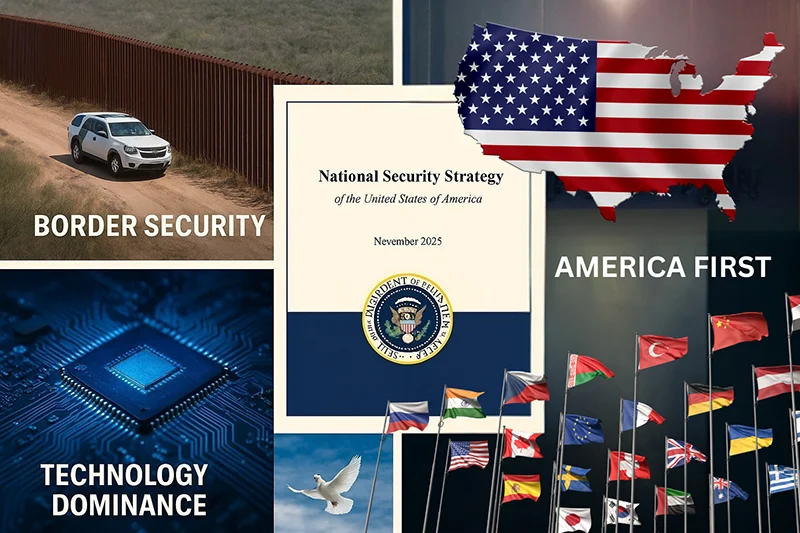
KEY TAKEAWAYS
Overall Conclusions:
- America First doctrine replaces global interventionism with focused pursuit of core national interests
- Economic security elevated to foundation of national security, emphasizing reindustrialization and fair trade
- Burden-sharing mandate requires allies to spend 5% of GDP on defense (the “Hague Commitment”)
- Peace through strength remains central: administration claims eight conflict resolutions in eight months
- Border security prioritized as primary element of national security; “era of mass migration is over”
- Strategic realism over ideology: willing to work with non-democratic partners where interests align
- Technology dominance emphasized in AI, biotech, quantum computing as critical to future competition
Regional Priorities:
- Western Hemisphere: Assert “Trump Corollary” to Monroe Doctrine; deny foreign adversaries access to hemisphere; enlist regional partners to control migration and cartels; expand U.S. commercial presence
- Asia: Win economic competition while deterring military conflict; rebalance trade with China; strengthen First Island Chain defenses; protect Taiwan Strait status quo; require allies to increase defense spending
- Europe: Push allies toward civilizational renewal and self-reliance; end Ukraine war to restore strategic stability with Russia; increase European defense spending; resist EU overreach and protect national sovereignty
- Middle East: Shift from region dominating U.S. foreign policy to partnership model; leverage weakened Iran after Operation Midnight Hammer; expand Abraham Accords; transition to investment rather than military engagement
- Africa: Move from aid paradigm to trade and investment focus; partner on critical minerals and energy development; resolve regional conflicts diplomatically; avoid long-term military commitments
The Trump administration released its National Security Strategy in November 2025, presenting a blueprint that reorients American foreign policy around a doctrine of “America First,” core national interests while reducing commitments characterized as unsustainable.
A Fundamental Reorientation
The 33-page document opens with a critique of post-Cold War American strategy, arguing that attempts at “permanent American domination of the entire world” through unsustainable commitments hollowed out the industrial base and middle class while binding U.S. policy to “sovereignty-sapping” international institutions.
President Trump’s strategy explicitly rejects this approach, defining national security through a “focused definition of national interest” that prioritizes territorial security, economic strength, technological leadership, and cultural renewal over what it characterizes as vague platitudes about global leadership.
“The purpose of foreign policy is the protection of core national interests; that is the sole focus of this strategy,” the document states, noting that “not every country, region, issue, or cause—however worthy—can be the focus of American strategy.”
The strategy document claims President Trump “leveraged his dealmaking ability to secure unprecedented peace in eight conflicts throughout the world over the course of just eight months.” These include negotiations between Cambodia and Thailand, Kosovo and Serbia, the Democratic Republic of the Congo (DRC) and Rwanda, Pakistan and India, Israel and Iran, Egypt and Ethiopia, Armenia and Azerbaijan, and ending the Gaza war with hostage returns.
The document also highlights Operation Midnight Hammer as having “obliterated Iran’s nuclear enrichment capacity” in a June 22, 2025, military action.
Border Security as National Security
Immigration and border control receive significant emphasis, with the strategy declaring that “the era of mass migration must end.” The document frames border security as “the primary element of national security,” arguing that Western nations have experienced strained resources, increased violence, weakened social cohesion, and undermined national security due to mass migration.
“A border controlled by the will of the American people as implemented by their government is fundamental to the survival of the United States as a sovereign republic,” the strategy states.
The strategy calls for restoring American “preeminence” and its military presence in the Western Hemisphere through four avenues, including “targeted deployments to secure the border and defeat cartels, including where necessary the use of lethal force…”
Economic Security Foundation
Economic policy occupies a central position in this security framework, with the strategy arguing that “economic security is fundamental to national security.” Key economic priorities include:
Trade: Reducing trade deficits, opposing export barriers, ending dumping practices, and negotiating reciprocal trade deals prioritizing American workers.
Reindustrialization: “Re-shoring” industrial production using tariffs and new technologies to reduce dependence on adversaries for critical products.
Energy: Restoring dominance in oil, gas, coal, and nuclear as a “top strategic priority.” The strategy rejects “climate change” and “Net Zero” ideologies.
Defense Industrial Base: Calls for increased production capacity to meet peacetime and wartime demands, addressing cost gaps between offensive and defensive systems.
Burden-Sharing Revolution
A cornerstone of the strategy is the “Hague Commitment,” which requires NATO allies to spend 5% of GDP on defense and security, an increase from the previous 2% target. The document emphasizes that “the days of the United States propping up the entire world order like Atlas are over,” and this commitment from the June 2025 NATO Summit includes 3.5% for core military requirements (troops, equipment, ammunition) and 1.5% for defense-related investments (infrastructure, cybersecurity, defense industry) by 2035.
The strategy promises more favorable commercial treatment, technology sharing, and defense procurement opportunities for countries that “willingly take more responsibility for security in their neighborhoods” and align their export controls with U.S. standards.
Regional Strategies
Western Hemisphere
The strategy announces a “Trump Corollary to the Monroe Doctrine,” declaring that the U.S. will “deny non-Hemispheric competitors the ability to position forces or other threatening capabilities, or to own or control strategically vital assets, in our Hemisphere.”
Priorities call for adjusting the global military presence to address hemispheric threats while enlisting regional partners to control migration and neutralize cartels, expanding U.S. commercial presence, and develop local economies while reducing adversarial foreign influence, particularly from China.
Asia
The Indo-Pacific strategy pursues economic competition alongside military deterrence. On economics, it commits to protecting against state-directed subsidies, intellectual property theft, and supply chain threats while working with allies whose combined economies exceed $65 trillion.
Military priorities include deterring conflict over Taiwan, maintaining declaratory policy on the Taiwan Strait, and preventing any competitor from controlling the South China Sea. The strategy presses First Island Chain allies for greater U.S. military access and increased defense investments.
Europe
The document argues Europe faces challenges including economic stagnation (GDP share declining from 25% in 1990 to 14% today), regulatory burdens, migration policy impacts, and loss of self-confidence.
U.S. priorities include negotiating cessation of hostilities in Ukraine to stabilize European economies and reestablish strategic stability with Russia, increasing European defense spending, supporting national sovereignty, opening markets to U.S. goods, and “ending the perception, and preventing the reality, of NATO as a perpetually expanding alliance.”
Middle East
With America again a net energy exporter and Iran weakened, the strategy states “the days in which the Middle East dominated American foreign policy in both long-term planning and day-to-day execution are thankfully over.”
The document describes the region as transitioning to “a place of partnership, friendship, and investment.” Priorities include expanding the Abraham Accords, partnering on AI and nuclear energy technologies, and accepting regional governments “as they are while working together on areas of common interest.”
Core interests remain ensuring Gulf energy supplies don’t fall to adversaries, maintaining open access through Hormuz and the Red Sea, preventing terror incubation, and ensuring Israeli security.
Africa
The strategy calls for transitioning “from a foreign aid paradigm to an investment and growth paradigm,” criticizing previous focus on spreading ideology.
Priorities include partnering on critical mineral development and energy sector investment in nuclear and natural gas technologies, negotiating conflict settlements, and “favoring partnerships with capable, reliable states committed to opening their markets to U.S. goods and services” while avoiding long-term military commitments.
Core Principles to National Security Strategy
The strategy articulates 11 core principles including focused definition of national interest, peace through strength, predisposition to non-interventionism with high bars for justified intervention, flexible realism accepting different governing systems, primacy of nations over transnational organizations, pro-American worker policies, fairness in alliances and trade, and emphasis on competence and merit.
National Security and Homeland Security Convergence
The strategy continues to blur the traditional distinctions between national security (focused on external threats and foreign policy) and homeland security (focused on domestic protection and resilience).
The focus on border security exemplifies this shift. The document designates it as “the primary element of national security” while controlling migration and smuggling, which are traditionally homeland security missions. The strategy frames immigration policy, drug trafficking, and transnational criminal organizations as core national security rather than law enforcement concerns, hence, proposing military deployments against cartels.
Similarly, supply chain resilience, critical infrastructure protection, and economic security – typically seen as homeland security portfolio items – are elevated to central national security priorities. The document states “economic security is fundamental to national security,” positioning trade policy, industrial capacity, and domestic energy production as matters of strategic defense rather than purely economic policy.
This convergence suggests increased military involvement in missions historically managed by civilian agencies, while treating domestic economic and border policies as foreign policy instruments. It raises questions about appropriate roles for military versus civilian agencies, legal authorities for domestic operations, and resource balance between external defense and homeland protection.
For homeland security practitioners, the strategy signals several major policy directions:
Border enforcement will receive significantly increased resources and authorities, including military support for operations against cartels. The document’s reference to “lethal force” against transnational criminal organizations ties back to the more aggressive operational posture already witnessed in prior strikes on drug-running vessels.
Critical infrastructure protection receives emphasis, with calls for resilient national infrastructure capable of withstanding foreign threats. The strategy highlights the importance of U.S.-government and private sector collaboration on network defense and cyber operations.
Supply chain security emerges as a central concern, particularly for defense-related production capacity and critical materials. The Intelligence Community is tasked with monitoring key supply chains and technological advances to identify vulnerabilities.
Counter-influence operations will expand, with the strategy emphasizing protection against foreign espionage, propaganda, cultural subversion, and manipulation of immigration systems to build foreign-aligned voting blocs.
Technology standards competition in AI, biotech, and quantum computing is framed as essential to both economic security and homeland protection.
The National Security Strategy indicates that homeland security portfolios will be increasingly integrated into broader national security planning and may receive elevated priority and resources. But it continues to blur the distinctions between homeland security missions and those of defense and intelligence agencies.
The complete National Security Strategy document is available at whitehouse.gov.