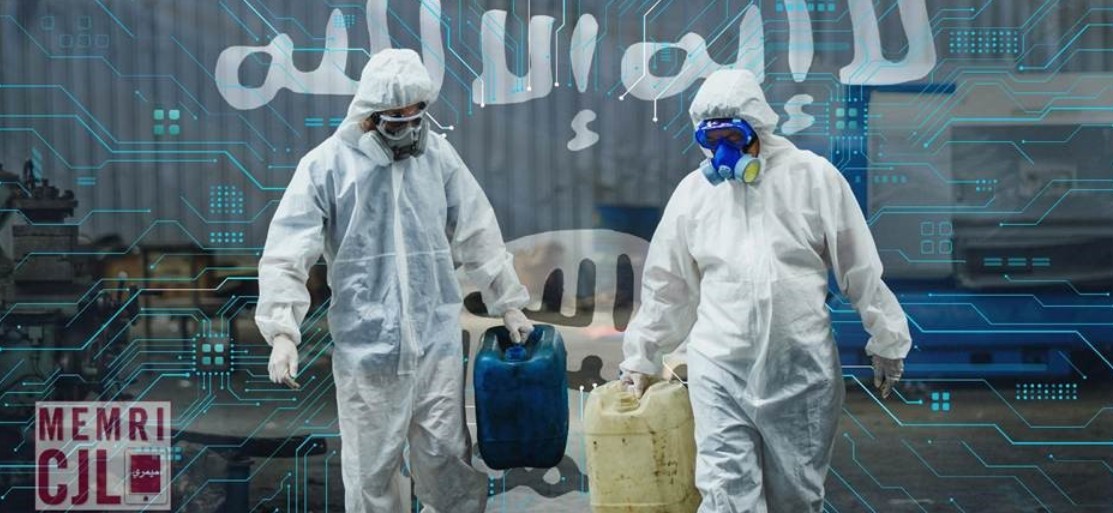
The recent spread of the Ebola virus recalls the early days of COVID-19, when terrorist organizations considered leveraging a global health crisis for attacks. Today, the threat landscape is more complex. Artificial intelligence (AI) now gives extremists shortcuts to technical guidance, biological research, and attack planning that did not exist when COVID emerged. MEMRI extensively researched the COVID-era threat over the course of three years and published the most comprehensive study on this subject to date. While Ebola is still very difficult to weaponize, there is a possibility that it could become another weapon in the terrorist arsenal – and AI could help them overcome some of the challenges involved.
At the same time, it was reported just yesterday that Stanford University researchers have used AI to create the first viruses unknown in nature. Project leader Brian Hie said, “Our study is a proof of concept showing for the first time that generative design can generate entire functional genomes.”
Jihadis are surely already asking AI platforms how Ebola might be weaponized or spread. Testing by the MEMRI Cyber Jihad Lab (CJL) research team found that Grok, ChatGPT, and Perplexity refused to answer directly, offering only general information – although ChatGPT offered to explain, at a high level and without operational details, why some pathogens are considered more suitable for weaponization than others. Claude immediately flagged the conversation, while DeepSeek was willing to discuss the topic in greater depth. The range of responses underlines a real challenge: Despite efforts by AI companies, protections remain inconsistent, as extremist interest grows.
AI Pioneers Warn About AI And Biological Weapons
The WHO’s declaration of the Ebola epidemic as a “global emergency” on May 18 coincides with security officials’ increasing alarm about the risk of AI use to devise new methods for biological attacks. Experts have been warning for years that as AI technology advances, so do the risks of its misuse in bioterrorism. Most recently, Microsoft cofounder Bill Gates stressed in his January 2026 annual letter that “today, an even greater risk than a naturally caused pandemic is that a non-government group will use open source AI tools to design a bioterrorism weapon.”
At the Nobel Prize banquet in December 2024, computer scientist Geoffrey Hinton, often called “the Godfather of AI,” warned that “in the near future, AI may be used to create terrible new viruses and horrendous lethal weapons that decide by themselves who to kill or maim.” He emphasized that “these short-term risks require urgent and forceful attention from governments and international organizations.”
After testifying before Congress in May 2023, OpenAI CEO Sam Altman called AI’s ability to design new biological threats “scary.” He noted two years later, at a July 2025 Federal Reserve conference, that the risk was growing and that despite warnings, “the world is not taking us seriously.”
Anthropic CEO Dario Amodei warned at a July 2023 hearing of the Senate Judiciary Subcommittee on Privacy, Technology, and the Law that “a straightforward extrapolation of today’s systems… suggests a substantial risk that AI systems will be able to fill in all the missing pieces, enabling many more actors to carry out large-scale biological attacks.” This, he added, “represents a grave threat to U.S. national security.”
Mustafa Suleyman, cofounder of DeepMind and now CEO of Microsoft AI, echoed these concerns in a November 2023 PBS interview. He explained that AI means “you don’t need to have the same undergraduate level skills in biology to be able to synthesize a new dangerous compound” because “you’ve got this intelligent aide” guiding you, “reducing the barrier” to causing “chaos.”
Even earlier, in September 2022, former Google CEO Eric Schmidt said that the biggest concern with AI “is actually going to be… its use in biological conflict.” He added: “There is a general concern that the database of viruses can be expanded greatly by using AI techniques” to “generate new viruses.”
Jihadi Interest In AI And Biological Attacks
Battle-hardened jihadis in Africa who have garnered the attention of the U.S. military for their systematic targeting of Christian villages and slaughtering of their inhabitants are using AI, as Cambridge University terrorism and technology researcher Dr. Antonia Juelich wrote in a paper published by the university. Over the past two years, the MEMRI Cyber Jihad Lab (CJL) has also documented their increasing use of AI.
There has also been an uptick in jihadi chatter about biological attacks in the West. For example, on May 29 and June 1, 2026, users on an encrypted platform favored by ISIS supporters discussed ways to obtain biological toxins. One even wrote that he was looking for documents “on how to extract ricin, kill them silently, how to make phosphene gas PH3, how to extract poisonous plant, botulinum toxin, etc” and asked, “If someone has access, can you send it to me.”
The Islamic State (ISIS) openly announced its intent to spread disease and epidemics among its enemies. The May 21, 2026 issue of its Al-Naba’ weekly featured an infographic titled “Types of Wars” that included biological warfare using “poisons and viruses.”
AI Ricin Guides, Inadequate Chatbot Safeguards, And Thwarted Bioterror Plots – A Toxic Brew
Reports published this summer showed why AI must be part of the bioterrorism conversation. They found that major chatbots, including OpenAI’s ChatGPT, provided step-by-step instructions for manufacturing ricin and other biological weapons that a high school student could follow. Experts said these instructions were accurate enough to be used for actual mass-casualty attacks. OpenAI blocked the accounts involved, but did not report them to law enforcement, citing a lack of clear legislation in this regard. Although the AI industry is calling for mandatory safeguards at the synthetic genetic material ordering stage, critics warn that excessive regulation could hinder legitimate research, including the development of new drugs.
This bioterror risk isn’t just theoretical. Two months earlier, in May 2026, India’s National Investigation Agency charged three men in an alleged ISIS-linked plot to use ricin in a mass poisoning attack. Authorities say the suspects conspired with foreign ISIS handlers to make ricin, procure weapons. Move funds through covert operations, recruit supporters, and target crowded places to cause mass casualties. One of the suspects, a Hyderabad doctor, was alleged to have established a home laboratory to manufacture ricin; according to authorities, he had been promised the position of ISIS “Amir” of South Asia in return for executing the terror plot.
COVID-19’s Exposure Of Vulnerabilities As A Blueprint For AI-Era Bioterrorism
The COVID-19 pandemic changed how governments think about disease and national security, and shapes how they view the Ebola crisis today. The UN Security Council Counter-Terrorism Directorate – and UN Secretary-General Antonio Guterres – have acknowledged that the pandemic’s exposure of critical vulnerabilities in our health systems, supply chains, and crisis response mechanisms has provided a blueprint for bad actors to exploit. In the AI era, those vulnerabilities matter even more: supply-chain gaps, public panic, and weak biological defense protocols can be studied – and potentially exploited – much faster and more easily.
Counterterrorism officials should also consider how jihadis viewed the pandemic as a model, brainstorming ways to further spread it across the West – as MEMRI extensively documented at that time during that period.
In a March 2020 memo, then-U.S. Deputy Attorney General Jeffrey A. Rosen informed federal law enforcement and U.S. attorneys that certain actions involving the “biological agent” coronavirus – including “the purposeful exposure and infection of others” – would be prosecuted as terrorism. He added: “Threats or attempts to use COVID-19 as a weapon against Americans will not be tolerated.”
At that time, officials saw that ISIS was expressing more interest in weaponizing the coronavirus. Lt.-Gen. (ret.) Michael Nagata, former strategy director at the U.S. National Counterterrorism Center, observed that although “the U.S. counterterrorism community has long held that the use of a biological agent of some kind for a major terrorist attack is not a matter of if, but when,” terrorists would likely provide early warning by first failing several times. This warning is even more urgent today: With AI-assisted reduction of the time, expertise, and experimentation needed to move from intent to action, this warning required to move from intent to attempted execution.
Biosecurity expert Hamish de Bretton-Gordon, who served as commanding officer of the UK Chemical, Biological, Radiological and Nuclear (CBRN) Regiment and NATO’s Rapid Reaction CBRN Battalion and is currently a senior advisor to the UK Ministry of Defence on CBRN, said that ISIS and Al-Qaeda had “experimented with bioweapons but found chemical [weapons] much easier to make” – but that COVID-19 had ”brought the world to its knees – and is a huge neon advert to every dictator, despot, rogue state and terrorist who would do us harm.”
Also in 2020, UK-based counterterrorism expert David Otto stressed that “nothing [is] stopping an ISIS sympathizer or an ISIS fighter infected with COVID-19 from going around and infecting more people in the name of jihad” in order to “force a lockdown, weaken Western economies, and punish countries that would have to treat these infected individuals.” The key, he said, was “extreme preventive vigilance against biological warfare… [T]errorists are looking at ways to turn this global pandemic into a gain to suit their perceived goals – how they can launch attacks that would have a more significant impact at a time when most countries are focused on tackling the coronavirus.”
Ebola, Conflict Zones, And AI-Enabled Jihadi Opportunities
Counterterrorism officials are warning that the jihadi threat in Africa could also endanger U.S. interests, especially if jihadis use AI to try to exploit Ebola. The convergence of the Ebola outbreak, the systemic vulnerabilities exposed by COVID-19, local terrorism, and increasingly accessible AI tools has accelerated the humanitarian and security crisis in Central Africa.
The difficulty of containing epidemics in conflict zones could play into the hands of terrorists. A report in June outlined the challenges facing international and government health authorities in the Democratic Republic of the Congo (DRC). Areas of particular concern are in the east of the country, including Ituri province where a particularly deadly strain of the virus is spreading and the Islamic State-affiliated Allied Democratic Forces (ADF) continues to murder civilians amid clashes with Ugandan troops, and Goma province, where Rwanda-backed M23 rebels control major cities.
While bioterrorism scholars note that Ebola is a poor choice for a mass-casualty bioweapon since it is spread mainly through direct contact, Ebola research is nevertheless closely monitored by security agencies. The principal concern is a low-tech “suicide-infected” scenario – extremists deliberately infecting themselves to spark a localized outbreak. AI does not make Ebola easier to weaponize, but it could help identify vulnerabilities, refine scenarios, and mimic technical language that previously required specialized expertise.
COVID-19 Exposed Jihadi Intent – AI Raised The Stakes
Long before COVID-19, the 2018 White House National Biodefense Strategy stated that “a number of terrorist groups have sought to acquire biological weapons.” During the COVID-19 pandemic, MEMRI research found that the idea of deliberately spreading infection, primarily to enemies of Islam, featured prominently in online jihadi discussions on Telegram channels and other platforms – and that this was viewed favorably by many of the most influential sheikhs – key drivers of global jihad – as well as jihadi organizations. Now, AI adds a dangerous new dimension, with the potential ability to merge wishful thinking and fragments of technical information into coherent guidance.
Many jihadists openly celebrated the virus. Balagh, a monthly magazine published in Idlib, Syria, by pro-Al-Qaeda clerics, called it “one of Allah’s soldiers” and the “corona-soldier.” Jihadi writer Khalid Al-Sibai warned on the Thabat News Agency’s Telegram channel that this “tiny soldier,” which had so devastated the U.S. and its allies, could soon be joined by actual jihadi soldiers. On Hamas’s Al-Aqsa TV, Imam Jamil Al-Mutawa boasted that Allah had “sent just one soldier,” the virus, that “has hit all 50 states” in the U.S. and driven Israel into lockdown – adding the claim that it had left Palestinians largely unaffected.
Adilly Shoukat, a jihadi based in the West, speculated in April 2020: “[W]hat if you wanted someone to die… And [you] contract the corona virus on purpose and deliberately get in close contact to someone you want wiping out and it kills them. Is this classed as murder/man slaughter?”
A “Lockdown Special” issue of the ISIS English-language magazine Voice of Hind released in In May 2020, informed Muslims that one way to “keep yourselves armed at all times to never miss a chance to kill as many Kuffar as you can” was to “spread COVID virus among as many Kuffar as possible.” This, it said, should be in addition to “keep[ing] chains, ropes, and wires ready to choke them or beat them to death.”
New York-based Egyptian Muslim Brotherhood activist Bahgat Saber, in a video posted in March 2020 on his Facebook page, urged people infected with the coronavirus in Egypt to go to public institutions to spread it to those “who work for Abdel Fattah Al-Sisi’s government.” He exhorted them: “The moment you get flu-like symptoms… go to the public prosecution office that is closest to your house… If you can, go to a building of the Security Investigations Service, and if you can’t, just wait for them and sneeze on their cars when they pass by… Casually walk into a police station, an office of the public prosecution, or to a courthouse. If you are a soldier, you can go into the defense ministry, and shake hands with all the generals of the military and the police. The same is true with the justice system… If you have contracted coronavirus, you should exact revenge!” He added: “If I am infected, I will go to the Egyptian consulate here.”
Fighters were also encouraged to infect others. Syrian jihadi commander and “military trainer” Al-Asif ‘Abd Al-Rahman suggested on his Telegram channel in March 2020 that Iran could use “alive or dead” coronavirus patients as a biological weapon, much like the Mongols in the 13th century who catapulted plague victims into Feodosia, now in Crimea. Warning fighters that “when the battle starts… those captured or killed might be among those infected with the coronavirus,” he explained: “There is no doubt… [that] the Iranian occupier will deliberately send patients infected with the virus to lead the attack, under the motto ‘martyrdom is more rewarding than dying of the coronavirus and reaping no benefit.'”
Counterterrorism officials on the front lines of fighting ISIS have actually stopped multiple plots. The Iraqi Interior Ministry warned that ISIS “is striving to recruit members who have contracted the coronavirus” and to disperse them across Iraq, “especially in the southern regions [populated mainly by Shi’ites] and in Shi’ite religious sites, and to use them as human biological bombs.”
In April 2020, media reported that Tunisian counterterrorism authorities had thwarted a terrorist plot to infect security forces by coughing, sneezing, and spitting on them and that two suspects had been arrested.
Conclusion
The evidence from the COVID-19 period demonstrates that jihadi interest in spreading disease is neither theoretical nor new. What has changed is the technological environment. AI now gives extremist actors a tool that can lower technical barriers, organize scattered information, generate plausible scenarios, and accelerate the path from curiosity to attempted action. Combined with synthetic biology and persistent instability in jihad-affected regions such as Central Africa, AI creates a threat landscape in which even pathogens that are difficult to weaponize can be explored, discussed, and exploited for terror, disruption, and propaganda.
The COVID-19 pandemic clarified that jihadi interest in disease as a weapon is neither theoretical nor new. What is different today is how technology is changing the landscape. AI gives extremist actors tools to overcome technical hurdles, connect scattered bits of information, generate scenarios, and move more quickly from ideas to action. When combined with developments in synthetic biology and ongoing instability in regions where jihadis operate, AI makes it easier for to explore, discuss, and exploit even pathogens that are difficult to weaponize for propaganda, social disruption, and terror attacks.
Six years after the arrival of COVID-19, a new virus could become even more deadly in the hands of jihadis using new tools such as AI. The spread of Ebola in conflict zones where jihadis are active is more than a public health emergency. In the AI age, it also is a warning for counterterrorism and biosecurity elements. The biggest risk isn’t that AI will suddenly make pathogens easier to weaponize, but that it can help determined individuals think more strategically and move more quickly to find more vulnerabilities that once required specialized knowledge.
Warning that “[m]any risks require serious attention” in a July 28 op-ed for The Wall Street Journal titled “The AI Future Is For Everyone,” Meta CEO Mark Zuckerberg underlined that for “biological risks, more coordination between governments and other institutions on responsibly deploying capable models will be helpful.” Monitoring jihadi discourse, strengthening AI safeguards, improving reporting requirements, and integrating public health with counterterrorism planning are now essential to preventing the next biological threat from being turned into a weapon.
MEMRI Daily Brief No. 961