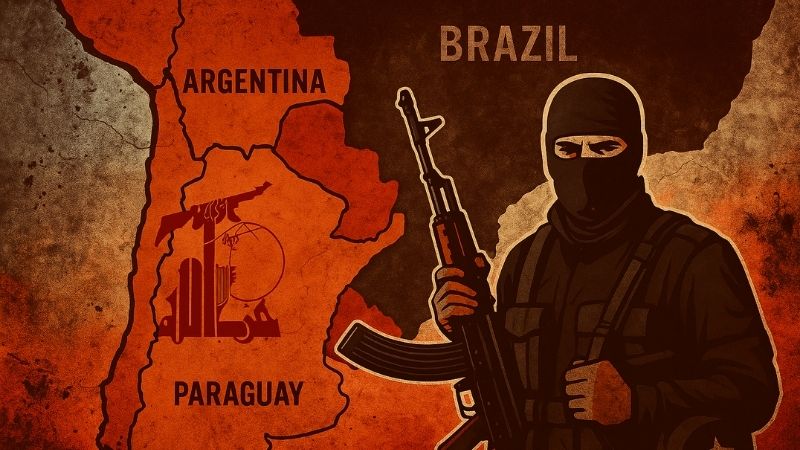
There is one area in the world that will have a detrimental effect on the United States and beyond in the next few years. Though relatively overlooked, the Tri-Border Area has faced criminal dangers from terrorist organizations, which, without government intervention, will grow their threat until it reaches the United States. The Tri-Border Area, also known as the Triple Frontier, is a tripoint where Argentina, Brazil, and Paraguay meet. The areas of conflict located directly within this junction are Puerto Iguazú in Argentina, Ciudad del Este in Paraguay, and Foz do Iguaçu in Brazil. These three areas have become a haven for drug trafficking and terrorist organizations to thrive, particularly, the allowance of Hizballah, also known as Hezbollah, to carry out extremely concerning activities. Without action from Argentina, Brazil, Paraguay, other countries near the region, and the United States, there is a looming threat that Hezbollah will continue to grow more powerful in this region, posing a significant threat to national security within the region and beyond.
To fully understand the severity of the problems occurring in the Tri-Border Area, it is of benefit to explain Hezbollah’s origins and presence around the world. Hezbollah is a Lebanon-based terrorist organization that is organized as both a political party and an armed group with Shiite Muslim roots. They were founded in response to the disorder caused by the Lebanese Civil War and grew in numbers steadily until recently, when many of their key leaders were killed in the war against Israel (Council on Foreign Relations). While it is difficult to pinpoint the exact number of remaining fighters in the organization, previous estimates have speculated an approximate of 100,000 operatives during 2021 (Council on Foreign Relations). Adding to this count is Hezbollah’s base in Lebanon, which the Department of State expanded its estimation in 2022 to include worldwide numbers ranging in the “tens of thousands” (Council on Foreign Relations). In conjunction with their large number of global supporters is their significantly large arsenal of arms, a believed result of their position as the only militia to keep its arms after the Lebanese Civil War. As time has evolved, the Council of Foreign Relations has considered them “the world’s most heavily armed non-state actor” with “150,000 to 200,000 rockets and missiles” (2024).
This base understanding of Hezbollah now calls to attention their current operations in the Tri-Border area. Since the 1980s, there has been minimal government action towards holding the groups accountable for the heinous crimes taking place, which has afforded them the belief that they control the region, not security forces. Locals in the area are also unaware of the seriousness of the crimes taking place, and those who are aware are afraid to report suspicious activity, creating a larger problem with holding the organization accountable (American Bar Association). This lack of government accountability alongside the fear tactics imposed on its citizens has afforded Hezbollah the opportunity to participate in a wide range of criminal activities, including human and narcotics trafficking, money laundering, illegal mining, and identity theft schemes. Other activities include charcoal and oil smuggling, the illicit diamond trade, and the smuggling of bulk cash, cigarettes, and luxury goods. Their dealings with money, whether in laundering, smuggling, or counterfeiting it, have provided them with dangerous profitability. Of all their illegal activities, the most concerning and threatening to U.S. national security is their ability to forge documents and counterfeit U.S. currency.
Counterfeiting U.S. currency is a more recent feature of theirs as, throughout Lebanon, the organization has relied heavily on the al-Qard al-Hasan financial system. This service, although recently attacked in a series of airstrikes by Israel, has been able to provide consistent aid to Hezbollah to maintain its military wing for decades (Mroue). In addition to using al-Qard al-Hasan as their primary source of funding, Paraguay has been the center of a smuggling system in which money was laundered by the criminal organizations “through banks and entities of the non-banking system” (Baisotti). Between the banking systems in Lebanon and Paraguay, it is evident that a way the organization obtains funds and launders money is through these systems.
Iran has been Hezbollah’s largest financial donor for the past thirty years. Each year has brought a faithful allotment of around $100 million with no apparent signs of an end to their relationship (Londoño-Bedoya et al.). What makes the knowledge of this partnership more concerning is that their initiatives have expanded beyond the Tri-Border Area to include countries like Venezuela, Panama, Colombia, Chile, Peru, and Bolivia. Venezuela in particular has generated concern, with Hezbollah cells forming under its jurisdiction that recruit, fundraise, and conduct logistical coordination while under protection of Iranian diplomats (Londoño- Bedoya et al.). This triple alliance should be alarming and extremely concerning to governments. Through the protection provided by Iran, Venezuela has been able to create a foundation for Hezbollah in its country, allowing for “political, economic, and logistical operations” (Londoño- Bedoya et al.). By having support from these two countries, Hezbollah knows that they are both a global force to be reckoned with and a low priority to international governments, particularly the United States (Londoño-Bedoya et al.).
Money laundering schemes have been recorded as one of Hezbollah’s more repeated offenses. Two notable schemes were conducted by Ayman Joumaa and Assad Ahmad Barakat: The former’s laundered millions of dollars through cocaine trafficking and car sales while the latter’s used Argentinian casinos’ chips-to-cash exchange (Marzia Giambertoni). Though the full extent of their involvement with Hezbollah has yet to be pinpointed, their aid in the organization’s significant accumulation of funds has been made apparent in their work. It was through the discovery of this network that law enforcement officials were able to determine its shared use in trafficking weapons, the illicit cigarette trade, and digital piracy (Marzia Giambertoni). What renders Hezbollah capable of these widespread afflictions is their initiative of concealment, which revolves around their identity theft scheme. The organization has been able to recruit individuals who can produce various documents of identification to allow their operatives the necessary cover, including the following: driver’s licenses, birth certificates, national identification cards, and, most notably, falsified passports.
This ability to forge documents presents a vital concern for financial and governmental reasons. Oftentimes, counterfeit items are difficult to identify because they are hidden among shipments containing legitimate products, and the penalty of the crime is less severe than others other crimes that terrorist organizations like Hezbollah may commit (Riza). The knowledge of this is what emboldens these organizations to rely on forged documents to carry out their plans which has, in turn, created an increased demand for them. As time has evolved, online industries are starting to create and sell these products, like the Uzbek citizen who was revealed indiscriminately selling “high-quality fake passports” to parties seeking entry to countries in the European Union–regardless of any potential affiliation with terrorist organizations (Mironova and McKernan, 2022). If one individual can make, at most, $15,000, the scale at which a large organization can earn is not far from imagination. When success is granted and there are few issues, sellers, like the one from Uzbekistan, begin to utilize encrypted messaging apps to expand the network they have created, making it easier to go unrecognized by governments.
Such is why the governments within the Tri-Border area and abroad must recognize the key implications that can arise if Hezbollah can operate within the region without consequences. Without conversations among the citizens and intervention by their respective governments, unchecked crimes like money laundering and terrorism financing become gradually reframed under the narrative of being a legitimate business (American Bar Association). This not only loosens the consequences of the crime but downplays the true economic effects. Furthermore, citizens are not aware of what terrorism financing is, so they only consider the severity of money laundering and neglect terrorism financing.
This wide breadth of public and legislative ignorance affords the necessary cover for Hezbollah to conceal their activities. Notably, the last time Hezbollah was explicitly mentioned in the Western Hemisphere was during a U.S. congressional hearing in March of 2015, and most unclassified documents regarding Hezbollah’s presence and threat to Latin America were released just in 2016 (Marzia Giambertoni). In the near ten years since then, no additional reports by either the Congressional Research Service or the government have delivered a thorough examination of Hezbollah and its activities in the region (Marzia Giambertoni).
In the meantime, Hezbollah has shown an apparent interest in U.S. targets, if by indirect means, after an operative was sent to surveil U.S. and Israeli embassies in Panama (Marzia Giambertoni). Knowing the patterns Hezbollah has followed in the past years, we know that indirect threats are not to be brushed aside. Even though we are not being directly affected, steps must be taken. This needs to be done first by examining the relationship they have with Iran and with countries in Latin America, like Venezuela and Colombia. Having governments directly working with designated terrorist organizations is a direct threat to our national security, as they are allowing the organizations to grow without repercussions and obtain monetary funding. The second action is to update our systems to recognize what present and evolving methods are being used to forge documents, and how to distinguish them from legitimate ones. The third action is to work towards identifying and stopping the money laundering schemes taking place in the Tri- Border Area. Knowing the strength that the U.S. dollar holds in the world’s economy, it stands to reason that its power, even counterfeited, risks far-reaching consequences in the wrong hands. The time for the United States to address this growing threat is now, not further down the line of ever-lengthening agendas.
One possible method of addressing this issue is through reinstating agreements between the United States and the governments of the Tri-Border Area. Some ideas include reinstituting the 3+1 doctrine, developing operations, and enhancing information sharing between the key governments in Latin America. Through a cross-governmental collaboration, we can benefit the Tri-Border Area by reshaping the narrative for the unaware and misinformed citizens, put a stop to Hezbollah’s expansion, and prepare ourselves against infiltration by this ever-evolving terrorist organization. To show inaction toward their presence in the region, as already experienced by the governments within the Tri-Border Area, is explicitly allowing Hezbollah to grow and develop into a strong terrorist network that may create significant issues in our future.
Works Cited
American Bar Association. “Money Laundering and the Financing of Terrorism in the Tri- Border Area.” American Bar Association, 2023. https://www.americanbar.org/advocacy/global- programs/news/2023/money-laundering-financing-terrorism-brazil-argentina-paraguay/
Baisotti, Pablo A. “The Triple Border, a Criminal Haven.” Small Wars Journal, November 13, 2021. https://smallwarsjournal.com/jrnl/art/triple-border-criminal-haven
Council on Foreign Relations. “What is Hezbollah?” Council on Foreign Relations, October 4, 2024. https://www.cfr.org/backgrounder/what-hezbollah
Ghambertoni, Marzia. “Hezbollah’s Networks in Latin America: Potential Implications for U.S. Policy and Research.” RAND Corporation, March 31, 2025. https://www.rand.org/pubs/perspectives/PEA3585-1.html
Ghaddar, Hanin. “Hezbollah Has Created Parallel Financial and Welfare Systems to Manage the Current Crisis.” The Washington Institute. https://www.washingtoninstitute.org/policy- analysis/hezbollah-has-created-parallel-financial-and-welfare-systems-manage-current-crisis
Gritten, David, and Jaroslav Lukiv. “Israeli Strikes Target Hezbollah-Linked Financial Association.” BBC News, October 21, 2024. https://www.bbc.com/news/articles/cz6wq71ly5po
Levitt, Matthew. “Hezbollah as a Criminal Organisation.” The Washington Institute. https://www.washingtoninstitute.org/policy-analysis/hezbollah-criminal-organisation
Levitt, Matthew. “Hezbollah’s Criminal and Terrorist Operations in Europe.” AJC, September 2, 2018. https://www.ajc.org/news/hezbollahs-criminal-and-terrorist-operations-in-europe
Levitt, Matthew. “Iran and Hezbollah Remain Hyperactive in Latin America.” The Washington Institute, August 11, 2016. https://www.washingtoninstitute.org/policy-analysis/iran-and- hezbollah-remain-hyperactive-latin-america
Londoño-Bedoya, David Andrés, et al. “The Denying Threat to National Security and Defense: Hezbollah’s Presence in Colombia.” Cogent Social Sciences, 2025. https://www.tandfonline.com/doi/full/10.1080/23311886.2025.2500653
Mironova, Vera, and Bethan McKernan. “Revealed: How Fake Passports Allow IS Members to Enter Europe and US.” The Guardian, January 31, 2022. https://www.theguardian.com/world/2022/jan/31/revealed-how-fake-passports-allow-is- members-to-enter-europe-and-us
Mroue, Bassem. “What Is the Financial Institution Affiliated with Hezbollah That Israel Is Targeting in Lebanon?” PBS NewsHour, October 21, 2024. https://www.pbs.org/newshour/world/what-is-the-financial-institution-affiliated-with-hezbollah- that-israel-is-targeting-in-lebanon
Riza, Gil. “Hezbollah and the Counterfeit Goods Industry.” INSS, August 20, 2024. https://www.inss.org.il/strategic_assessment/hezbollah-and-the-counterfeit-goods-industry/
Rodríguez, Henry M. “Hezbollah and Its Illicit Activities in Latin America.” Latinoamérica 21, September 21, 2024. https://latinoamerica21.com/en/hezbollah-and-its-illicit-activities-in-latin- america/
U.S. Department of the Treasury. “Treasury Sanctions Hizballah Financial Officials.” U.S. Treasury Department, July 3, 2025. https://home.treasury.gov/news/press-releases/sb0189
U.S. Embassy in Brazil. “Rewards for Justice: Reward Offer for Information on Hizballah Financial Networks in the Tri-Border Area.” U.S. Department of State, Mary 19, 2025. https://br.usembassy.gov/rewards-for-justice-reward-offer-for-information-on-hizballah- financial-networks-in-the-tri-border-area/
U.S. House of Representatives. “Attacking Hezbollah’s Financial Network: Policy Options.” Hearing before the Committee on Financial Services, June 8, 2017. https://www.govinfo.gov/content/pkg/CHRG-115hhrg25730/html/CHRG-115hhrg25730.htm
Zill, Oriana. “Crossing Borders- How Terrorists Use Fake Passports, Visas & Other Identity Documents.” PBS Frontline. https://www.pbs.org/wgbh/pages/frontline/shows/trail/etc/fake.html