
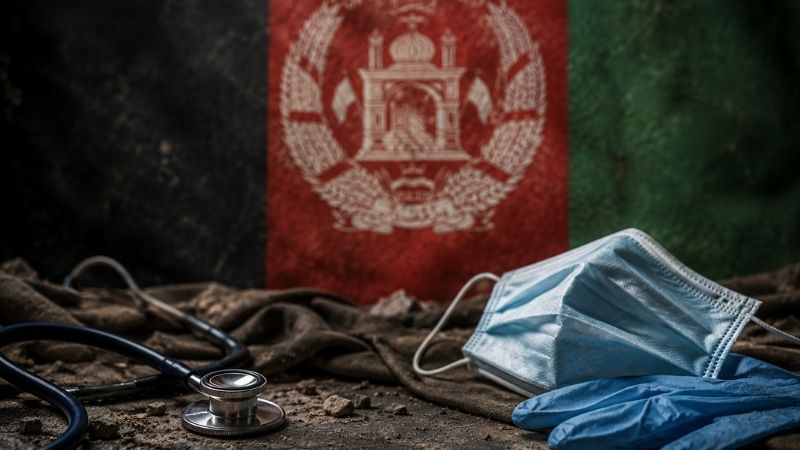
Afghanistan’s healthcare system is in catastrophic collapse. Between January 2018 and December 2022, GTTAC records 42 incidents targeting or associated with healthcare in Afghanistan, yet by incident count alone, the period since the Taliban assumed governing authority in August 2021 appears safer than the preceding years of active conflict. It is not. Maternal mortality is rising. Female healthcare workers have been systematically removed from the workforce. Medical training for women has been banned. International NGOs have been expelled. Nearly half the population requires humanitarian assistance. The incident analysis in this paper draws on GTTAC records identified through keyword searches across healthcare-related terms, capturing a broader set of healthcare-associated incidents than facility-specific filters alone would produce. This reflects the analytical judgment that healthcare destruction encompasses attacks on personnel, programs, supply infrastructure, and governance capacity, not only physical facilities.
This case study examines the destruction of healthcare in Afghanistan through the lens of two actors whose relationships to that destruction are fundamentally different. The Taliban, who operated as a non-state insurgent before August 2021 and as a de facto governing authority after, expressed the same underlying ideology through different mechanisms: kinetic attacks on internationally-funded health programs and Western-associated health infrastructure as insurgents, and systematic policy destruction of the same targets as governing authority. ISIS-K, a non-state actor whose sporadic high-casualty attacks used healthcare-associated venues as symbolic targets rather than conducting a campaign against healthcare as a system, reveals a different logic of political violence entirely. The contrast between them, sustained ideological destruction versus high-impact symbolic violence, is the analytical subject of this paper. This contrast is visible across every dimension of the dataset: in casualty scale, geography, method, and in each group’s relationship to the healthcare system itself.
The Taliban as Non-State Actor: Sustained Low-Casualty Targeting
The Taliban waged a decades-long insurgent campaign against the Afghan Republic and its Western partners, beginning after their ouster by US-led coalition forces in 2001. Rooted in Deobandi Islamic ideology and Pashtun tribal networks, their project was explicitly territorial: control of Afghanistan under their interpretation of sharia law. The Taliban never recognized the Afghan Republic as legitimate, consistently referring to it as a puppet government, a rejection that shaped every dimension of their insurgent behavior, including their relationship to internationally-funded health programs and Western-associated health infrastructure.
The Taliban’s healthcare-associated targeting affected every dimension of the system between 2018 and 2021: programmatic delivery, human capital, supply infrastructure, security capacity, and governance capacity. In August 2018, GTTAC attributes a Taliban attack on police guarding a hospital in Farah City, three officers killed. In April 2019, the Taliban planted an IED outside a health complex in Baghlan, killing one and wounding eighteen. In January 2020, five healthcare workers were kidnapped after the Taliban demanded money from the Global Fund for Children’s provincial office in Sar-e Pul. In January 2020, a Taliban militant threw a hand grenade in a medical store in Faryab, killing one and wounding six. In June 2021, the Taliban fired an RPG at a hospital in Kunar province, destroying a stockpile of COVID-19 vaccines. In June 2021, the Taliban conducted a coordinated attack on three polio vaccination locations in Jalalabad, killing five vaccinators.
Vaccination and polio workers were a recurring target across the full timeline. In January 2018, five public health workers administering vaccinations were kidnapped in Allah Yar district, Ghor province, one of Afghanistan’s most medically underserved areas where residents confirmed the absence of well-equipped health facilities. In July 2018, six health workers returning from Lal wa Sarjangal district’s hospital were kidnapped in Dawlatyar district, a remote Hazara-majority area in Ghor province where thousands of residents lacked access to healthcare services and existing facilities suffered from chronic shortages of doctors and medicine, with health delivery dependent on NGO and international organization support. The June 2021 coordinated polio vaccination attack, killing five across three simultaneous locations, represents the most lethal incident in a pattern of anti-vaccination targeting that began in 2018. In April 2022, seven polio vaccinators were killed in coordinated attacks across Kunduz and Takhar provinces, unattributed and occurring under Taliban governance. The targeting of vaccination workers evolved over the period from kidnapping to lethal attack.
The dataset documents a pattern of doctor targeting across multiple provinces between 2018 and 2021. Fifteen incidents targeting individual doctors appear in the full dataset, the majority unattributed. Taliban militants are specifically attributed to four: drive-by shootings killing doctors in Ghor province in October 2019 on two separate occasions, the killing of a doctor in Baghlan in February 2021, and the killing of a doctor and his assistant in Ghor province in March 2021. These killings occurred within a documented broader Taliban civil society assassination campaign. Afghan intelligence publicly identified a special Taliban unit, Obaida Karwan, in December 2020, with 270 arrests ultimately reported, though the October 2019 Ghor killings predate that public identification by fourteen months, suggesting the campaign was operational earlier. Whether these killings were motivated specifically by the victims’ healthcare roles or by their status as educated professionals associated with the Afghan Republic cannot be determined from open-source data alone.
Within this broader pattern of doctor targeting, female doctors were specifically and repeatedly targeted. In October 2019, one of the Taliban-attributed killings in Ghor was explicitly a female doctor. In March 2021, unknown perpetrators detonated a mine attached to a rickshaw transporting a female doctor in Jalalabad. In July 2021, unknown perpetrators killed a female doctor in a roadside bomb attack in Jalalabad. The March and July 2021 incidents remain unattributed, but the pattern of targeting female medical professionals is consistent with the ideological opposition to women in public professional roles that multiple actors shared, and that the Taliban would later codify into governing policy. The kinetic targeting of female doctors as insurgents is consistent with and finds its governing expression in the policy elimination of female healthcare workers as governing authority.
The dataset also documents Taliban targeting of health governance officials at both the provincial and national level. In December 2019, GTTAC attributes a Taliban IED attack targeting the district health department director in Uruzgan, two civilians killed and the director wounded, the earliest documented targeting of a health governance official in the dataset, predating the Doha Agreement. In June 2021, a Ministry of Health official in Kabul was killed within a documented broader Taliban campaign targeting Afghan government officials, noted explicitly by the Long War Journal. Together these two incidents document Taliban targeting of health governance capacity at multiple levels across the full final phase of the insurgency. Both officials represented not only governance expertise but institutional relationships with Western donors and NGOs that sustained healthcare delivery. Neither attack was formally claimed.
The February 2020 Doha Agreement, signed between the United States and the Taliban without the Afghan Republic as a party, committed the US to full withdrawal within fourteen months. GTTAC records a sharp drop in Taliban-attributed healthcare incidents in the post-Doha period, consistent with a broader dampening of Taliban kinetic activity under the negotiated framework. A separate intra-Afghan negotiation process began in September 2020 in Doha, where the Afghan Republic and the Taliban sat together for the first time. Unknown healthcare-associated incidents accelerated sharply during this period, with seven unattributed incidents between February and July 2021, coinciding with the intensification of the Obaida Karwan campaign and the final pre-takeover period when multiple actors were active in urban environments across the same window. After President Biden’s April 2021 withdrawal announcement, Taliban healthcare-associated targeting surged in the final months before the takeover, culminating in the coordinated polio vaccination attack and the Ministry of Health assassination.
The Taliban as De Facto State Actor: Ideology Through Policy
On August 15, 2021, the Taliban seized Kabul. The Afghan Republic collapsed. No Taliban-attributed kinetic healthcare attacks appear in open-source data since. The Taliban transitioned overnight from non-state insurgent to de facto governing authority, responsible in practice for forty million people while remaining unrecognized in law by every UN member state. The mechanism of destruction changed. The ideology did not.
Without international recognition, the Taliban cannot access the financial architecture of sovereign states. Of the $7.1 billion in Afghan central bank assets frozen by the United States in 2021, approximately $3.5 billion remains blocked following Executive Order 14064, which allocated the remainder for humanitarian relief. Their designation as a Specially Designated Global Terrorist (SDGT) under Executive Order 13224 further constrains humanitarian engagement. They are not currently designated as a Foreign Terrorist Organization, though legislation to do so was introduced in December 2025 and remains pending in the House Foreign Affairs Committee. The Taliban have instrumentalized this legal reality, framing aid withdrawal as Western economic aggression against Afghan Muslims. Human Rights Watch concluded in 2024 that Taliban abusive policies, not aid withdrawal, are the primary driver of healthcare collapse, a finding echoed by the UN Special Rapporteur on Afghanistan.
The same ideology that drove the Taliban to target vaccination workers, doctors including female doctors, and Western NGO-funded health programs as insurgents now dismantles the healthcare system through policy. The ban on female employment removed a significant portion of healthcare workers from a system where cultural norms prohibit male providers from treating female patients, with particularly devastating effects on obstetric and gynecological care. Mahram requirements made facility access functionally impossible for many women, with Taliban officials preventing women from attending healthcare appointments unless accompanied by a male relative. The December 2022 ban on women working with international humanitarian organizations triggered widespread NGO withdrawal. In December 2024, the Taliban banned women from medical education entirely. According to UNICEF, these restrictions risk the loss of 25,000 women teachers and health workers. WHO has raised concerns that maternal mortality, already among the highest in Asia before 2021, is rising further as female obstetric care becomes inaccessible. The nodes of the healthcare system targeted kinetically as insurgents, vaccination programs, Western NGOs, health governance capacity, and female healthcare workers are now being dismantled systematically through the power of governance.
ISIS-K: High-Impact Symbolic Violence
Founded in January 2015 from TTP defectors and Afghan extremist splinter groups, ISIS-K follows a Salafi-jihadist framework that rejects the nation-state model entirely. The Taliban’s project is territorial and nationalist: govern Afghanistan under sharia. ISIS-K’s project is a borderless caliphate that renders existing state boundaries illegitimate. ISIS-K considers the Taliban apostates for their nationalism and for negotiating the Doha Agreement with Western powers. The two groups have been enemies since ISIS-K’s founding.
That ideological rejection of the nation-state has a direct implication for healthcare. In Afghanistan, healthcare delivery was predominantly financed and regulated through state and donor architecture, making internationally-funded clinics and health programs visible expressions of the governing order ISIS-K’s ideology rejects. For a group whose ideological project involves demonstrating the illegitimacy of all existing governing authorities, healthcare collapse under Taliban governance serves their delegitimization narrative, whether they cause it or not.
ISIS-K’s four documented healthcare-associated incidents in the Afghan dataset are geographically concentrated in Kabul and Jalalabad, consistent with their urban operational pattern, and uniformly high-casualty relative to Taliban healthcare-specific incidents. In October 2018, ISIS-K bombed a USAID office in Jalalabad, killing two and wounding nine. USAID was among the primary funders of healthcare delivery in Afghanistan through the Basic Package of Healthcare Services, making its offices visible symbols of Western-associated governance presence that ISIS-K’s ideology rejects. In February 2019, ISIS-K killed a doctor returning home from his private clinic in Kabul via car bomb. This killing is analytically distinct from the Taliban’s gunfire-based doctor killings under the Obaida Karwan campaign. The Taliban killed doctors as Republic-associated civil society figures whose elimination degraded Afghan state governing capacity. ISIS-K killed a private clinic doctor in Kabul as a symbol of Western-associated professional medical presence, consistent with their pattern of targeting symbols of Western-associated civil society in urban environments. On May 12, 2020, ISIS-K attacked the maternity ward at Dasht-e-Barchi Hospital in Kabul, killing 24 civilians and medical staff including foreign doctors. The attack converged three distinct ideological motivations simultaneously: the hospital serves the Hazara community, a Shia Muslim minority ISIS-K’s takfiri ideology considers apostates; the facility was a maternity ward representing women’s public healthcare that ISIS-K’s ideology rejects; and the presence of foreign doctors made it a visible symbol of Western-associated medical presence. On November 2, 2021, ISIS-K attacked the Sardar Daud Khan Military Hospital in Kabul, killing 20 and injuring 16, targeting a symbol of the Taliban’s new state apparatus.
Two explanations account for the near-absence of ISIS-K healthcare attacks post-2021. First, the Taliban’s own ideological governance was collapsing healthcare more effectively than ISIS-K could through kinetic means. Every closed clinic and expelled NGO is simultaneously a Taliban governance failure ISIS-K can amplify in recruitment and propaganda, and a reduction in the viable target set. By 2022, the Taliban’s policy cascade had already collapsed much of the healthcare system ISIS-K might otherwise have targeted, closing clinics, expelling NGOs, and removing the workforce. You cannot bomb what no longer exists. Second, the post-2021 information environment is controlled by the Taliban, who have every incentive to suppress reporting of successful ISIS-K attacks on healthcare within their territory. That kinetic healthcare targeting has not disappeared entirely is evidenced by the April 2022 coordinated killing of seven polio vaccinators across Kunduz and Takhar provinces by unknown perpetrators, a reminder that the closed information environment makes the true post-2021 picture unknowable from open-source data alone.
The Contrast: Sustained Ideological Destruction versus High-Impact Symbolic Violence
The ideological overlap between Taliban and ISIS-K on healthcare targets deserves acknowledgment. Both groups share conservative Islamic opposition to Western-associated health programs, female professionals in public roles, and international NGO presence, drawing from overlapping ideological traditions that produce similar positions. But shared ideological opposition does not produce identical behavior. Taliban and ISIS-K are not conducting similar operations with different resources; they are conducting fundamentally different types of violence that happen to intersect with healthcare infrastructure. The Taliban’s territorial governing project drove systematic dismantling. ISIS-K selected healthcare-associated targets for their symbolic density in specific operations, making statements through the system rather than dismantling it. Shared ideological opposition. Fundamentally different expressions.
The Taliban systematically dismantled healthcare because it represented everything their ideology opposes about Western-associated governance. Vaccination workers, health complex infrastructure, medical supply stores, polio vaccination teams, female doctors, health governance officials: every node of the healthcare system was touched kinetically across 2018-2021, and then through policy as governing authority: female worker bans, NGO expulsion, mahram requirements, medical education prohibition. The Taliban were not making a statement. They were removing a system that contradicted their governing vision, comprehensively and consistently across both phases of their power.
The casualty differential makes this distinction empirically visible. Even at their most intensive, including coordinated polio vaccination attacks, health complex IEDs, and the Ministry of Health assassination, Taliban healthcare-specific incidents produced single-digit casualties. ISIS-K’s two direct facility attacks produced 24 and 20 killed respectively. The Taliban never produced that scale of casualties in healthcare-specific targeting. Systematic dismantling does not require mass casualties. Spectacle does. ISIS-K’s individual attacks produced higher casualties per incident. The Taliban’s destruction produced greater cumulative harm, not through any single operation, but through systematic policy enacted prior to and after coming into power and its effects on healthcare access for the population.
The geographic distribution of incidents reinforces this distinction. Taliban healthcare-associated targeting spread across the country: remote rural communities in Ghor, provincial centers in Baghlan and Faryab, major cities in Kunduz and Jalalabad, and ultimately Kabul. ISIS-K’s incidents were concentrated almost entirely in Kabul and Jalalabad, where symbolic impact is highest. Taliban comprehensiveness extended geographically across the entire healthcare architecture. ISIS-K concentrated where visibility was greatest.
Each group’s relationship to physical healthcare infrastructure further illustrates the distinction. ISIS-K conducted mass casualty attacks inside healthcare facilities, entering buildings and detonating explosives within them. The Taliban’s targeting was predominantly directed at people, programs, and contents rather than physical destruction of healthcare infrastructure: kidnappings away from facilities, attacks on security forces outside hospitals, destruction of vaccine stockpiles, and assassination of personnel. Whether this reflected deliberate calculation about inheriting Afghanistan’s infrastructure cannot be determined from open-source data. But the pattern is observable. Taliban targeting degraded the healthcare system without demolishing it. ISIS-K attacked the structures themselves. ISIS-K’s direct facility attacks targeted healthcare at the point of care, striking patients and staff inside facilities in active use. The Taliban targeted healthcare at the point of delivery, killing and intimidating the workers, programs, and officials that sustained the system. These represent two fundamentally different mechanisms of healthcare destruction. ISIS-K’s point-of-care attacks threatened the demand side, making patients afraid to seek care inside facilities. The Taliban’s point of delivery targeting attacked the supply side, degrading the capacity to provide care at all. Post-2021 Taliban governance policy extended that supply-side destruction to its logical conclusion: no workers, no programs, no institutional knowledge, no system left to deliver.
Two Taliban incidents in the dataset fall outside the systematic targeting pattern entirely. In January 2018, the Taliban detonated an ambulance bomb at a police checkpoint in Kabul, killing 95 and wounding 158, healthcare infrastructure weaponized as a delivery mechanism for mass casualty violence, not targeted as healthcare. In August 2019, the Taliban used hospitals and clinics as fighting positions during a multipronged assault on Kunduz city, the one incident the Taliban formally claimed, healthcare infrastructure instrumentalized as combat terrain. These represent a third relationship to healthcare: weaponization and tactical instrumentalization, distinct from both the Taliban’s systematic ideological targeting and ISIS-K’s high-impact symbolic attacks. Three distinct relationships to healthcare infrastructure are visible in the dataset. None of these is the same as the others.
Conclusion
The Afghan case reveals that healthcare destruction in conflict is not a single phenomenon. Taliban ideology drove sustained, comprehensive, low-casualty healthcare-associated targeting as insurgents and systematic policy destruction as governing authority; the same ideological opposition was expressed through different mechanisms as their relationship to power changed. ISIS-K conducted sporadic, high-casualty, symbolically concentrated operations that used healthcare-associated venues without conducting a healthcare targeting campaign.
Three implications follow. Healthcare system integrity in fragile states is a governance legitimacy indicator, not merely a humanitarian metric. Its destruction, whether through kinetic means or policy, creates the conditions that non-state actors use to demonstrate governance failure, recruit from aggrieved populations, and challenge the legitimacy of whoever claims to govern. The actor taxonomy matters: understanding whether healthcare destruction reflects sustained ideological opposition or high-impact symbolic violence has direct implications for how to anticipate, document, and address it.