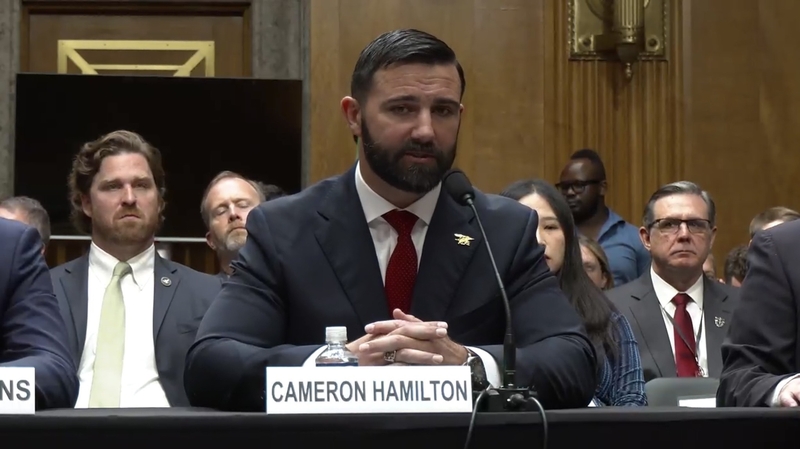
The Senate Homeland Security and Governmental Affairs Committee’s decision to advance the nomination of Cameron Hamilton to lead the Federal Emergency Management Agency represents an important step toward providing FEMA with the permanent leadership it needs.
And at a time when FEMA faces significant challenges, questions about its future direction, and an evolving role in the nation’s emergency management enterprise, Cameron Hamilton may be the right leader at the right time.
Every FEMA administrator inherits the responsibility to execute the priorities of the President who appoints them. That is how our government works. The American people elect a President to set a vision, and agency leaders are responsible for implementing that vision.
Hamilton understands the mission and priorities of the Administration that nominated him. But equally important, he also understands that FEMA’s success depends on the career professionals who accomplish the mission every day.
That balance will be critical.
FEMA is not an agency built by any one administration. It is built by thousands of dedicated employees who bring decades of institutional knowledge, technical expertise, and commitment to helping communities before, during, and after disasters.
A successful FEMA administrator must understand both realities: the responsibility to implement the Administration’s priorities and the responsibility to value the expertise of the workforce.
Hamilton brings a unique background to that challenge.
With experience in national security, leadership, and government operations, Hamilton has served at the Department of State and the Department of Homeland Security. He is also familiar with FEMA from his previous service in agency leadership roles focused on resilience and emergency management.
Hamilton’s commitment to service did not begin with a political appointment. He comes from a family tradition of service, entering the military as a fourth-generation service member before becoming a Navy SEAL. It is worth pausing there. Becoming and serving as a Navy SEAL is not just another line on a résumé. SEALs are professionals at remaining calm under pressure, during duress, in distress, and under the most demanding circumstances. They have an uncanny ability to filter out the noise, focus on the mission, operate in some of the most life threatening situations, and they are always about the team. Those are skills that emergency management values and needs in its leaders. We value those who remain calm under pressure to accomplish the mission.
We need those qualities throughout emergency management. We need them in our leadership.
Most importantly, Hamilton is not entering the FEMA Administrator’s office for the first time. He has already served as Acting Administrator, giving him firsthand experience with the responsibilities, challenges, and demands of leading the nation’s emergency management agency.
That experience provides an important measure of continuity during a critical transition. He understands the pace of the job, the complexity of the mission, and the challenges that come with balancing policy direction, operational realities, and the needs of communities facing disasters.
During his time as Acting Administrator, Hamilton also demonstrated an understanding of the importance of the agency he was leading. When questions were raised about FEMA’s future, he acknowledged the need for improvement and reform while also emphasizing that the agency’s mission of helping Americans before, during, and after disasters remains essential.
That balance matters.
At the same time, it is important to accurately define what Hamilton brings to the role. He is not a traditional emergency management leader who spent decades as a state emergency management director or leading major disaster recovery operations. It is worth asking what constitutes a traditional path to becoming a FEMA Administrator. More importantly, is a traditional path what we need? With an increase in disaster occurrences and an evolving and dynamic threat environment, impacting communities in new and challenging ways, perhaps following a new path to FEMA leadership is what our industry needs to advance. In fact, Hamilton’s different experiences and point of view may actually prove helpful to some of our long-term challenges as an industry, such as long-term community recovery, streamlining the scoping and implementation of hazard mitigation projects, and even professionalizing the standards practitioners strive to achieve. These are challenges we have struggled to get unstuck from. A fresh perspective to some of our long-standing and deep-seated problems may be exactly what we need.
Leadership is not measured only by the number of years spent in a particular field. It is measured by the ability to listen, learn, make decisions, build teams, and bring people together around a common mission. Hamilton’s greatest opportunity may be bringing those leadership skills to a moment when FEMA needs both confidence and clarity.
The agency must continue improving. It must examine processes, reduce unnecessary barriers, and ensure resources reach survivors and communities efficiently. Those goals are shared by emergency managers across the country.
But improvement cannot come at the expense of the people and partnerships that make FEMA effective.
The future of emergency management depends on collaboration among federal, state, local, tribal, territorial, nonprofit, and private sector partners. It depends on relationships built before disasters occur, not during them. It depends on trust.
FEMA’s career workforce also deserves a leader who recognizes their value. During periods of uncertainty, employees need clarity of purpose and confidence that their expertise matters. The men and women of FEMA have dedicated their careers to helping people on their worst days. A successful administrator must recognize that commitment and build upon it.
If confirmed, Hamilton’s success will be measured by how well he builds that trust.
Trust with the Administration.
Trust with Congress.
Trust with FEMA employees.
Trust with emergency managers across the nation.
Trust with the communities FEMA serves.
Disasters do not care about politics. Survivors do not care which administration appointed the FEMA administrator. They care whether help arrives, whether leaders listen, and whether government delivers when they need it most.
Cameron Hamilton has an opportunity to lead FEMA into its next chapter. His background, experience, and approach position him to bridge important divides: between policy and practice, between reform and experience, and between Washington and the communities FEMA serves.
The best leaders do not need to know every answer on day one. They need to understand the mission, recognize the people who do have the answers, and create the environment where expertise can thrive.
The mission is too important for anything less.
The country needs a FEMA that is capable, trusted, and prepared for the challenges ahead.
Cameron Hamilton has the opportunity to help build that FEMA.
And that is why this nomination represents an opportunity for FEMA’s next chapter to begin with the right leader at the right time.
Dan Stoneking is the Owner and Principal of Stoneking Strategic Communications, the Author of Cultivate Your Garden: Crisis Communications from 30,000 Feet to Three Feet, the Founder and Vice President of the Emergency Management External Affairs Association, and an Adjunct Professor in the Communications Department at West Chester University .
Carrie Speranza, CEM, is the Director of Emergency Management Solutions at Esri, the first emergency manager to have served as Chair of the FEMA National Advisory Council and President of the International Association of Emergency Managers; she is also an advisory board member for the Private Sector Emergency Management Association, and a Homeland Security Advisory Board Member for Columbia Southern University.