



I worked at FEMA for fifteen years. One of the most effective approaches I experienced was the External Affairs organizational model and its emphasis on coordination, clear roles, and unity of effort.
Too often, I saw organizations that did not use a similar structure struggle with fragmented communications, duplicated efforts, and delayed decision-making.
Emergency management has long embraced the principles of unity of effort and unified coordination. Response operations work best when organizations understand their roles, share information, and operate toward common objectives.
Yet many emergency management agencies continue to approach external communications very differently.
Public information, government affairs, legislative outreach, private sector engagement, and community relations are often managed as separate functions during day-to-day operations. Then, when a major disaster occurs, those same organizations attempt to rapidly integrate them under an External Affairs structure that may not have existed the day before.
This creates a familiar operational tension. The system is expected to function in an integrated way during the most complex and time-sensitive moments, yet it is not consistently organized that way in steady state.
The question is simple. If integration is the right model during a disaster, why is it not the right model before one?
The External Affairs framework established through ESF 15 offers more than a disaster response structure. It provides a model for aligning external engagement functions around shared objectives, shared situational awareness, and coordinated action. Just as importantly, it enables a more seamless transition from steady state operations into incident operations, reducing the need to reorganize communications structures at the moment speed and clarity matter most.
Public Affairs
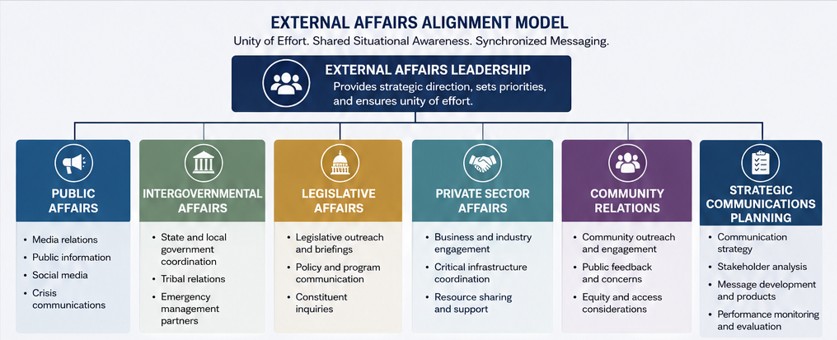
Public Affairs is often the most visible component of External Affairs. It serves as the primary connection between emergency management organizations, the media, and the public.
This function develops press releases, coordinates interviews, manages social media, and provides timely information during incidents. Public Affairs professionals help ensure that communities receive accurate information that enables them to make informed decisions before, during, and after disasters.
While Public Affairs is frequently viewed as the face of emergency management communications, it represents only one part of a much larger ecosystem.
Intergovernmental Affairs
Emergency management depends upon relationships across all levels of government.
Intergovernmental Affairs focuses on engagement with governors, mayors, county executives, tribal leaders, emergency managers, and other governmental partners. This function helps ensure that decision makers receive timely information and understand how emergency management activities affect their jurisdictions and constituents.
Strong intergovernmental relationships improve coordination, build trust, and reduce the likelihood that stakeholders learn critical information from news reports rather than directly from emergency management officials.
Legislative Affairs
Legislators have significant influence over emergency management policy, authorities, and funding. They also serve as a critical source of information for constituents during disasters.
Legislative Affairs professionals provide elected officials and their staffs with accurate and timely information regarding incidents, programs, and recovery efforts. They answer questions, coordinate briefings, and help ensure that policymakers understand the operational realities facing emergency managers.
When this function operates effectively, elected officials become informed advocates rather than frustrated observers.
Private Sector Affairs
The private sector owns and operates much of the nation’s critical infrastructure. Businesses provide essential goods and services, support economic recovery, and often possess resources that can assist response operations.
Private Sector Affairs focuses on building relationships with businesses, trade associations, nonprofit organizations, and infrastructure partners. During disasters, these relationships help emergency managers understand impacts, identify resource gaps, and coordinate recovery activities.
In many communities, business leaders are among the most trusted voices available. Their engagement can significantly influence public confidence and community resilience.
Community Relations
Community Relations creates direct connections between emergency management organizations and the people they serve.
This function helps identify concerns, answer questions, and gather feedback from affected populations. Community Relations personnel often work in neighborhoods, disaster recovery centers, community meetings, and other venues where residents seek information and assistance.
Their role is not simply to share information. It is to listen. Community feedback frequently reveals issues that may not appear in situation reports, news coverage, or leadership briefings.
Strategic Communications Planning
Effective communication requires more than distributing information. It requires planning.
Strategic Communications planning, often referred to as a Planning and Products function develops communication strategies, stakeholder analyses, message maps, briefing materials, talking points, and coordinated products that support all other External Affairs activities.
This function helps ensure that every communication effort advances common objectives and reflects a shared understanding of the situation.
Without planning, communication becomes reactive. With planning, communication becomes strategic.
Where These Functions Overlap
Although these six functions are often discussed separately, they rarely operate separately in practice.
A mayor’s question may originate from concerns raised by residents.
A congressional inquiry may be triggered by media coverage.
A business leader may share information that shapes public messaging.
Community feedback may identify issues that require legislative attention.
Every stakeholder operates within the same information environment.
When these functions work independently, organizations risk creating inconsistencies, duplicating effort, and missing opportunities to build trust. Information may reach different audiences at different times. Stakeholders may receive conflicting messages. Leaders may learn important developments through unofficial channels rather than through coordinated outreach.
These are not communication failures. They are organizational failures.
The solution is integration.
The Value of Alignment
Emergency management agencies should consider aligning External Affairs functions around the six core areas of public affairs, intergovernmental affairs, legislative affairs, private sector engagement, community relations, and communications planning.
Such alignment allows organizations to coordinate all external engagement activities under a single leadership framework. Media relations, government outreach, legislative engagement, private sector partnerships, community relations, and communication planning operate from the same situational awareness and pursue common objectives.
This is not an argument for creating six new offices or hiring personnel that an organization cannot afford. Many local emergency management agencies operate with only a handful of employees. Some have a single public information officer. Others rely on an emergency manager who performs every communication function personally.
The reality, however, is that the functions still exist.
When a reporter calls, someone responds.
When an elected official requests information, someone responds.
When a business leader has concerns, someone responds.
When residents seek answers, someone responds.
Whether these responsibilities are assigned to one person or twenty people, they remain essential functions of emergency management.
The goal is not to create additional bureaucracy. The goal is to recognize these functions, align them under a common framework, and ensure they operate from shared situational awareness and common objectives.
In fact, the need for alignment may be even greater in organizations with limited staff. When one or two people are responsible for all external engagement, clearly understanding how these functions connect becomes critical.
The same principle applies in larger organizations. Many states and major jurisdictions already perform these functions but place them in separate organizational silos. A private sector liaison may report through logistics while public affairs reports elsewhere. Government relations may operate independently from community outreach. Each function serves an important purpose, but separation can create inconsistent messaging, conflicting priorities, and missed opportunities for coordination.
The challenge is often not a lack of capability. It is a lack of alignment.
The benefits of alignment extend well beyond improved day to day coordination.
It also creates a more seamless transition into disaster operations. When External Affairs functions are already aligned in steady state, they do not need to be reorganized under pressure when an incident occurs. Roles, relationships, and reporting lines are already understood, which allows the organization to scale quickly and shift into ESF 15 style coordination without delay or confusion.
This continuity also improves coordination with FEMA and other federal partners during large scale incidents. External Affairs at the federal level operates through a defined ESF 15 structure. When state and local partners mirror the same functional alignment, information flows more efficiently, expectations are clearer, and joint messaging becomes easier to synchronize across jurisdictions. Alignment at the local and state level reduces friction at the exact moment when speed and clarity matter most.
Most importantly, organizations would no longer need to reinvent themselves when disasters occur. The same structure used every day would simply expand to meet the demands of a major incident. Additional personnel could be added, Joint Information Centers could be activated, and operations could scale without requiring a fundamental organizational transformation.
Emergency managers often remind communities that disasters are not the time to exchange business cards. The same principle applies to communications organizations. The structures, relationships, and coordination mechanisms needed during a disaster should already exist before one occurs.
Moving Forward
The federal government has already demonstrated the value of the ESF 15 model during some of the nation’s most complex disasters. The concept deserves broader consideration at the state and local levels.
The specific organizational chart may vary from one jurisdiction to another. Staffing levels, authorities, and resources will differ. The underlying principle, however, remains the same.
All external engagement functions should operate as part of a coordinated system.
Emergency management has spent decades refining how we organize operations. It may be time to apply the same discipline to how we organize communications.
The result would not simply be better messaging.
It would be better emergency management.
Dan Stoneking is the Owner and Principal of Stoneking Strategic Communications, the Author of , Crisis Communications and Emergency Management, the Founder and Vice President of the Emergency Management External Affairs Association, the Founder of Message Prism, and an Adjunct Professor in the Communications Department at West Chester University.