
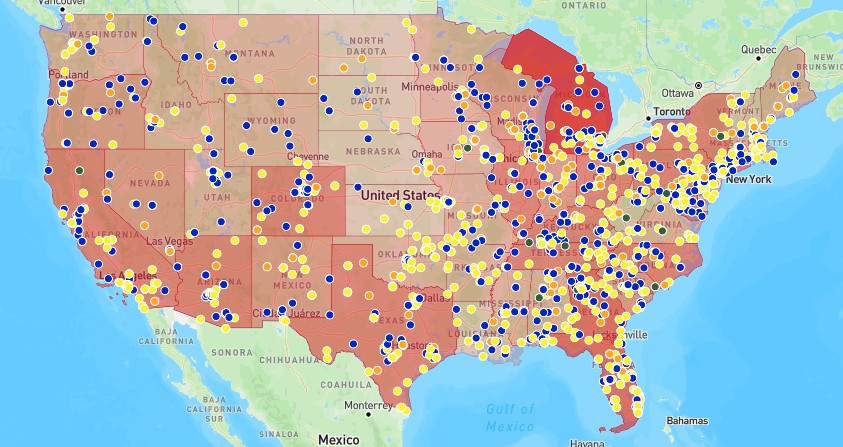
The Impact Project and the Public Service Alliance (PSA) have released the second version of The Security Map, broadening the scope of its novel dataset on violent threats against America’s public servants. Building on the first version of this map released last year, the expanded version includes in its scope public servants such as firefighters, librarians, and public school teachers, who are not always thought of as government workers.
The updated Security Map shows that between 2013 and 2026, violent threats targeting public servants in the United States surged across all levels of government and political parties, with local public servants targeted most frequently based on The Impact Project’s analysis of thousands of news reports. Whereas a decade ago, threats were seemingly concentrated at the federal level, between 2015 and 2025, there was a more than 1,000% increase in threats to local public servants. Further, families of public servants were also increasingly impacted, with reported threats increasing by more than 3,000% over the same period. Of these, about 30% occurred in 2025 alone.
The Security Map is one of the most comprehensive public datasets of its kind, analyzing over 2,000 news reports on threats to public servants between 2015-2026 from The Impact Project, nearly 2,000 records of threats to local officials between 2022-2025 from the Bridging Divides Initiative (BDI) at Princeton University, and more than 500 federal court records documenting threats to public servants between 2013-2022 from Chapman University and the National Counterterrorism Innovation, Technology, and Education Center (NCITE) at the University of Nebraska Omaha.
Based on its analysis of news reports alone, The Impact Project identified several key trends:
- Families of Public Servants Have Become a Target: Violent threats against public servants’ families are increasingly common, with reported threats against families increasing 3,700% between 2015 and 2025, and 34% of these threats occurring in 2025 alone.
- Any Public Servant Can Become a Target: Violence against public servants extends far beyond high-profile figures such as Members of Congress. Today, librarians, school board members, election workers, 911 dispatchers, and even mail carriers face escalating levels of hostility and intimidation. Threats now impact those serving at every level of government, with judges, law enforcement, and election workers among the most frequent targets.
- Local Public Servants Now Face the Largest Share of Threats: Local public servants received slightly more threats than federal public servants based on the sample reviewed (42% and 36%, respectively). This is a significant change from historical trends, as federal officials typically have received the lion’s share of threats throughout the last decade. Violent threats against local public servants have increased 2,030% since 2015. Between 2023 and 2025, 42% of threats reported were against local public servants. This increase is acutely felt by librarians and public school teachers, who have experienced a sharp increase in threats from community members. Further, local officials seem to be much more likely to be threatened by people they know or work with (e.g.,threats by parents against librarians or by community members against city council members and school boards) than their federal counterparts.
- Public Servants Face Threats Nationwide; Those in Battleground States Face Increased Risks: Threats against public servants occur in every state across the country. Over 20% of all reviewed threats were concentrated in seven battleground states—Pennsylvania, Georgia, Arizona, Nevada, North Carolina, Wisconsin, and Michigan—where political polarization likely puts public servants at increased risk. In cases where the political affiliation of the threatened individual(s) was identified, both Democrats and Republicans faced threats, with Democrats targeted more often (57% vs. 43%). While underreporting and media bias obscure the full picture, the data demonstrates a nationwide problem exacerbated in politically tense areas.
- Threatening Statements Dominate: Reviewed threatening statements occurred at nearly six times the rate of physical attacks. Threatening statements against public servants, even when not acted on physically, create fear and intimidation, and undermine democratic processes, including by deterring individuals from seeking public office. Further, one form of threat often precipitates another—for example, verbal harassment escalating into doxxing. Although certain studies have analyzed the link between specific categories of threats and violence (such as in stalking incidents), additional empirical evidence is needed to determine the overall rate at which threats culminate in physical harm.
- Gaps in Information Persist: Despite growing attention to this issue and extensive research on political violence in the United States, substantial information gaps remain. Key areas for further study include:
- The extent to which doxxing amplifies coordinated harassment
- The unique risks faced by family members of public servants
- The applicability to public servants, especially in cases that do not lead to arrest, of the ideological dimensions of threats, as well as the related scale of sexual and gender-based violence
- The scale of underreporting and reasons for it
- The causal factors of threats to public servants and whether the identified trends persist in a larger or more representative dataset
- The link between threatening statements and physical violence generally, as well as violence following social media-based threats specifically
The Security Map does not capture the entire threat landscape. Threats often go underreported, many are not formally investigated, and only a portion are covered in the news. Further, information gaps remain. The Security Map will continue to expand as new cases are identified and verified.
PSA and The Impact Project partnered to build The Security Map to raise awareness of the threat landscape facing public servants nationwide, amplify resources to support those who are or may be at risk, and synthesize the data needed to inform actionable solutions. Through the PSA Marketplace, America’s current and former public servants, across all levels of government and political lines, can save time and money on trusted services that help protect their and their families’ privacy, security, and personal and professional well-being.
Explore The Security Map at TheImpactProject.org/Security-Map/.