
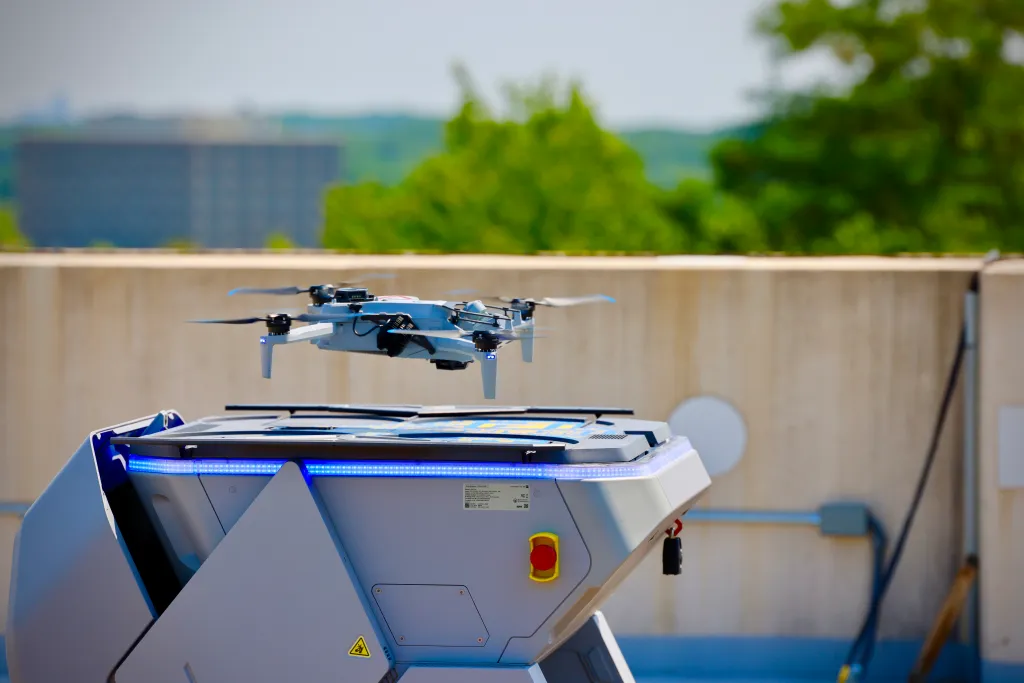
A Fairfax County, Viriginia, program that puts drones in the sky before officers reach a scene has picked up a top national honor. The National Association of Counties (NACo) named the Fairfax County Police Department’s Drone as First Responder (DFR) initiative Best in Category for Criminal Justice and Public Safety as part of its 2026 Achievement Awards, presented July 19 at the association’s annual conference in New Orleans.
The award singles out one standout program in each category from among county governments nationwide, and public safety was Fairfax’s category this year.
Improving Response and Outcomes
The numbers behind the program are what set it apart: drones launch in under two minutes and reach roughly 7 in 10 of the incidents they’re sent to before patrol units arrive. That head start means officers often have live aerial video of a scene – a fleeing suspect, a crash, a missing person’s last known location – before they ever pull up.
Fairfax County Police Department launched the effort in September 2025 out of its Real Time Crime Center (RTCC), and in doing so became the first department in the DC region cleared by the Federal Aviation Administration (FAA) to fly drones beyond an operator’s direct line of sight within restricted airspace, a regulatory hurdle that has limited how far and fast similar programs elsewhere can scale.
NACo’s judges pointed to more than just speed. The award citation credited Fairfax Country Police for building public trust alongside the technology, keeping the program’s use transparent and engaging the community rather than simply deploying drones and hoping residents wouldn’t notice.
Police Chief Kevin Davis framed the honor as a validation of that dual focus: “The Drone as First Responder program is another example of how innovative technology is helping us better serve our community. By combining cutting-edge technology with the expertise of our officers, dispatchers, and public safety partners, we’re improving emergency response, strengthening public safety, and providing our first responders with the information they need to make better decisions.”
Still Growing
The program hasn’t stood still since its launch. Dispatchers at the Real Time Crime Center are now backed by artificial intelligence that scans incoming 911 calls as they happen, shaving time off the decision to launch a drone even as call-takers are still gathering details. Fire and rescue personnel have also been folded permanently into the crime center’s staffing, a move meant to keep police, fire and dispatch working off the same real-time picture rather than relaying information between separate teams.