
Background: From 9/11 to Congressional Action
Following the September 11, 2001, attacks, investigations revealed significant communication failures among first responders. Police and fire departments operated on incompatible radio systems, hampering coordination during the emergency response.
In response, public safety organizations across the country advocated for a dedicated, interoperable nationwide broadband network. After years of development, Congress passed the Middle Class Tax Relief and Job Creation Act in 2012 with bipartisan support, establishing the First Responder Network Authority (FirstNet Authority).
The legislation allocated $7 billion in initial funding and 20 megahertz of broadband spectrum to build and operate the network through 2027. The FirstNet Authority was structured as an independent agency within the National Telecommunications and Information Administration (NTIA), part of the Department of Commerce.
FirstNet’s Structure and Funding
The FirstNet Authority operates under a governance model featuring a board with public safety expertise. Unlike many federal programs, FirstNet is designed to be self-sustaining, funded through fees paid to lease its allocated broadband spectrum rather than ongoing congressional appropriations.
The network was built through a competitive procurement process in which AT&T was selected over other bidders to build and operate FirstNet. According to program data, FirstNet currently supports approximately 8 million connections across nearly 30,600 public safety agencies and direct-support organizations, covering nearly 3 million square miles.
AT&T completed the initial network build in March 2023, on time and on budget. The company reports investing more than $14 billion of its own capital since the partnership began and expects to invest approximately $40 billion over the 25-year contract life.
The Reauthorization Question
As the February 2027 authorization deadline approaches, Congress is considering whether and how to reauthorize the FirstNet Authority. Bipartisan draft legislation has been released, and recent congressional hearings have featured testimony from public safety organizations, the network contractor, and lawmakers from both parties.
Representative Richard Hudson (NC-09), Chairman of the Subcommittee on Communications and Technology, stated during a February 4, 2026, hearing: “The future of public safety relies on safe resources like FirstNet, so thank you all for joining us to ensure that our country is taken care of in times of need.”
Representative Doris Matsui (CA-07), Ranking Member of the Subcommittee on Communications and Technology, remarked: “If we get this right, we can build on what’s already working, fix what isn’t, and ensure FirstNet keeps delivering for communities big and small, urban and rural for decades to come.”
During a January 28, 2026, Senate hearing, Mel Maier, CEO and Executive Director of APCO International, testified that FirstNet provides critical priority access and preemption capabilities that ensure first responder communications take precedence during network congestion. He emphasized that millions of public safety professionals depend on FirstNet for their lifesaving missions and urged swift reauthorization under the continued oversight of the independent FirstNet Authority Board.
Maier also called for continued network expansion to reach rural and underserved communities, sustained investment in emerging technologies including 5G and 6G capabilities, and the development of performance metrics reflecting real-world operational needs during both routine operations and major emergencies.
Scott Agnew, AT&T’s President of FirstNet and Public Sector Mobility, testified before the House subcommittee that AT&T “fully supports the reauthorization of the First Responder Network Authority” and stands with major public safety organizations including the International Association of Fire Chiefs, National Fraternal Order of Police, International Association of Chiefs of Police, and International Association of Fire Fighters in supporting reauthorization.
Recent Legislative Action
On February 10, 2026, House lawmakers voted unanimously to advance The First Responder Network Authority Reauthorization Act (H.R. 7386), forwarding it to the full House Energy and Commerce Committee for consideration. The bill, drafted by Representatives Neal Dunn (R-FL) and Jennifer McClellan (D-VA), would extend the FirstNet Authority through September 2037.
However, the legislation would also place FirstNet under increased control from the Commerce Department’s National Telecommunications and Information Administration—a provision that has raised concerns among public safety advocates who argue that FirstNet’s independence has been essential to its success.
FirstNet’s Operational Performance
Testimony and program data highlight several aspects of FirstNet’s operational capabilities:
Network deployment: The initial build covered more than 2.91 million square miles across all 50 states, the District of Columbia, and five U.S. territories. All 56 governors of U.S. states and territories opted into FirstNet in 2017, with no federal mandate requiring participation.
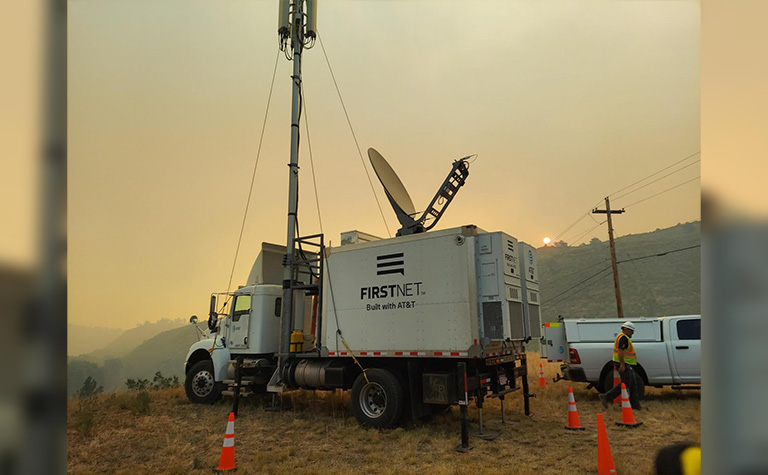
Emergency response: FirstNet has deployed portable assets during major disasters including Hurricanes Helene and Milton in 2024, catastrophic flooding in Central Texas in 2025, and provided communications during the July 2024 assassination attempt at President Trump’s campaign rally in Butler, Pennsylvania. During the Butler incident, more than 1,200 instances of priority access protected critical calls, and over 11,000 voice and data sessions were completed in one hour at peak response.
Deployable assets: AT&T operates the FirstNet Response Operations Group (ROG), a dedicated team of former first responders that deploys a fleet of 190+ mobile assets, including satellite cells, rapid deployables, and portable units available at no additional cost to subscribing agencies.
Future investment: The FirstNet Authority announced $6 billion over the next 10 years for 5G network upgrades and a dedicated, physically separate 5G standalone core, plus over $2 billion for additional coverage enhancements. AT&T deployed an additional 1,000 new Band 14 tower sites ahead of schedule at no cost to the FirstNet Authority. (Band 14 is “public safety’s VIP lane,” a spectrum set aside specifically for public safety that only those on FirstNet can access.)
Economic impact: A 2024 economic impact study estimated that FirstNet deployment has generated nearly 14,000 jobs per year over seven years and produced approximately $5.6 billion in wages and salaries, with $8 billion in net economic output across related industries.
Reported Governance Concerns
According to sources cited in public safety community discussions, draft legislative language has been circulating that would alter FirstNet’s governance structure. Specific details of the proposed changes have not been publicly released.
Critics of potential governance changes point to the original congressional intent to create an independent authority with public safety expertise at its center. They argue this structure was deliberately designed to prevent mission drift and ensure the network remains focused on first responder operational requirements.
In his Senate testimony, Maier cautioned against changes that would undermine FirstNet’s governance model, stating that the board of public safety professionals, guided by the Public Safety Advisory Committee, represents an independent structure that is “responsive, mission-focused, and grounded in the needs of first responders.” He argued that regular engagement with public safety users ensures operational realities inform network management and investment decisions.
NTIA’s Role and Track Record
NTIA currently provides administrative support to the FirstNet Authority, including fiscal management, human resources, and compliance functions. The relationship between NTIA and the FirstNet Authority has been subject to examination in Inspector General reports.
Prior to FirstNet, NTIA administered the Public Safety Interoperable Communications (PSIC) Grant Program, which distributed nearly $1 billion in federal funding. A 2011 Congressional Research Service analysis by Linda K. Moore noted that over $13 billion was spent on interoperability efforts between 2001 and 2010 with limited success in achieving nationwide interoperability.
More recently, NTIA has administered several broadband programs with varying outcomes:
Broadband Equity, Access, and Deployment (BEAD) Program: In 2024-2025, the GAO issued a legal decision (B-337604) finding that NTIA failed to comply with the Congressional Review Act when it substantially revised BEAD program rules without submitting them to Congress as required.
Digital Equity Act Competitive Grant Program: NTIA terminated this program in May 2025 after award notifications had been issued, according to the National Association of Counties, requiring local entities to halt planned projects.
Middle Mile Broadband Infrastructure Program: Government oversight bodies identified weaknesses in NTIA’s planning and accountability framework, noting the absence of clearly defined performance goals and outcome metrics during early implementation.
Innovation Fund Program: The Department of Commerce Office of Inspector General (OIG) found that NTIA launched this program without adequate strategic planning or risk management, with insufficient staffing and governance frameworks.
Broadband Technology Opportunities Program (BTOP): The Commerce OIG found deficiencies in NTIA’smonitoring of BTOP infrastructure projects. Separately, GAO concluded (GAO-15-473) that NTIA lacked clear outcome-based performance measures to determine program effectiveness.
Competing Perspectives
Public safety advocates argue that FirstNet’s independence has been essential to its success and should be preserved in any reauthorization. They contend that NTIA lacks operational familiarity with first responder requirements and that the FirstNet Authority board’s public safety expertise is critical to maintaining network focus.
The Public Safety Broadband Technology Association has launched a campaign supporting reauthorization while maintaining the current governance structure. Major public safety organizations including the International Association of Fire Chiefs, National Fraternal Order of Police, International Association of Chiefs of Police, and International Association of Fire Fighters have publicly supported FirstNet reauthorization.
Network operator perspective: AT&T’s testimony emphasized that FirstNet operates as a successful public-private partnership with rigorous oversight from the FirstNet Authority, GAO, and the Commerce Department’s Office of Inspector General. Agnew stated that “FirstNet stands alone in the industry in subjecting itself to such rigorous and public oversight” and that the company welcomes accountability measures that drive continuous improvement.
Federal oversight perspective: Inspector General reports have identified areas where FirstNet governance could be strengthened. Questions have been raised about supervisory relationships, board oversight responsibilities, and administrative accountability.
Administrative efficiency arguments: Some argue that clearer lines of authority between NTIA and the FirstNet Authority could improve program administration and accountability while reducing potential conflicts over jurisdiction.
What’s at Stake
The debate centers on balancing several competing priorities:
- Maintaining public safety expertise and operational focus in network governance
- Ensuring appropriate federal oversight and accountability
- Preserving the self-sustaining funding model
- Clarifying administrative relationships and responsibilities
- Building on FirstNet’s current operational success while addressing identified weaknesses
- Expanding coverage to rural, remote, and underserved communities
- Supporting technological advancement and mission-critical applications
- Preparing for major upcoming events including the U.S. 250th anniversary celebration, 2026 FIFA World Cup, and 2028 Summer Olympic games
FirstNet’s unique features distinguish it from commercial networks: priority access ensures first responders receive service 24/7 without exception, while preemption capabilities guarantee public safety traffic moves to the front of the line during network congestion; critical capabilities during emergencies when commercial networks may become overloaded.
Next Steps
Congress will determine the terms of any FirstNet reauthorization, including whether to maintain, modify, or restructure the Authority’s governance model. The legislative process will involve input from public safety organizations, federal agencies, oversight bodies, and other stakeholders.
The reauthorization decision will shape how the nation’s dedicated public safety broadband network operates for years to come, affecting first responders in all 50 states who rely on the system for emergency communications.