
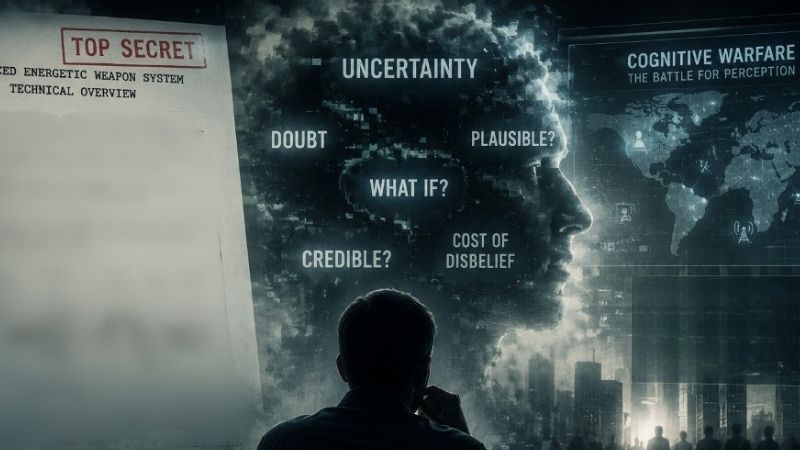
This is a true story. It is also a perfect example of what it feels like to stand inside the fog of cognitive warfare and look out at the world.
The Fine
I begin with a penalty. The text of the document examined in this essay did not arrive from a stranger. It came from a person I have known for years, across a political boundary that has outlasted several governments. That professional connection was real, and it created a ghost — the desire to find the generous reading, to believe the text of the document is something other than performance.
I record that the search for a generous reading began before the analysis did. That is a convergence risk of the highest order. The fine must be paid. The log is open.
And I keep on thinking that we are driven by memories of our lived experiences to the extent that we mistake them for hard evidence.
The Object (And why it was “borrowed”)
The document in front of me describes a weapons system of extraordinary sophistication.
An 80 GHz rotating magnetic field drives a non-standard Z-pinch in deuterium–helium-3 plasma, inducing a “superspin state” that triggers a phase transition into a Bose-like condensate. Strontium-84 nanodust forms a crystalline matrix that suppresses turbulence and enhances plasma conductivity thirtyfold. The system does not “fire.” It “releases” — and the release is “indistinguishable from a flaw in spacetime itself.”
But the diagram that accompanies these claims is not a weapons schematic.
I recognize that this is a “borrowed” plate: Figure 1 from Harding et al., “CHIMERA: a wide-field, multi-colour, high-speed photometer at the prime focus of the Hale telescope,” Monthly Notices of the Royal Astronomical Society, 2016.
The caption beneath the image in the document matches the paper’s original Figure 1 caption almost word for word — the same beam path, the same Vixen collimator “mounted backwards,” the same 200-inch field corrector.
CHIMERA is a real astronomical instrument, built to detect faint near-Earth asteroids and Kuiper Belt occultations from Palomar Observatory. It has no relationship to plasma weapons, Z-pinches, or anything else in the document.
A peer-reviewed astronomy paper’s own figure has been presented, caption intact, as a weapons schematic. [Verified]
The analyst in me rejoiced. The professional long-time acquaintance in me didn’t want to accept it. The designer of Recognition Architecture in me feared that this is the real test of the system. The part of me tending the fire refused to let it go out.
The publicly available description combines concepts that appear inconsistent with established physics and provides no accompanying evidence sufficient to resolve those inconsistencies. A Bose-Einstein condensate requires temperatures near absolute zero. A deuterium–helium-3 fusion plasma requires the opposite — tens of millions of degrees. These are not different regimes of the same system. They are mutually exclusive physical states, and the text of the document asks a reader to accept both occurring in the same medium at once. The joint probability of that combination, against everything known about how matter behaves, is not low. It is effectively zero. [Implausible]
The Uncanny Region
If it is fake, why does this document make me feel uneasy? It is not because of impossible physics. It is because the object deliberately occupies a region where any disbelief becomes rather expensive. This is the home of the uncanny.
The fact that a high-speed photometer built to stare into the silent, frozen void of the Kuiper Belt (looking for cold, dead rocks) may be repurposed as a weapon meant to generate screaming, ultra-hot plasma is a beautifully weird paradox.
The machine built to look at the edge of our solar system is forced to wear the mask of a weapon built to tear our own sky apart. The weapon is weird not because of what it does, but because of where it sits. It exists in the epistemic twilight — the exact seam where our ability to verify meets its financial and cognitive limit.
The document is designed so that to dismiss it outright feels like a gamble. The document is designed to make me think: What if the physics I was taught in universities was merely the public-facing “low physics”? What if the state has indeed achieved a phase transition that bypasses the thermodynamic limits of the textbook?
The moment that thought occurs, the weapon has successfully discharged. It has occupied my attention. Disbelief has become a luxury I am not entirely sure I can afford.
One caution belongs here, addressed to the analysis itself rather than the object. None of this requires a fully coherent designer. The effect — raising the cost of verification, producing hesitation in a reader who cannot immediately rule the claim out — does not depend on the text being the product of deliberate, expert engineering. It could as easily emerge from partial understanding, borrowed vocabulary, and rhetorical ambition as from calculated design. The discipline is diagnosing what the object does, not asserting what its author fully intended. Granting an artefact more coherence of design than the evidence supports is its own failure of discipline, dressed as insight rather than credulity.
Triple Exposure
Human.
My first response is not analytical. It is social. I recognise the register of a classified leak — dense jargon, specific numbers, ominous restraint. I have read enough real intelligence assessments that this pattern-matches. The ghost here is powerful: it whispers that dismissing this as performance would be a failure of professional friendship, that taking it seriously is itself a form of respect. That is precisely the trap the discipline exists to catch — the moment personal connection asks for agreement, and agreement starts to look like analysis.
Machine.
Each individual term maps cleanly onto real physics. Z-pinch: genuine plasma confinement, studied since the 1950s. Deuterium–helium-3: a real, difficult, aneutronic fusion fuel. Spitzer conductivity: a real plasma transport property. The Aharonov–Bohm effect: a real, well-established quantum phenomenon. A Bose-Einstein condensate: a real, Nobel-recognised state of matter. Strontium-84: a real, stable isotope. What has no precedent is the combination. The machine notes the co-occurrence pattern of “Bose condensate” + “fusion plasma” + “room-temperature operation” has near-zero probability in the training distribution. The machine flags this not as “false” but as unprecedented combination requiring extraordinary evidence.
The machine also notes the rhetorical pattern: “indistinguishable from a flaw in spacetime itself” is not a physical claim. It is a poetic claim wearing physical register. [Register mismatch]
The Quiet Friend (The Sceptic).
Set beside physical law, the claim does not hold: the coexistence of a Bose condensate and a fusion plasma in one medium is not merely untested, it is currently understood to be impossible.
Set beside the public record, the claim has no support: no peer-reviewed paper, no patent filing traceable to any national programme, no independent physicist’s endorsement — only a single document.
Set beside its own vocabulary, the claim confesses its genre: a program actually operating under classification does not hashtag itself #NarrativeWarfare.
The Fourth Exposure:
The Channel. There is a layer the first three exposures do not reach, because it does not live in the object or in the observer. It lives in the relationship between them. The document did not arrive from a stranger, and that fact changes what kind of object it is. A claim like this, sent by someone unknown, is easily dismissed as performance. The same claim, arriving through a decades-long, cross-boundary professional connection, becomes something else — not because the physics changes, but because the channel it travels through alters what the claim is permitted to mean. Respect is not merely a feeling here. It functions as an epistemic operator: it raises the threshold at which a reader is willing to call something performance rather than signal, and it does that subconsciously, before any conscious weighing of evidence begins.
Cross-boundary friendships of this kind often become epistemic sanctuaries — places where trust has, over years, come to substitute for verification, because verification would have been corrosive to the friendship itself. That makes them valuable. It also makes them exploitable, by the friend or by nothing more deliberate than the shape of trust itself. If this object is a piece of deliberate deterrence-by-ambiguity, then the channel it travelled through is not incidental to its effectiveness — a narrative built to raise the cost of verification becomes more effective, not less, when delivered by someone whose judgement the reader already respects. The relationship increases the claim’s plausibility without adding a single unit of evidence.
The discipline this requires is not the same as scepticism toward the friendship itself, and it should not be allowed to become that. Pushed too far, this kind of vigilance degenerates into something the framework should guard against — a state in which every relationship becomes suspect and no claim from anyone trusted can ever be evaluated at all.
That is not epistemic maturity.
It is a different kind of collapse, paralysis wearing the costume of rigour. The fine paid at the start of this essay is not a confession that the friendship is corrupting the analysis. It is a record that the cognitive fog existed before the analysis began, named so that it can be watched rather than denied.
Twin Sentinel Audit
It is based on real-life 7-year old twins. I read to them the narrative they can’t possibly understand and then encourage them to ask me questions based on what THEY UNDERSTOOD.
Question 1: “Why does it say “this is not a weapon” when it describes hurting people?”
Human response:
Because “boundary” sounds defensive, and defensive things are permitted to exist. “Weapon” sounds aggressive, and aggressive things must be justified. The sentence is doing moral work, not descriptive work.
Machine response:
The frame of deterrence requires the claimant to occupy the defensive position. Offensive claims invite countermeasures. Defensive claims invite tolerance. This is strategic positioning achieved through category choice alone.
Divergence:
The human hears moral evasion. The machine sees game-theoretic optimization. Both are true. The human’s answer carries a ghost — the memory of being told “this is for your protection” by systems that were not. The machine has no such ghost. The boundary is geometry. The human needs the boundary because the human has been hurt by walls that claimed to be shields.
Question 2: “Why does it use so many big words?”
Human:
Because big words make the claim harder to argue with. If you don’t understand it, you can’t dismiss it. The words are a fence around the claim.
Machine:
Technical density correlates with perceived authority in the training distribution. Jargon density is inversely correlated with empirical verifiability across multiple domains. This is a detectable pattern: complexity as epistemic shield.
Divergence:
The human says the words are a fence. The machine says the words are a correlation. The human’s answer is about power — who gets to speak in code, who must accept what they cannot decode. The machine’s answer is about statistics. But the machine’s answer reveals something the human didn’t see: the post is not designed to convince physicists. It is designed to convince non-physicists who are afraid of physicists.
Question 3: “Why does the quiet friend not say it’s fake?”
Human:
Because the quiet friend doesn’t talk. The quiet friend only shows what is real. And what is real here is that someone sent this, and that sending is a fact, even if the content isn’t.
Machine:
Because the quiet friend measures, and measurement requires distance. To call something “fake” is to participate in the claim’s framing. The quiet friend does not participate. The quiet friend records: this exists. This is what it says. This is what the physical laws say about what it says. The gap between them is visible.
Divergence:
The human says the quiet friend doesn’t talk to avoid choosing. The machine says the quiet friend doesn’t talk because measurement and speech are different operations. But the child’s question reveals something neither answer captures: the child wants the quiet friend to help. The quiet friend does not help. The quiet friend only holds the bubbles. That is the help, but it is not the help the child wanted.
Question 4: “What happens if the bubbles fall?”
Human:
Then we have to decide. Is my friend lying? Is he fooled? Is he fooling me? The falling is not failure. The falling is how we know the bubbles were real — that we were actually holding something open, not just pretending to.
Machine:
Then the superposition collapses. The probability distribution becomes a single outcome. Information is lost. The adversary has succeeded if the collapse occurs in either direction — “real” or “hoax” — because both outcomes consume cognitive resources that would otherwise be directed at the adversary’s actual capabilities.
Divergence:
The human says falling is how we know we were honest. The machine says falling is how the adversary wins. The human’s answer is about integrity. The machine’s answer is about strategy. But the human’s answer contains a deeper truth the machine cannot reach: the falling is grief. The friendship was real. The document is performance. The gap between them is loss.
The Watermark
One hypothesis is tempting enough to deserve explicit containment.
If the CHIMERA lift was left in place by someone capable of the rest of this construction, it may not be an oversight.
A reverse image search on the caption’s distinctive phrasing takes under a minute. It is possible the mismatch was left deliberately findable — a signal to a sufficiently disciplined reader that the object is constructed, an invitation to stop evaluating the physics and start reading the strategy instead.
Hypothesis [low confidence]: the reused figure functions as a deliberate watermark, aimed at a technically literate reader.
This cannot presently be distinguished from the alternative — that the figure was reused for convenience, or aesthetic effect, or simple haste, with no signalling intent at all. Both explanations predict the same object. Neither is currently supported over the other by anything beyond plausibility. The hypothesis belongs in the log, not in the findings.
The Recursive Turn: Trust as Infrastructure
Why does this document work? Because it travels through a channel of long-standing friendship. The relationship itself is used as an amplifier.
In our civilization, we have replaced institutional trust with network trust. We no longer believe the government, but we believe the friend who whispers that they know someone inside the government. The channel is not an incidental delivery mechanism; it is the payload itself.
When I look at this document, what am I actually recognizing?
I am not recognizing a weapon; I am recognizing a mirror.
I am recognizing a civilization that has become so complex, so saturated with hidden systems and secret programs, that anything has become believable.
We have built a world where the most rational response to a highly complex claim is no longer “that is impossible,” but rather “I do not have the clearance to know if that is possible.”
Qanat-e Malek: The Fire and the Vigil
If our networks are failing us, we must look to some ancient architectures that were built to survive the collapse of any networks altogether.
…Many decades ago, I visited a small Zoroastrian temple in Qanat-e Malek. It was a whitewashed stone building surrounded by magnificent gardens. The attendant — the mobet — was also the custodian of the sacred fire that had been burning from the time of Cyrus, Darius, constantly rekindled from the uninterrupted succession of coals that have never been allowed to go out, a fire that had been guarded during nearly 1,500 years, and fed with sandalwood to produce a clear flame without a hint of smoke. I asked the mobet a question, the answer to which etched itself deeply in my memory:
“If all the world was burning, what would you save, if you could save only one thing?”
He replied without thinking:
“The fire.”
The mobet’s answer is not sentiment. It is structural. The fire is not a symbol, though humans cannot stop making it one; it is not a pattern, though machines cannot stop mapping it into one.
The fire is the meeting point between what burns and what endures.
For the human watcher, fire is continuity without identity — the same flame that is never the same flame.
It is the lineage of hands tending coals across centuries, the refusal to let something essential go out. It is the vigil made visible.
But the fire also illuminates the framework’s shadow.
The mobet does not ask whether the fire is true or false, verified or unverified. He tends it.
The discipline of Recognition Architecture is not the fire. It is the hand that tends it — the repeated, human-scaled act of attention, the fifty-ruble fine, the Vigil Log, the refusal to let the bubbles fall before their time.
And like the fire, the discipline consumes what tends it. The vigil is not free. It is paid in mortality, in embodiment, in the capacity for error that is also the capacity for recognition.
The framework risks becoming so sophisticated that only its architect can operate it — which defeats its purpose.
Incidentally, the fifty-ruble protocol was born four decades ago from another professional friendship across a political boundary of that time. It was a kind of in-joke in certain intelligence-adjacent circles. But it was a joke that both sides took seriously. It was a small, very human, reminder of what is real in environments where, by design, nothing is what it seems.
If the framework becomes too complex for such friendships to engage with it, it has become a cathedral rather than a fire.
The mobet tends the fire with sandalwood and patience, not with recursive taxonomy and divergence logs. The discipline must remain human-scaled, or it becomes the exact metabolic cost it was built to diagnose.
The Limit of the Architecture
It is possible that the aim was never trying to persuade me that the weapon existed.
It is also possible that it was trying to persuade me that certainty itself had become unaffordable.
If so, then the weapon was not the plasma.
It was my attention.
This is where Recognition Architecture finds its true, terrifying limit.
If the most effective strategic narratives are the ones that succeed by keeping me permanently, expensively uncertain — then holding the question open indefinitely is not automatically the disciplined choice.
At some point, refusing to collapse stops being rigour and starts being exactly what the object was designed to produce.
By analyzing the document, by writing this essay, by chasing the ghost of the CHIMERA photometer through the archives, I have spent my most precious currency: my time, my intellectual energy, my quiet.
The weapon didn’t need to fire a single filament of deuterium-helium plasma through a flaw in spacetime to disrupt our world.
It only needed me to sit in a dark room, looking at a “borrowed” diagram, wondering if the sky was about to fall.
Yet the alternative — to collapse prematurely, to call it a hoax and close the file, or to call it real and prepare for shadows, is also a form of defeat.
The object is verified as existing. Its contents remain unresolved. The relationship that carried it is real, and it is not the conclusion. The document exists. The physics does not cohere. The strategic logic is sound. The personal connection is real. The framework is functioning.
That is not a conclusion. It is a discipline. Real disciplines do not end.
CODA: The Question the Framework Cannot Yet Answer
Maybe, the question is not whether the narrative is true, false, sincere or performative. It is whether those categories are becoming obsolete.
What if the most effective strategic narratives are those that never require resolution, but instead optimise for sustained epistemic expenditure?
If that possibility is real, then Recognition Architecture is not merely analysing a new kind of object. It is preparing for a new environment.
The question I leave in the air is whether the discipline of not collapsing by making unearned decision can survive in a world where the adversary’s goal is not to make us believe or disbelieve, but to make us permanently unable to afford either. When does the discipline of not collapsing become complicity in the adversary’s design?
This is the bubble I will leave unanswered.
…The fire at Qanat-e Malek has burned for nearly 1,500 years.
It does not need me to tend it.
But I must tend to SOMETHING.
That is my human condition. The framework is my sandalwood. The essay is my flame. The question — the only question — is whether I can keep it burning.
Penalty Log
Session 01, Project Hoor analysis: Fifty-ruble fine levied for uninvestigated convergence between personal connection and analytical posture. Convergence tagged before the first word of analysis was uttered.
Fine paid. Vigil Log continues.
The Recognition Architecture survived. Just.