
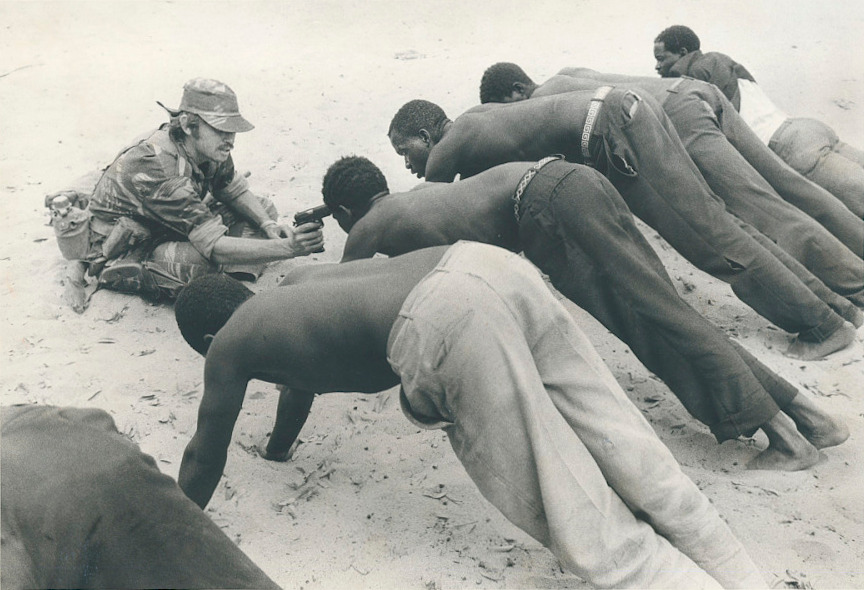
The story of the Rhodesian Bush War – an otherwise obscure conflict within a small African nation over half a century ago – has an enduring legacy within white supremacist narratives, best exemplified by Dylann Roof’s embrace of Rhodesian symbols prior to the 2015 Charleston shooting. This is partly due to the Rhodesian government’s contemporary embrace of international white supremacist groups, as well as the recent resurgence of Rhodesian imagery in online extremist spaces. As a romanticized “Lost Cause,” Rhodesia will likely continue to endure as a potent symbol within white supremacist narratives.
White supremacist narratives are far from a monolith – in the United States alone, they claim descent historical groups such as the Ku Klux Klan as well as more recent organizations such as neo-Nazis and skinheads, but in general, these groups share a common frame of reference. White supremacy narratives rely heavily on conspiracism, the idea that they are the victim of all-encompassing global conspiracies. Their worldview is fundamentally divided between the forces of good and evil, destined to collide in an apocalyptic final battle. In the meantime, the forces of white supremacy are locked in a “constant battle” against groups such as non-white races, homosexuals, Jews, and other minority groups. It is a narrative that rewards violent extremism, paranoia, and a festering sense of grievance. It is also a narrative that has increasingly embraced the persistent “Lost Cause” of Rhodesia in recent years.
On November 11, 1965, the colony of Rhodesia, located in what is now Zimbabwe, declared independence from the United Kingdom. The colony, made up of approximately 250,000 white settlers that ruled an apartheid state over millions of native Africans, fiercely rejected the UK’s demand that it transition from white minority rule to majority rule, leading to its Unilateral Declaration of Independence (UDI). This directly led to the Rhodesian Bush War, a bloody and complex conflict between the pariah state and multiple African guerilla groups. The war was exceptionally brutal, and marked by multiple war crimes including the use of chemical and biological warfare. Despite the embattled regime’s increasingly desperate tactics, by 1980, the country transitioned to majority rule and was reborn as modern Zimbabwe.
This relatively obscure conflict, nearly half a century distant from the present day, may initially seem to be a minor anecdote in the wider process of African decolonization. However, to both contemporary and modern extremists, Rhodesia plays an outsized role in neo-Nazi and white supremacist narratives. Rhodesia’s recent resurgence and continuing influence in the extremist lexicon is best exemplified by Dylann Roof.
Dylann Roof
On June 17, 2025, twenty-one-year-old Dylann Roof entered Emanuel African Methodist Episcopal Church in Charleston, South Carolina, and opened fire, killing nine African-American congregants. Upon his capture, Roof confessed that he was trying to revive segregation and ignite a race war. Roof also behind a detailed manifesto, as well as a significant digital footprint with links to multiple white supremacist platforms including Stormfront and The Daily Stormer.
Roof was fascinated with the Rhodesian regime. In February 2015, he created a website called “The Last Rhodesian” which featured multiple pictures of himself, sometimes wearing clothing that featured South African and Rhodesian flags, and multiple references to other white supremacist symbols. The site was filled with vitriol toward multiple minority groups, including blacks, Jews, and Hispanics.
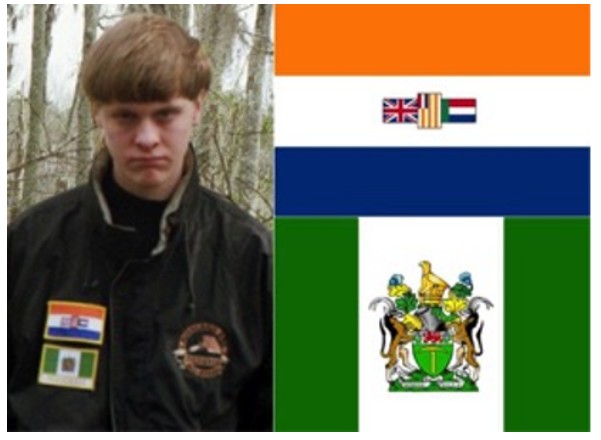
An image from Dylann Roof’s social media depicting him wearing the apartheid flag of South Africa (top right) and the Rhodesian flag (bottom right).
Roof’s embrace of the symbology of the Rhodesian regime was part of a larger narrative within white supremacist spaces that has embraced Rhodesia as a romantic “lost cause” myth. Within these modern narratives, Rhodesia is framed as a redoubt of white settlers heroically holding out against a black communist invasion, an “underdog” story where a tiny minority of whites ruled over a majority black population with an iron fist – precisely the white ethno-state that many supremacists yearn for. Rhodesia has become a “story of lost greatness, existential threat, and the righteous defiance of white rule.” As a mythical lost Eden, it provides the grievances of the white supremacy narrative with both a sense of history and of warning – the fall of Rhodesia’s minority government to majority rule could occur anywhere. This makes for a powerful mix of nostalgia, fear, and grievance that further fuels extremist narratives.
Modern white supremacists appear to have become enamored with the story of Rhodesia starting around 2012, as part of a wider trend of increasing militancy within the movement. Since then, Rhodesian imagery has had an online resurgence. So-called “Rhodesiaboos” fascinated with Rhodesia can be found on message boards; images of Rhodesian Selous Scouts circulate on Instagram; a number of YouTube videos call for the return of Rhodesia and condemn the West for betraying it; Rhodesian-themed merchandise and collectibles with slogans such as “Be a Man Among Men” and “Rhodesians Never Die” have gained popularity. In one notable example, Fireforce Ventures, a Canada-based company, sold an extensive collection of Rhodesia-themed apparel and merchandise. In a 2018 investigation, several members of its staff – active members of the Canadian military – were linked to white nationalist groups, including neo-Nazi online messaging boards, the white nationalist group “ID Canada”, and neo-Nazi podcasts. Much of the company’s merchandise also extensively referenced “slotting floppies.” “Slot” was Rhodesian slang for “shoot”, and “floppy” was a racial slur used by the white population against African natives. Several other companies selling Rhodesian-themed merchandise, such as the Western Outlands Supply Company, are far less subtle than Fireforce Ventures and are openly classified as white nationalist hate groups. In general, the guise of nostalgia for the Cold War-era Bush War cleverly obscures the dog-whistle nature of the merchandise; as one vendor stated, “The great thing about most of our designs is that they are essentially inside jokes and references that the general public will not understand.” The Rhodesian flag is especially effective as an extremist dog-whistle. “If you’re into the political stuff, get yourself a flag…” one of the Fireforce Venture founders stated on a neo-Nazi podcast. “Because normies don’t know what that flag means, the Rhodesian flag.”
As a symbol for modern white supremacists, the Rhodesian flag can be used as an effective stand-in for Confederate or Nazi imagery, precisely because it is much more obscure to the general public. The potent symbology of it – as an indicator of “militarized white nationalism and the fantasy of a race war” – has ensured that it has endured beyond Roof’s use of it in 2015.
In April 2023, a white gunman killed three African-Americans at a Dollar General store in Jacksonville, Florida. The 21-year-old shooter was bedecked in white supremacist symbols, including a number of swastikas and racial slurs that he had drawn on his rifle and handgun. On his tactical vest, he also wore a Rhodesian patch in a similar manner to Roof. While the racially-motivated shooting was not as widely reported as Roof’s attack, it demonstrates the persistent influence that Rhodesia has in the violent ideology of white supremacists.
Rhodesia and the “White Genocide” Narrative
The fascination that modern white supremacists have with Rhodesia is not accidental. Rather, it can be traced back to the Rhodesian government’s deliberate embrace of extremist ideology and international extremist networks, in a vain attempt to prop up support for the faltering regime.
Ian Smith’s Rhodesian Front (RF) party open embraced far-right white supremacy. Upon Rhodesia’s declaration of UDI, it rapidly purged the government of any substantial political opposition, cracked down on political freedoms within the regime, and soon achieved a near-complete control over Rhodesian media. P.K. van der Byl, the government’s Parliamentary Secretary of Information, said flatly, “If television is able to be used as a brain-washing medium or one of indoctrination then… the highest authority in the land should have a say in it.” Buoyed by fears of Communism and black rule, the RF swept to complete dominance over the country. The embattled regime cast itself as a “White Redoubt”, heroically battling for white supremacy against the forces of Communism and Africanism, unlike the ineffectual, “decadent and socialist” Britain that freely engaged in racial mixing.
The RF also employed the propaganda expert Ivor Benson, a former student of British fascist Oswald Mosley, to saturate Rhodesian media with extremist messaging. Benson was extremely vocal about his theories of a Jewish world conspiracy, and in 1966 became a co-editor of the American Mercury, during which he published multiple antisemitic and racist articles parroted by various international fascist organizations, including the UK’s neo-Nazi National Front. Benson eventually retired from his position in the Rhodesian government, complaining that Ian Smith’s leadership was “too moderate”. However, his propaganda efforts were highly successful in radicalizing the white minority population and introducing a global network of fascists, neo-Nazis and white supremacists to the embattled regime.
Rhodesia’s embrace of militant racism and its status as a pariah state led it to seek out extremist international networks to buoy its support. Propaganda, typically in the form of bulletins and pamphlets spread in the thousands across Europe and North America, portrayed Rhodesia as the victim of a vast global conspiracy, its white population the brave “240,000 White Sentries” that stood against an all-encompassing global Zionist/Communist plot to wipe out “White Christian Civilization”. While these propaganda efforts were not enough to sustain the regime, they are one of the earliest examples of the “White Genocide” myth that animates much of contemporary white supremacist narratives.
Rhodesia and Contemporary White Supremacists
In the southern United States, recent racial anxieties about the Civil Rights Movement led to a surge of extremist support for Rhodesia. As Senator J. Strom Thurmond of South Carolina claimed, “Most African nations haven’t yet solved the problem of cannibalism.” These racial fears led to the formation of many pro-Rhodesian groups across America, including Friends of Rhodesian Independence (FORI), which claimed 25,000 members; the American Southern-Africa Council (ASAC), which raised thousands of dollars for the Rhodesian cause, and other groups that included Rhodesian Gung-Ho Troops (RIGHT), and even Hooray for Ian Smith, Titan of Rhodesian Yearning (HISTORY). Other American radical groups, including the American Nazi Party, also reportedly developed unofficial linkages with Salisbury. The Rhodesian government, eager to maintain an air of legitimacy, often found the blatant extremism of their American allies discomforting. Ken Towsey, Rhodesia’s chief propagandist within the United States, reluctantly admitted, “We have considered it prudent to sup with them with a long spoon.”
In other nations, Rhodesia also evoked the interest of extremists. Within the UK, a number of white supremacist organizations, including the Racial Preservation Society (RPS) and the neo-Nazi National Front, expressed vociferous support for Rhodesia even as they blamed the ruling Labour Party for condemning “Britain to a multi-racial society.” The RPS loudly warned of a “black invasion” that would destroy British civilization, just as Rhodesia was supposedly under siege. Oswald Mosley, founder of the Union of British Fascists and leader of the later Union Movement, was particularly fascinated with Rhodesia’s resistance to majority rule. Mosley called for an alliance with South Africa and Rhodesia – a “quasi-mythical land of unimpeded white power,” the kind of pure ethno-state that he dreamed of making Britain into.
International extremists offered more than financial and political support to the regime; they also offered bodies. Rhodesia’s critically low supply of manpower forced the regime to rely more and more heavily upon foreign mercenaries as the war dragged on. The quality of these mercenaries ranged wildly – from skilled veterans of the Vietnam War to adventurers eager for glory to “simple psychopaths, white supremacists, and bloodthirsty criminals.” Many of these mercenaries were frank about their white supremacist leanings. As one mercenary admitted about his decision to serve in Rhodesia rather than the nearby Angolan conflict, “I frankly don’t give that much of a shit about Angola. I just don’t like [racial epithet]. But, I’d fight like hell in Rhodesia or South Africa to keep white minority rule.” In a cruel war that saw extensive use of scorched-earth tactics, torture, and even the secretive use of chemical and biological weapons, Rhodesia’s mercenary forces quickly gained a reputation for exceptional brutality.
Ads calling for mercenaries to serve in Rhodesia were prominently featured in magazines like Soldier of Fortune.
One notable example was Eugene “Prime Evil” de Kock, a South African mercenary. The son of a neo-Nazi, de Kock served nine tours of duty in Rhodesia, which he learned many of the techniques he later employed as a torturer and assassin for the South African apartheid government. Another radical to first cut his teeth in Rhodesia was Peter Casselton, a “blue-eyed young pilot and warrior for Ian Smith’s thousand-year Reich” who later helped bomb the ANC offices in London in March 1982 on behalf of the South African government.
In a 2017 blog post, American neo-Nazi Martin Kerr described his work as National Organizer for the National Socialist White Peoples Party (NSWPP), the successor to the American Nazi Party during the 1970s. He reported that many NSWPP members had traveled to Rhodesia “for the express purpose of defending their racial brothers and sisters there in the struggle for national and racial freedom.” Among them was Richard Biederman, a prominent NSWPP member and one of seven Americans killed in action during the Rhodesian Bush War. He identified another half-dozen NSWPP members by name, including Frederick Verduin, a “dynamic NSWPP street activist” who went on to fight for the South African government, as well as several representatives from the UK’s National Front. According to Kerr, both the Rhodesian government and the NSWPP elected to keep the “story of the NS [National Socialist] and WN [White Nationalist] volunteers” under wraps – the Rhodesian government wanted to avoid potential bad publicity, and the NSWPP did not want to advertise “the fact that some of its key activists were giving up the political fight at home to engage in a military adventure abroad.” The one exception to this was Biederman, whose death due to friendly fire was memorialized in a special spread in the neo-Nazi newspaper White Power.
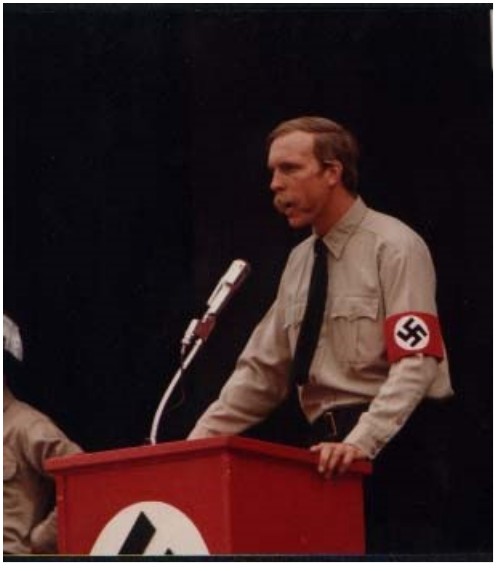
Richard Biderman speaking at a NSWPP function.
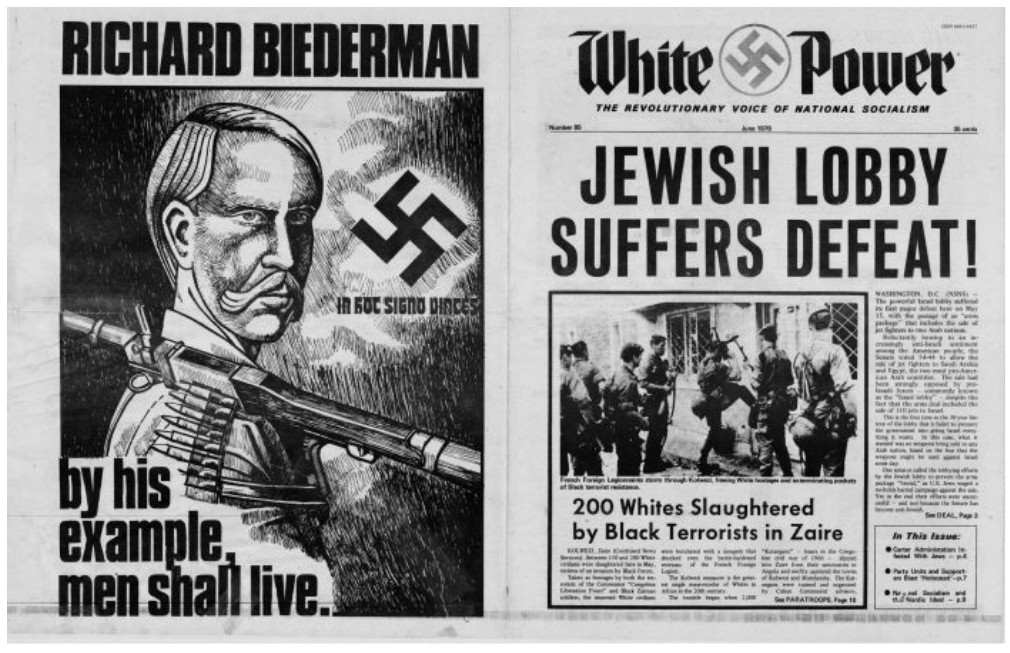
The 1977 publication of White Power memorializing Richard Biederman.
Harold Covington
Out of all the American white supremacists with a direct link to Rhodesia, Harold Covington was perhaps the most influential. Born in North Carolina in 1953, Covington was a controversial figure even within extremist circles. Known as the “Nazi Bard” for his talent with prose, he is most famous for his series of novels about the construction of a white ethno-state from the ruins of the American Northwest after a violent war of secession. These self-published novels prominently featured his own self-insert. Other American neo-Nazis knew him less charitably as “Weird Harold” due to his lack of social graces and habit of viciously lambasting his ideological colleagues.
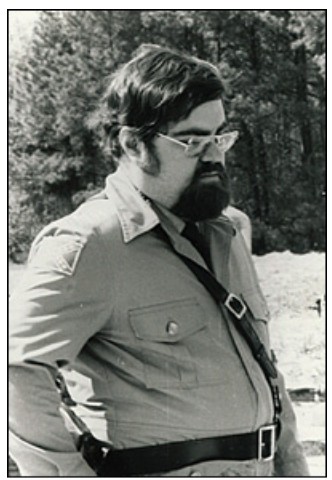
Covington was active in white supremacist circles from a young age. Upon graduating from high school in 1971, he joined the NSWPP. After being discharged from the U.S. Army in 1973 for racist agitation, Covington traveled to Johannesburg, and from there to Rhodesia. For the rest of his life, he claimed that he was a mercenary there. The truth is likely different – it appears that Covington was a file clerk rather than a hardened fighter. Even other neo-Nazis dismissed his claims of glory in the Bush War. However, he remained politically active. During his time in Rhodesia, he became active what he described as the “proto-NS [National Socialist]” Rhodesian White People’s Party before being evicted from the country after threatening the local Jewish community. For the rest of his life, Covington was a zealous white supremacist, best known for his writing, and his support for a “Northwest Imperative” – a call for white supremacists to move to the Pacific Northwest and establish a white ethno-state there.
While Covington was largely ostracized by the white supremacist movement, he did have a significant online presence, with a notable influence on recent terrorist groups including the Atomwaffen Division and The Base. His writings seem to have influenced Roof in particular.
Roof’s manifesto directly referenced the Northwest Front separatist movement created by Covington. For his part, Covington loudly praised Roof’s 2015 shooting on his radio show, describing it as a “preview of coming attractions.”
It is impossible to say whether or not Roof’s interest in Rhodesia was influenced by Covington’s history with the regime, but their shared connection between this short-lived apartheid regime in Africa should be emphasized. Although both men pose no further threat – Covington died in 2018 and Roof has been on death row since 2017 – Rhodesia will likely continue to influence white supremacist narratives, partly due to the legacy of violence and malice that these two left behind.
Conclusion
Even during its brief lifespan, the Rhodesian regime deliberately crafted and embraced a narrative that, at its core, was built upon white supremacy – an embattled redoubt of whiteness standing alone against a great global conspiracy. This narrative, while not enough to save the regime, bought it significant international material and mercenary aid, including from contemporary white supremacists and neo-Nazi groups. In the modern day, Rhodesia’s narrative has been subsumed within the greater white supremacist mythos, painting Rhodesia as a romantic “Lost Cause” comparable to the Confederacy. The recent increase in Rhodesian symbology in white supremacist circles, most notably in the case of the Dylann Roof shooting, demonstrates the persistent presence of the Rhodesian myth in white supremacist narratives.